• Home
  • Tools dropdown img
    • Spreadsheet Charts

      • ChartExpo for Google Sheets
      • ChartExpo for Microsoft Excel
    • Power BI Charts

      • Power BI Custom Visuals by ChartExpo
    • Word Cloud

  • Charts dropdown img
    • Chart Category

      • Bar Charts
      • Circle Graphs
      • Column Charts
      • Combo Charts
      • Comparison Charts
      • Line Graphs
      • PPC Charts
      • Sentiment Analysis Charts
      • Survey Charts
    • Chart Type

      • Box and Whisker Plot
      • Clustered Bar Chart
      • Clustered Column Chart
      • Comparison Bar Chart
      • Control Chart
      • CSAT Survey Bar Chart
      • CSAT Survey Chart
      • Dot Plot Chart
      • Double Bar Graph
      • Funnel Chart
      • Gauge Chart
      • Likert Scale Chart
      • Matrix Chart
      • Multi Axis Line Chart
      • Overlapping Bar Chart
      • Pareto Chart
      • Radar Chart
      • Radial Bar Chart
      • Sankey Diagram
      • Scatter Plot Chart
      • Slope Chart
      • Sunburst Chart
      • Tornado Chart
      • Waterfall Chart
      • Word Cloud
    • Google Sheets
      Microsoft Excel
  • Services
  • Pricing
  • Contact us
  • Blog
  • Support dropdown img
      • Gallery
      • Videos
      • Contact us
      • FAQs
      • Resources
    • Please feel free to contact us

      atsupport@chartexpo.com

Categories
All Data Visualizations Data Analytics Surveys
Add-ons/
  • Google Sheets
  • Microsoft Excel
  • Power BI
All Data Visualizations Data Analytics Surveys
Add-ons
  • Google Sheets
  • Microsoft Excel
  • Power BI

We use cookies

This website uses cookies to provide better user experience and user's session management.
By continuing visiting this website you consent the use of these cookies.

Ok

ChartExpo Survey


Home > Blog > Data Analytics

Economic Indicators Examples: A Complete Guide

Economic indicators examples give analysts, investors, and business leaders a measurable window into how an economy performs over time.
Economic Indicators Examples

From GDP shifts to employment trends, these data points shape everything from policy choices and investment strategies to detailed business planning, risk assessment, and market analysis.

Without them, evaluating whether conditions are improving, deteriorating, or simply holding steady would rely entirely on guesswork.

This guide breaks down what economic indicators examples mean, highlights the most widely tracked measures, and walks through practical methods for analyzing them. Readers will also learn how visualization tools can turn raw figures into clearer, more actionable insights.

What are Economic Indicators?

Definition: Economic indicators are quantifiable data points that governments, financial institutions, and businesses monitor to gauge how an economy is performing. GDP, the unemployment rate, and the inflation rate rank among the most frequently cited measures.

These metrics serve a clear purpose: tracking economic health, supporting sound decision-making, and comparing performance across time periods. Key economic indicators reveal whether an economy is on an upward trajectory, pulling back, or holding steady at any given point.

Why are Economic Indicators Important?

Economic data provides the clearest picture of where an economy stands and where it may be heading, giving decision-makers reliable signals for planning and response. The economic indicators examples below show how these data points serve different purposes.

  • Guide policy decisions: Governments rely on economic data and leading vs lagging indicators to calibrate interest rates, adjust tax policy, and direct public spending.
  • Forecast economic trends: Analysts study patterns in economic data to project whether growth, deceleration, or recession lies ahead.
  • Track inflation: Measures such as the CPI capture price movements and shifts in consumer purchasing power over time.
  • Monitor employment: Labor market data shows the strength of job creation and the broader stability of an economy.
  • Inform investment choices: Investors weigh economic signals against factors such as interest rate vs yield before committing capital to any position.
  • Assess business cycles: Tracking indicator patterns helps pinpoint whether an economy is expanding, recovering, or contracting at a given moment.
  • Evaluate market health: Reviewing several indicators together provides a more complete picture of overall market conditions.

Key Types of Economic Indicators

Economic indicators are classified by when they reflect changes in the economy. This timing distinction, familiar in how key risk indicators are used to flag threats, also defines the three main categories of economic indicators, examples applied in analysis.

  • Leading indicators: Signal where the economy is likely headed, making them useful for anticipating growth or contraction before it occurs.
  • Lagging indicators: Confirm that a trend has taken hold by reflecting changes that have already worked their way through the economy.
  • Coincident indicators: Move in step with current economic activity, offering a real-time snapshot of conditions as they unfold.

Top 12 Economic Indicators

Among the many economic indicators examples tracked by analysts worldwide, a core set consistently draws attention for capturing the most direct signals of growth, stability, and overall economic output.

  • GDP growth: Tracks the total monetary value of goods and services an economy produces, serving as the primary gauge of overall output.
  • Unemployment rate: Measures the share of the workforce actively seeking jobs but unable to find them, reflecting labor market conditions.
  • Inflation rate: Captures the pace at which prices climb, revealing how far each dollar stretches for consumers and businesses alike.
  • Consumer confidence: Gauges households’ optimism about current and future economic conditions, influencing their willingness to spend.
  • Retail sales: Tracks consumer purchasing activity and is often reviewed alongside retail industry KPIs to measure demand at the market level.
  • Industrial production: Measures manufacturing and factory output and is routinely benchmarked against KPIs for the manufacturing industry to assess production trends.
  • Interest rates: Set the cost of borrowing money, shaping decisions around spending, saving, and business investment.
  • Balance of trade: Compares the value of exports against imports to indicate whether a country is a net seller or net buyer in global markets.
  • Housing starts: Counts new residential construction projects to signal activity levels in the construction sector and broader economic momentum.
  • Stock market trends: Capture investor sentiment and forward-looking expectations about corporate earnings and economic growth.
  • Wage growth: Measures how worker compensation changes over time, reflecting income strength and consumer spending potential.
  • Government spending: Monitors public sector expenditures that inject funds into the economy and support development priorities.

Economic Indicators Examples

Reviewing concrete economic indicators examples from real reports makes it easier to understand how these metrics behave in practice.

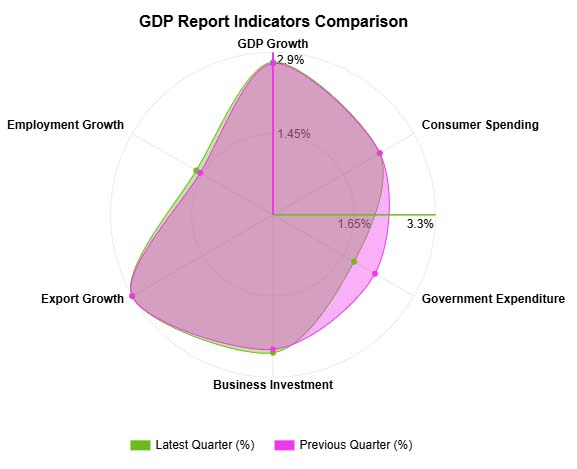
  • GDP Repaqort Indicators Comparison

Among economic indicators examples, this GDP report captures modest overall expansion, with GDP and exports nudging upward while consumer spending pulled back and most remaining measures held flat.
Economic Indicators Examples
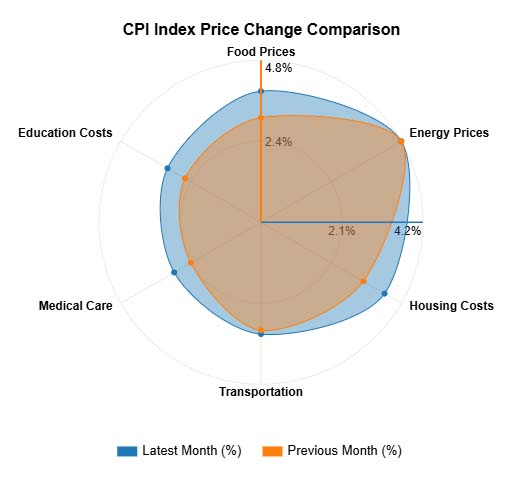
  • CPI Index Price Change Comparison

This CPI index entry, one of the most closely tracked economic indicators examples, shows that energy and food saw steeper price increases in earlier periods, while more recent figures point to moderate inflation across housing, medical care, and education.
Economic Indicators Examples
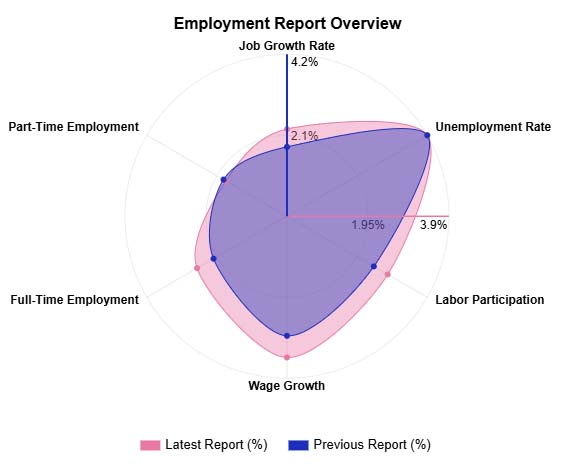
  • Employment Report Overview

This employment report, another of the widely followed economic indicators examples, reflects a period of above-average job creation and wage increases, falling unemployment, and broadly stable conditions relative to the prior reporting period.
Economic Indicators Examples

How to Analyze Economic Indicators in Google Sheets?

Working with key economic indicators in Google Sheets lets you organize figures, compare trends across periods, and generate charts that surface patterns more clearly than raw data alone.

  • Collect indicator data

Gather figures such as GDP, inflation rates, and unemployment numbers from trusted sources and enter them into clearly labeled columns.

  • Organize by date or period

Sort data by month, quarter, or year to make trend comparisons straightforward and consistent.

  • Use formulas for calculations

Run percentage change, average, and growth-rate formulas to interpret performance, applying methods similar to those used when comparing economic profit vs. accounting profit across reporting periods.

  • Create charts for comparison

Build line charts, bar charts, or Radar Charts to display multiple indicators side by side for easier analysis.

  • Enhance visualization with tools

When native chart options fall short, connect ChartExpo to Google Sheets to unlock more advanced visualization formats.

  • Final Insights

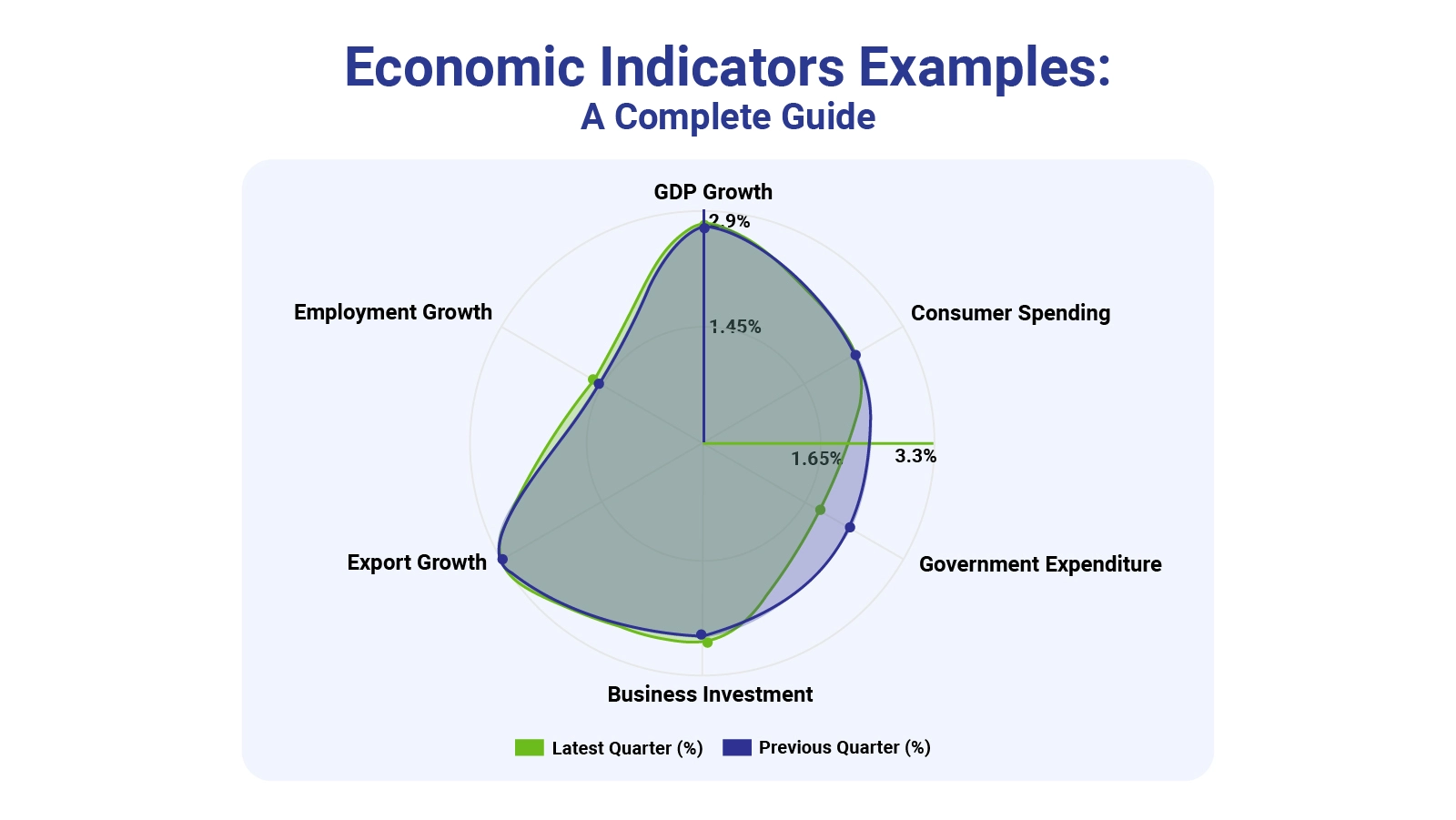
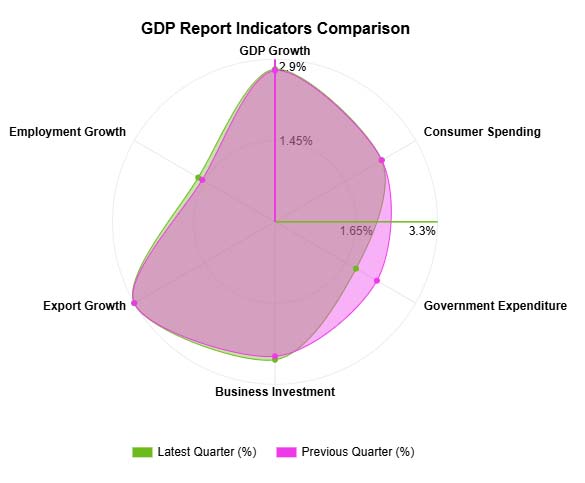
The radar chart compares key GDP indicators across the latest and previous quarters, including growth, consumer spending, government expenditure, investment, exports, and employment.

It shows relatively stable performance overall, with slight improvements in consumer spending and government expenditure, while other indicators remain largely consistent.
Economic Indicators Examples

Key Insights

  • GDP expanded at a modest pace, with the latest quarter showing only a slight uptick in output compared to prior performance.
  • Trade drove growth while household consumption contracted, indicating that external demand was the primary engine rather than domestic spending.
  • Capital investment and the labor market remained on a steady footing, consistent with a period of stable but unremarkable economic conditions.

Benefits of Tracking Economic Indicators

Consistent review of economic indicators gives individuals and organizations the foresight to anticipate changes and adjust their plans before conditions shift.

  • Informed decisions: Grounding choices in economic data replaces guesswork with evidence, giving businesses a stronger foundation for strategy.
  • Early trend detection: Shifts in indicator readings often precede broader economic moves, allowing organizations to act before the full impact arrives.
  • Investment planning: Economic signals guide investors on when to build positions, reduce exposure, or hold current allocations.
  • Risk management: Watching indicator trends helps surface financial vulnerabilities early, similar to how reviewing COGS vs. operating expenses uncovers cost pressures in business planning.
  • Policy evaluation: Reviewing indicator outcomes gives governments a clear basis for judging whether current policies are delivering the intended results.
  • Market insight: Taken together, multiple indicators reveal the true condition of markets far more accurately than any single measure can.

Best Practices for Using Economic Indicators

Drawing accurate conclusions from economic data requires disciplined methods. Applying these practices helps analysts extract more value from economic indicators and examples and avoid common misinterpretations.

  • Use multiple indicators: Combining several data points produces a more balanced and accurate view than leaning on any single metric.
  • Track over time: Following indicators across extended time periods helps distinguish temporary fluctuations from meaningful structural shifts.
  • Compare with benchmarks: Measuring current figures against historical values or established standards puts performance into proper context.
  • Focus on relevant sectors: Selecting indicators that align with your specific industry or research objective yields far more targeted and useful insights.
  • Update regularly: Refreshing data on a consistent schedule ensures analysis reflects current conditions rather than outdated information.
  • Interpret in context: No indicator tells the full story on its own; always read figures alongside related economic factors to reach sound conclusions.

FAQs

What are the top 3 indicators of economic growth?

GDP, unemployment rate, and inflation are the three measures most commonly used to assess growth. Together, they cover output levels, labor market strength, and price stability, making them the most widely relied-upon metrics in standard economic analysis.

What are the 5 main economic indicators?

The five most widely recognized economic indicators are GDP, CPI, unemployment rate, interest rates, and consumer confidence. Analysts use this set to evaluate both current economic conditions and expectations for the period ahead.

Who uses economic indicators?

Governments, investors, corporations, economists, and financial analysts all draw on economic indicators examples to guide policy, allocate capital, evaluate risk, and understand market conditions across different time horizons.

Wrap Up

Economic indicators examples provide the data foundation that policymakers, investors, and business leaders need to make sense of shifting market conditions.

By tracking the right measures consistently, it becomes possible to spot trends early, weigh risks with greater precision, and position decisions around evidence rather than assumptions.

Whether the goal is forecasting growth, managing financial exposure, or refining a longer-term strategy, the ability to read and interpret these indicators accurately is a core competency in today’s data-driven environment.

Combine that skill with strong visualization tools, and the insights embedded in the numbers become far clearer and more actionable.

How much did you enjoy this article?

GSAd1
Start Free Trial!
161197

Related articles

next previous
Data Analytics10 min read

How to Calculate Closing Costs: Easy Formula and Visuals

How to calculate closing costs correctly before any deal closes. Compare fees, plan your budget, and stay in control. Read on now!

Data Analytics10 min read

How to Normalize Data: Step-by-Step Guide

How to normalize data transforms raw datasets into reliable insights. Explore methods, best practices, and step-by-step techniques. Read on!

Data Analytics9 min read

Investment Performance Reporting: Insights for Better ROI

Investment performance reporting turns raw data into portfolio insights. Learn key metrics, report types, and analysis methods. Read on!

Data Analytics10 min read

Pay Equity Analysis: Smart Ways to Analyze Pay Gaps

Pay equity analysis uncovers hidden salary gaps. Learn how to measure compensation fairness, close pay disparities, and build trust. Read on!

Data Analytics10 min read

What Are Sales KPIs: Sales Metrics Made Easy

What are sales KPIs, and why should every business track them? Learn the top indicators, how to measure them, and improve results. Read on!

ChartExpo logo

Turn Data into Visual
Stories

CHARTEXPO

  • Home
  • Gallery
  • Videos
  • Services
  • Pricing
  • Contact us
  • FAQs
  • Privacy policy
  • Terms of Service
  • Sitemap

TOOLS

  • ChartExpo for Google Sheets
  • ChartExpo for Microsoft Excel
  • Power BI Custom Visuals by ChartExpo
  • Word Cloud

CATEGORIES

  • Bar Charts
  • Circle Graphs
  • Column Charts
  • Combo Charts
  • Comparison Charts
  • Line Graphs
  • PPC Charts
  • Sentiment Analysis Charts
  • Survey Charts

TOP CHARTS

  • Sankey Diagram
  • Likert Scale Chart
  • Comparison Bar Chart
  • Pareto Chart
  • Funnel Chart
  • Gauge Chart
  • Radar Chart
  • Radial Bar Chart
  • Sunburst Chart
  • see more
  • Scatter Plot Chart
  • CSAT Survey Bar Chart
  • CSAT Survey Chart
  • Dot Plot Chart
  • Double Bar Graph
  • Matrix Chart
  • Multi Axis Line Chart
  • Overlapping Bar Chart
  • Control Chart
  • Slope Chart
  • Clustered Bar Chart
  • Clustered Column Chart
  • Box and Whisker Plot
  • Tornado Chart
  • Waterfall Chart
  • Word Cloud
  • see less

RESOURCES

  • Blog
  • Resources
  • YouTube
SIGN UP FOR UPDATES

We wouldn't dream of spamming you or selling your info.

© 2026 ChartExpo, all rights reserved.