• Home
  • Tools dropdown img
    • Spreadsheet Charts

      • ChartExpo for Google Sheets
      • ChartExpo for Microsoft Excel
    • Power BI Charts

      • Power BI Custom Visuals by ChartExpo
    • Word Cloud

  • Charts dropdown img
    • Chart Category

      • Bar Charts
      • Circle Graphs
      • Column Charts
      • Combo Charts
      • Comparison Charts
      • Line Graphs
      • PPC Charts
      • Sentiment Analysis Charts
      • Survey Charts
    • Chart Type

      • Box and Whisker Plot
      • Clustered Bar Chart
      • Clustered Column Chart
      • Comparison Bar Chart
      • Control Chart
      • CSAT Survey Bar Chart
      • CSAT Survey Chart
      • Dot Plot Chart
      • Double Bar Graph
      • Funnel Chart
      • Gauge Chart
      • Likert Scale Chart
      • Matrix Chart
      • Multi Axis Line Chart
      • Overlapping Bar Chart
      • Pareto Chart
      • Radar Chart
      • Radial Bar Chart
      • Sankey Diagram
      • Scatter Plot Chart
      • Slope Chart
      • Sunburst Chart
      • Tornado Chart
      • Waterfall Chart
      • Word Cloud
    • Google Sheets
      Microsoft Excel
  • Services
  • Pricing
  • Contact us
  • Blog
  • Support dropdown img
      • Gallery
      • Videos
      • Contact us
      • FAQs
      • Resources
    • Please feel free to contact us

      atsupport@chartexpo.com

Categories
All Data Visualizations Data Analytics Surveys
Add-ons/
  • Google Sheets
  • Microsoft Excel
  • Power BI
All Data Visualizations Data Analytics Surveys
Add-ons
  • Google Sheets
  • Microsoft Excel
  • Power BI

We use cookies

This website uses cookies to provide better user experience and user's session management.
By continuing visiting this website you consent the use of these cookies.

Ok

ChartExpo Survey


Home > Blog > Data Analytics

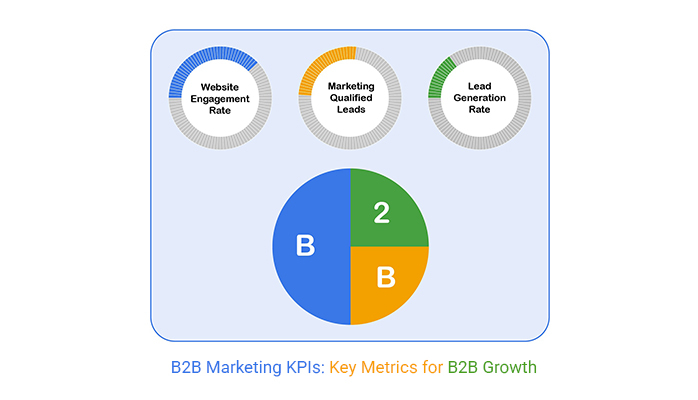
B2B Marketing KPIs: Key Metrics for B2B Growth

What are B2B marketing KPIs, and why do they matter so much? The truth is, without the correct data, you’re making an educated guess. And in B2B, guessing costs money.
B2B Marketing KPIs

B2B marketing KPIs make things clear. They show where leads are coming from, which channels perform, and what drives revenue. But tracking clicks and impressions isn’t enough. You need to tie those numbers to actual outcomes, and that’s where strong performance metrics come in.

B2B marketing KPIs aren’t just about marketing—they’re about alignment. They connect sales, finance, and leadership to help you stop chasing vanity stats and start building results. Need to boost pipeline quality? There’s a KPI for that. Want to cut cost-per-lead? Track it and tweak your efforts.

And don’t forget about money. Financial metrics, such as Customer Acquisition Cost (CAC) and marketing-influenced revenue, matter more than likes and shares. They speak the language your CFO understands.

Still, many marketers get stuck. They either track too much or focus on the wrong things. That’s why this post exists—to help you choose KPIs that help your business grow.

If your metrics aren’t connected to outcomes, they’re not helping. They’re just numbers on a slide.

Let’s fix that.

Table of Contents:

  1. What are B2B Marketing KPIs?
  2. Why are B2B KPIs Important for Growth?
  3. Top 10 KPIs for B2B Marketing
  4. Most Common B2B Marketing KPI Examples
  5. How to Choose KPIs for B2B Marketing?
  6. How to Analyze B2B Marketing KPIs in Google Sheets?
  7. Benefits of Marketing KPIs for B2B
  8. Best Practices for B2B Marketing KPIs
  9. FAQs
  10. Wrap Up

What are B2B Marketing KPIs?

Definition: B2B marketing KPIs are the key metrics that indicate whether your marketing efforts are effective. They track progress, performance, and real results. These include metrics such as lead conversion rates, sales pipeline impact, and customer engagement.

Good KPIs are directly connected to customer success KPIs and those for accounting. They help teams speak the same language—revenue. Instead of guessing, you measure. And instead of reporting activity, you prove value. That’s what metrics and KPIs are meant to do.

Why are B2B KPIs Important for Growth?

You can’t grow a B2B business on guesswork. You need numbers that guide every move—and prove every win. That’s the job of B2B Marketing KPIs. They don’t just measure performance—they shape the strategy behind it.

Here’s why they’re essential for real growth, explained clearly:

  • They highlight what’s working—and what’s not: KPIs give you proof, not assumptions. You can double down on what drives results and cut what doesn’t.
  • They align teams with shared goals: Sales, marketing, and operations often work in silos. KPIs bring them together with one focus: outcomes that matter.
  • They help you scale smarter: You can’t grow a process you don’t understand. KPIs reveal where your pipeline is strong and where it weakens.
  • They simplify decisions: With the correct data, you move faster and with confidence. You stop relying on opinions and start acting on facts.
  • They make reporting meaningful: Leaders don’t want noise—they want clarity. KPI graphs turn spreadsheets into stories people understand.
  • They connect actions to revenue: Every campaign should have a clear goal. KPIs link marketing activity to the financial metrics your CFO cares about.

Top 10 KPIs for B2B Marketing

Most marketers track too much—or the wrong stuff. Endless dashboards, endless noise. But growth? That comes from focus. You don’t need more data. You need better data. The kind that tells you what to fix, what to keep, and what to grow.

Here are the 10 B2B marketing KPIs that matter—because they connect effort to impact:

  1. Marketing Qualified Leads (MQLs): These leads have demonstrated genuine interest through downloads, sign-ups, or repeat visits to your website. A strong MQL count indicates that your marketing is attracting the right audience.
  2. Sales Qualified Leads (SQLs): Leads passed from marketing that sales agree are ready. This KPI shows alignment and handoff quality between teams.
  3. Customer Acquisition Cost (CAC): How much do you spend to land a customer? A lower CAC with strong results indicates that you’re scaling efficiently.
  4. Lead Conversion Rate: This metric measures the percentage of leads that actually become customers. If it’s low, your funnel needs attention.
  5. Revenue from pipeline influenced by marketing: How much revenue comes from leads that marketing touched? This connects your efforts directly to business outcomes.
  6. Return On Marketing Investment (ROMI): What do you get back for every dollar spent? High ROMI = brilliant campaigns.
  7. Website engagement: Are Visitors Sticking Around? High engagement means your site content is hitting the mark.
  8. Content performance: Not all content is created equal. This KPI shows what drives traffic, leads, and conversions.
  9. Social media engagement: Beyond likes—are people sharing, clicking, commenting? With the right social media analytics tools, this KPI becomes a growth driver.
  10. Customer Retention Rate: Getting new customers is hard. Keeping them? That’s where customer success KPIs shine.

Most Common B2B Marketing KPI Examples

You don’t need to track everything. You need to track what moves the needle. In B2B marketing, that means numbers tied to real action—clicks, sign-ups, and cost. These aren’t vanity stats. They show intent and value.

Here are three B2B marketing KPIs that teams rely on every day:

  • Paid B2B Click-Through Rate (CTR): CTR shows how many people clicked your ad after seeing it. A high CTR indicates that your message strikes the right pain point at the ideal time.
  • Demo requests and free trial sign-ups: These actions signal serious interest—they’re your hottest leads. Tracking this KPI helps you measure how well your content and offers convert curiosity into pipeline.
  • Cost Per Lead (CPL): CPL tells you how much each lead is costing your team. It’s one of the most essential performance metrics for balancing budget with results.

How to Choose KPIs for B2B Marketing?

Picking the right KPIs can feel like throwing darts in the dark. Good B2B marketing KPIs don’t come from guesswork. They come from clarity – from knowing what success looks like before you start. Here’s how to choose KPIs that help your team grow:

  1. Start with your goals: If your goal is lead generation, don’t track brand awareness. Match each KPI to a clear business outcome.
  2. Talk to sales and leadership: Ask what numbers matter to them. Aligning with their priorities builds trust and aligns with their budget.
  3. Avoid vanity metrics: Big follower counts or impressions may look good, but they don’t prove anything. Stick to KPIs that tie back to financial metrics or conversions.
  4. Measure impact, not activity: Don’t track how many emails you send—track how many leads convert because of those emails. That’s where growth happens.
  5. Use a mix of short-term and long-term metrics: Track quick wins, such as CTR or CPL. But also monitor their impact on the pipeline and customer retention over time—balance is key.
  6. Choose metrics you can act on: If you can’t do anything with the number, it’s not a good KPI. The best ones guide real decisions.

How to Analyze B2B Marketing KPIs in Google Sheets?

What are B2B marketing KPIs? Think of them as your marketing team’s scoreboard. But staring at raw data in rows and columns is no fun—and not helpful. Google Sheets can store the numbers, sure. But when it’s time to see what’s working, it falls flat. No context. No clarity. No wow factor.

That’s where data visualization steps in. Turning dry metrics into powerful visuals makes everything click. And this is precisely what ChartExpo does best. It picks up where Google Sheets stops—and turns data into decisions.

How to Install ChartExpo in Google Sheets?

  1. To start using ChartExpo, download it directly from the Google Sheets program. To do this, select Extensions from the top toolbar.
  2. A menu will appear. Click the Get add-ons option.
  3. Search for ChartExpo, and click on Charts, Graphs & Visualizations by ChartExpo when it appears in the results.
  4. Click the Install button. You will have to confirm your Google account and accept some permissions.

ChartExpo charts are available both in Google Sheets and Microsoft Excel. Please use the following CTAs to install the tool of your choice and create beautiful visualizations in a few clicks in your favorite tool.

Example

Let’s visualize and analyze B2B marketing KPIs data in Google Sheets using ChartExpo.

KPIs Completion (%)
Marketing Qualified Leads (MQLs) 80
Lead Conversion Rate 68
Demo Requests 75
Website Engagement Rate 85
Social Media Engagement 60
Return on Marketing Investment 72
  • To get started with ChartExpo, install ChartExpo in Google Sheets.
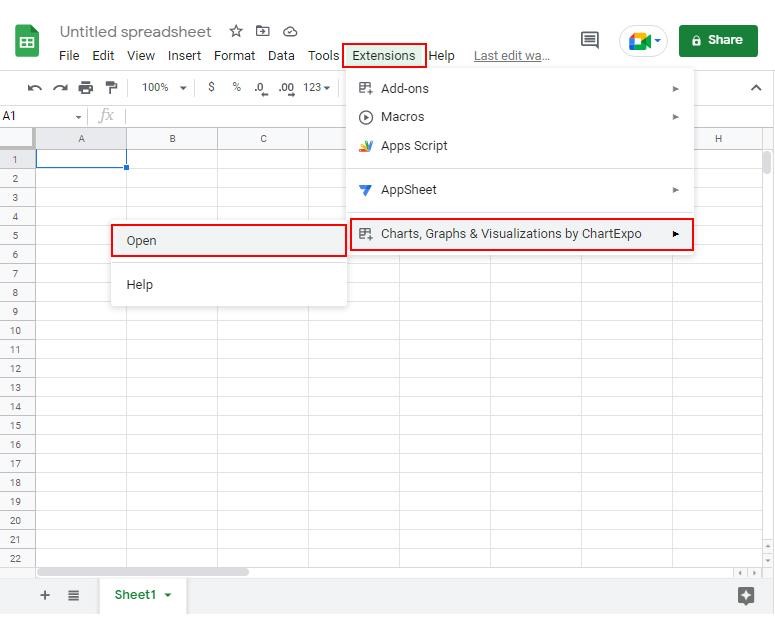
  • Go to Extensions > Charts, Graphs & Visualizations by ChartExpo > Open.
B2B Marketing KPIs
  • To access the charts library, click the Add new chart button.
B2B Marketing KPIs
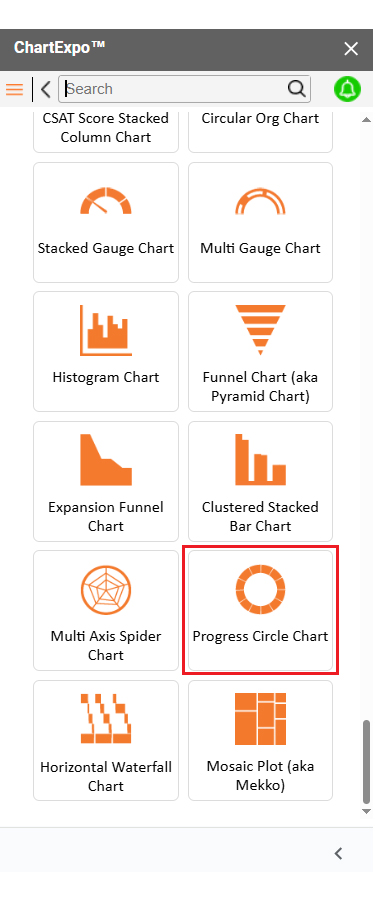
  • Once it loads, scroll through the charts list to locate and choose the “Progress Circle Chart”.
B2B Marketing KPIs
  • Put the data table in the sheet first. Then, choose the Sheet name from the drop-down in the ChartExpo section.
  • Select the metric column; metric is the numeric column in your data sheet.
  • Select the dimensions column; the dimension is the categorical column in your datasheet that contains text information.
  • Click the Create chart button to complete the process.
B2B Marketing KPIs
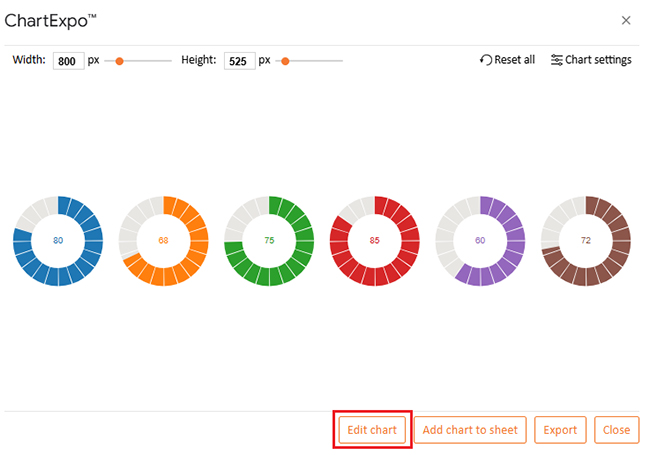
  • If you want to add anything to the chart, click the Edit Chart button:
B2B Marketing KPIs
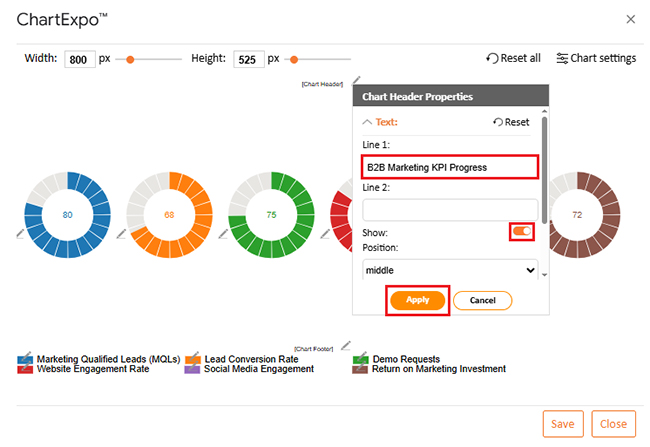
  • Click the pencil icon next to the Chart Header to change the title.
  • It will open the properties dialog. Under the Text section, you can add a heading in Line 1 and enable Show.
  • Give the appropriate title of your chart and click the Apply button.
B2B Marketing KPIs
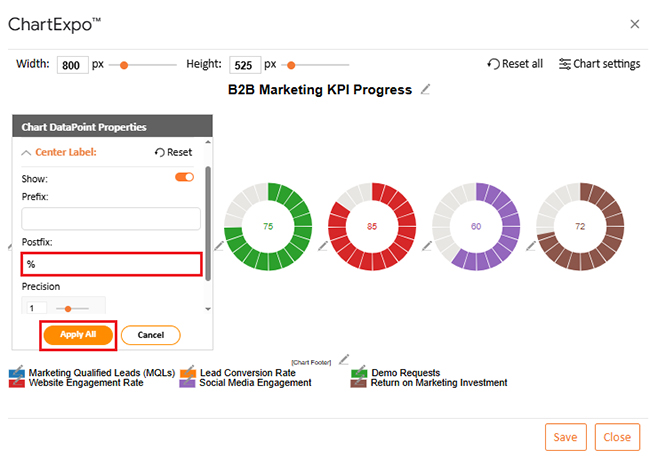
  • You can add the percentage sign with all values as follows:
B2B Marketing KPIs
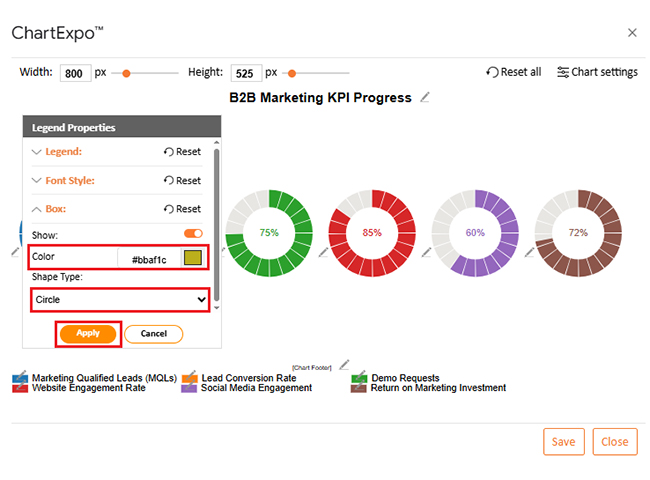
  • You can change the Legend Color and Shape type as follows:
B2B Marketing KPIs
  • You can change the Variation type by clicking on Settings as follows:
B2B Marketing KPIs
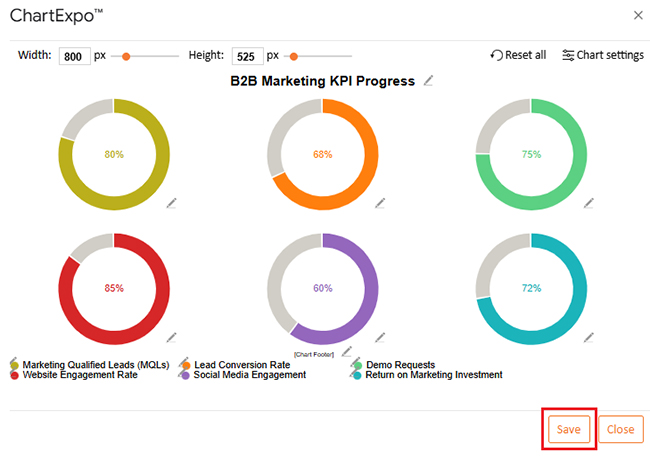
  • After making all changes, click the “Save Changes” button:
B2B Marketing KPIs
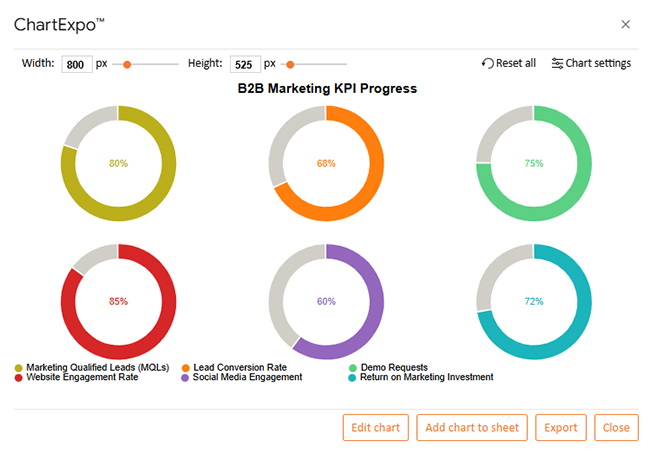
  • Your final chart will look like the one below.
B2B Marketing KPIs

Insights

  • Website Engagement Rate – 85%: Strongest performer, showing high user interaction and compelling content.
  • Marketing Qualified Leads (MQLs) – 80%: Indicates healthy lead generation activity.
  • Demo Requests – 75%: Reflects strong buyer interest and intent.
  • Return On Marketing Investment (ROMI) – 72%: Shows good efficiency, with room for improvement.
  • Lead Conversion Rate – 68%: Suggests a need for better nurturing or more substantial sales alignment.

Benefits of Marketing KPIs for B2B

Marketing without KPIs is like throwing darts with your eyes closed. You might hit something, but not the target. In B2B, where sales cycles are long and stakes are high, you can’t afford to guess. You need clarity and direction. That’s what B2B marketing KPIs give you.

Here’s why they’re a game-changer:

  • They show what’s working: You stop wasting money on guesswork. Instead, you double down on what drives real results.
  • They prove marketing’s value: KPIs connect campaigns to revenue. That means less defending and more celebrating.
  • They guide better decisions: Data tells you when to pivot and when to push harder. No more relying on gut feelings alone.
  • They align teams: Sales, marketing, and leadership finally speak the same language—metrics and KPIs. That builds trust and stronger collaboration.
  • They improve accountability: Everyone knows what they’re working toward—no confusion, no finger-pointing.
  • They help you spot problems early: Low lead conversion rates? Or High customer acquisition costs? KPIs flag issues before they spiral.

Best Practices for B2B Marketing KPIs

Have you ever felt overwhelmed by dashboards? You’re not alone. B2B marketers often drown in numbers but still miss what matters. The problem isn’t the data—it’s how we use it. Great B2B marketing KPIs don’t shout the loudest. They tell the truth, quietly and clearly. But only if you follow a few smart habits.

Here are the best practices to get it right:

  • Start with real goals: Don’t pick KPIs because they sound impressive. Choose ones that match your business objectives.
  • Focus on quality over quantity: Track fewer KPIs—but make sure they tell a complete story. Think depth, not volume.
  • Review KPIs regularly: Your business evolves, and so should your KPIs—outdated metrics = misleading direction.
  • Align with other teams: For instance, Sales focuses on different metrics. Sync up all departments and agree on shared success metrics, such as Sales KPIs.
  • Use visuals to bring numbers to life: No one wants to stare at spreadsheets all day. KPI graphs make your data clear, fast, and actionable.

FAQs

What are the 4 major areas of B2B marketing?

Lead generation, brand awareness, customer retention, and sales enablement. Each plays a key role – together, they drive growth:

  • Lead generation pulls prospects in.
  • Brand builds trust.
  • Retention keeps customers.
  • Sales enablement turns interest into action.

What are the 4 Ps of B2B marketing?

Product, Price, Place, Promotion. These items shape your strategy:

  • The product solves business problems.
  • Price reflects value.
  • Place covers distribution and channels.
  • Promotion drives awareness and demand.

All four must align for B2B success.

Wrap Up

B2B marketing KPIs help you measure what matters. They turn raw data into clear direction. No more guessing. No more wasted effort. Strong KPIs show what’s working, and also highlight what needs fixing. This saves time, budget, and energy. You focus on results, not activity.

What are sales KPIs? They track how well your sales team performs. Think lead response time, win rate, or quota attainment. These KPIs align directly with revenue goals.

Key performance indicators for operations help streamline execution. They focus on process, efficiency, and delivery. Together with marketing and sales KPIs, they close performance gaps.

KPIs for accounting measure financial health. They include profit margins, expense ratios, and revenue growth. Without them, decisions can go off track.

Finally, use SMART KPIs examples to stay focused. SMART means Specific, Measurable, Achievable, Relevant, and Time-bound. It keeps your team aligned and accountable.

Conclusively, choose the right KPIs, and growth will become intentional. How? You track, learn, and improve. And don’t wait to install ChartExpo. This tool will make those insights visual, fast, and clear. Win with purpose!

How much did you enjoy this article?

PBIAd1
Start Free Trial!
157281

Related articles

next previous
Data Analytics10 min read

KPI Tracking Software: A Visual Approach to KPIs

Understand what a KPI tracking software does and why it's essential. You’ll discover the best tools and tips to improve decision-making and performance.

Data Analytics14 min read

Enterprise Reporting: Definition, Benefits, and Examples

Enterprise reporting transforms data into clear insights for smarter decisions. Learn steps, tools, and visuals to use to create reports that drive results.

Data Analytics12 min read

Issue Tracker Template for Smarter Issue Monitoring

Learn what an issue tracker template is and why it’s useful. This blog post shows you how to build and analyze one to track issues and boost team productivity.

Data Analytics9 min read

Lead Generation KPIs: A Guide for Better Results

Lead generation KPIs measure how well you attract and convert leads. Click here to learn how to track, analyze, and improve these KPIs for better results.

Data Analytics9 min read

Sales Pipeline Template: Visualizing Sales Flow

Sales pipeline templates organize your sales process and boost deal tracking. Click here to learn how to build and improve them in Google Sheets.

ChartExpo logo

Turn Data into Visual
Stories

CHARTEXPO

  • Home
  • Gallery
  • Videos
  • Services
  • Pricing
  • Contact us
  • FAQs
  • Privacy policy
  • Terms of Service
  • Sitemap

TOOLS

  • ChartExpo for Google Sheets
  • ChartExpo for Microsoft Excel
  • Power BI Custom Visuals by ChartExpo
  • Word Cloud

CATEGORIES

  • Bar Charts
  • Circle Graphs
  • Column Charts
  • Combo Charts
  • Comparison Charts
  • Line Graphs
  • PPC Charts
  • Sentiment Analysis Charts
  • Survey Charts

TOP CHARTS

  • Sankey Diagram
  • Likert Scale Chart
  • Comparison Bar Chart
  • Pareto Chart
  • Funnel Chart
  • Gauge Chart
  • Radar Chart
  • Radial Bar Chart
  • Sunburst Chart
  • see more
  • Scatter Plot Chart
  • CSAT Survey Bar Chart
  • CSAT Survey Chart
  • Dot Plot Chart
  • Double Bar Graph
  • Matrix Chart
  • Multi Axis Line Chart
  • Overlapping Bar Chart
  • Control Chart
  • Slope Chart
  • Clustered Bar Chart
  • Clustered Column Chart
  • Box and Whisker Plot
  • Tornado Chart
  • Waterfall Chart
  • Word Cloud
  • see less

RESOURCES

  • Blog
  • Resources
  • YouTube
SIGN UP FOR UPDATES

We wouldn't dream of spamming you or selling your info.

© 2025 ChartExpo, all rights reserved.