Categories

Revenue data tells a story, but only those who know how to read it gain a real competitive edge. Calculating revenue growth converts raw financial numbers into a clear picture of business momentum, showing whether a company is gaining ground or losing pace over time.
For leaders and analysts, this metric shapes every strategic conversation about sustainable scaling. From monthly check-ins to annual board reviews, revenue growth figures drive investment priorities, sales targets, and market expansion plans.
Businesses that track this consistently are better positioned to spot financial risk early, seize opportunity before competitors, and build long-term strategies grounded in data rather than guesswork.
Definition: Calculating revenue growth is the process of measuring the percentage change in a company’s total income between two defined periods. It quantifies how effectively a business is expanding sales and deepening its market position.
Put simply, calculating revenue growth places two time periods side by side, whether monthly, quarterly, or annually, to express the difference as a percentage. That figure tells stakeholders whether the business is accelerating, holding steady, or contracting.
Teams across finance, sales, and leadership use the result to benchmark performance, confirm that strategies are producing returns, and flag areas where adjustments are needed to stay on track with long-term goals.
Before applying the steps for calculating revenue growth, it helps to know which underlying variables actually move the numbers. Recognizing each one gives businesses the context to explain why their totals shifted, not just by how much.
Core factors to examine include:
Calculating revenue growth relies on a single, repeatable formula that converts two revenue figures into a meaningful percentage. Once that percentage is in hand, performance becomes directly comparable across any time period the business chooses to examine.
Revenue Growth = Previous Revenue (Current Revenue − Previous Revenue) ×100
Start by subtracting the earlier period’s revenue from the current period’s total to isolate the change. Divide that figure by the prior revenue to produce a ratio, then multiply by 100 to convert it into a percentage that is easy to communicate and compare.
Consistently applying this approach to calculating revenue growth across reporting cycles gives teams a reliable benchmark and makes it far easier to set defensible targets for the periods ahead.
Businesses choose from several approaches when applying the process of calculating revenue growth, each suited to different reporting windows and analytical goals.
The most widely used methods include:
Accurately calculating revenue growth starts with a consistent process. Each step below reduces the risk of errors and ensures the resulting figure reflects true financial performance.
Apply these steps in sequence:
Applying the process of calculating revenue growth to real scenarios shows how different reporting windows produce distinct insights for business decision-making.
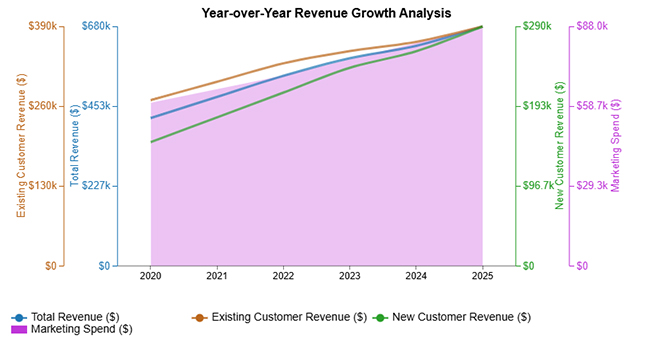
This year-over-year revenue analysis shows consistent income expansion from 2020 to 2025, with rising contributions from both new and existing customers alongside a growing marketing investment each year.
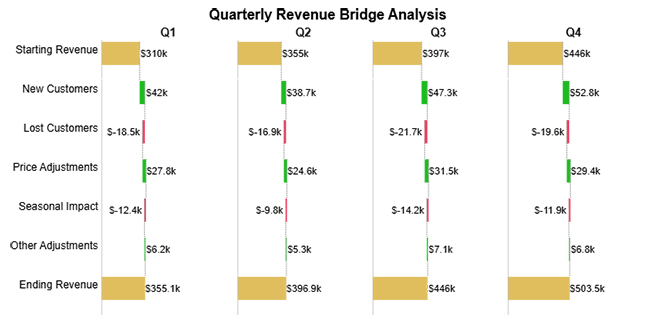
The quarterly revenue bridge illustrates how individual Q1 through Q4 gains and losses combine to produce the net movement from the period’s opening figure to its final total.
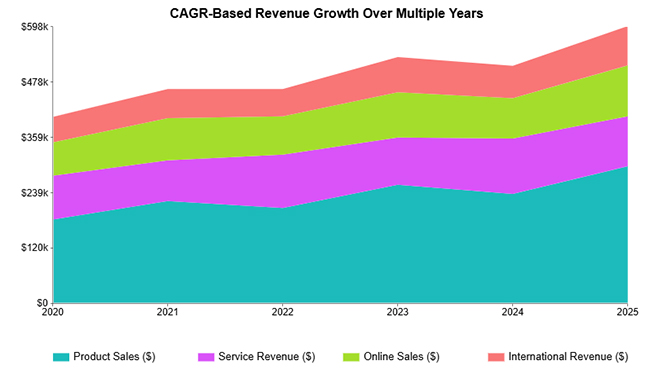
This multi-year view captures how several distinct revenue streams drive combined growth from 2020 to 2025, with visible fluctuations across the period that a single annual snapshot would miss.
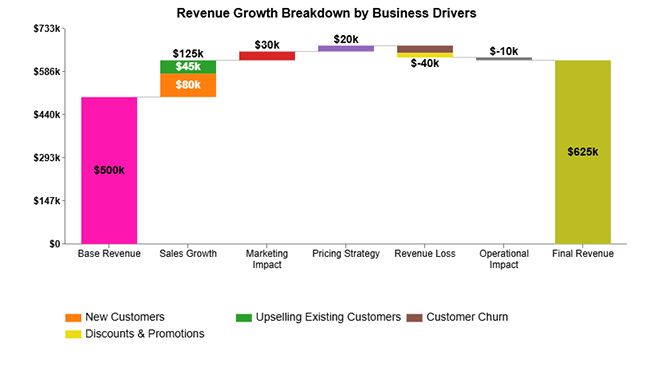
This breakdown traces how sales expansion, marketing activity, and pricing decisions push revenue from $500K to $625K, while also accounting for the minor losses that partially offset those gains.
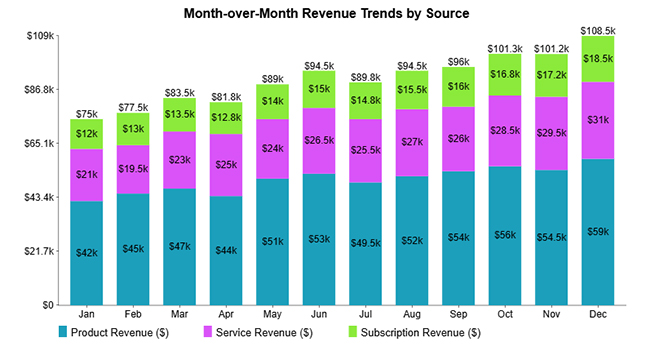
This month-by-month view separates product, service, and subscription income streams to show how each source contributes to total monthly performance across the full calendar year.
Google Sheets gives teams a practical environment for calculating revenue growth and tracking financial patterns without specialist software. With the right structure and formulas in place, income data becomes far easier to interpret and act on across reporting periods.
Enter income figures by month, quarter, or year so the dataset has a consistent structure that supports reliable formula application.
Use built-in spreadsheet formulas to subtract the prior period’s total from the current one, divide by the earlier figure, and multiply by 100 to get the growth percentage.
Add a line or column chart to the sheet so revenue shifts are immediately visible without requiring readers to scan rows of figures.
Pairing your spreadsheet with a dedicated charting add-on produces interactive visuals that surface patterns that standard chart types can obscure.
Placing income vs profit vs revenue side by side within the same sheet adds depth to the analysis and flags whether top-line gains are translating into real profitability.
Including a column that uses calculated days’ sales outstanding alongside revenue totals shows how quickly earned income converts into cash that the business can actually use.
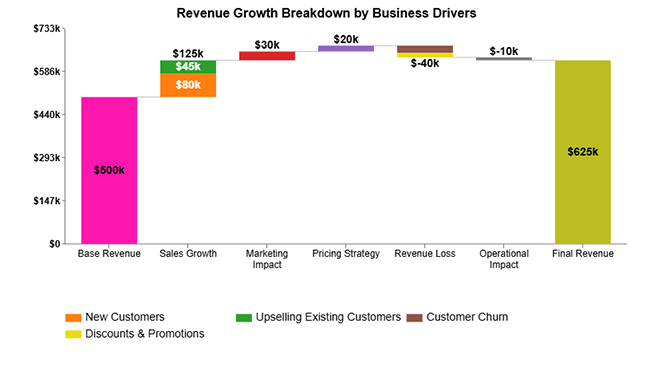
The waterfall chart shows revenue increasing from a $500k base through sales growth (+$125k), marketing (+$30k), and pricing strategy (+$20k), driven by new customers and upselling.
However, losses from churn, discounts, and operations (-$50k total) reduce gains, resulting in a final revenue of $625k.
Tracking and calculating revenue growth is only half the equation. Sustaining that growth requires deliberate, repeatable operating habits that build the conditions for consistent upward momentum over time rather than isolated wins.
High-impact approaches include:
Even when the process of calculating revenue growth produces a positive number, companies often encounter obstacles that make those results unreliable or hard to sustain. Several recurring pitfalls can undermine accuracy or limit long-term performance.
Watch for these common pitfalls:
Start by identifying the revenue figure from year one and the revenue figure from year three. Calculating revenue growth across that span means subtracting the starting amount from the ending amount, dividing by the starting amount, and multiplying by 100 to express the total change as a percentage.
Pull the revenue total from the current year and the equivalent figure from the prior year. Subtract last year’s amount from this year’s, divide the difference by last year’s total, and multiply by 100 to arrive at the year-over-year growth rate.
In most industries, a 12% rate when calculating revenue growth signals solid momentum. Whether it is strong or merely adequate depends on the company’s stage, the competitive landscape, and the benchmarks that are standard for its particular market.
Calculating revenue growth is one of the most direct ways a business can verify that its strategy is producing real results. When tracked with consistent data, the right formula, and meaningful time comparisons, the metric turns abstract financial activity into a clear progress signal that every level of leadership can act on.
Understanding how to calculate revenue growth is the first step, but the real advantage comes from building it into every reporting cycle as a consistent habit. Organizations that develop more than a number. They build the institutional discipline to catch problems early, validate what is working, and make resource decisions grounded in evidence rather than assumptions.
How much did you enjoy this article?


Calculate accounts receivable turnover ratio to measure credit collection speed, improve cash flow, and strengthen your financial strategy. Read on!

Change Management KPIs are the key to tracking adoption, performance, and ROI during transitions. Find out which metrics matter. Read on!

Data collection methods and techniques determine the quality of every insight you act on. Explore key approaches for gathering reliable data. Read on!