• Home
  • Tools dropdown img
    • Spreadsheet Charts

      • ChartExpo for Google Sheets
      • ChartExpo for Microsoft Excel
    • Power BI Charts

      • Power BI Custom Visuals by ChartExpo
    • Word Cloud

  • Charts dropdown img
    • Chart Category

      • Bar Charts
      • Circle Graphs
      • Column Charts
      • Combo Charts
      • Comparison Charts
      • Line Graphs
      • PPC Charts
      • Sentiment Analysis Charts
      • Survey Charts
    • Chart Type

      • Box and Whisker Plot
      • Clustered Bar Chart
      • Clustered Column Chart
      • Comparison Bar Chart
      • Control Chart
      • CSAT Survey Bar Chart
      • CSAT Survey Chart
      • Dot Plot Chart
      • Double Bar Graph
      • Funnel Chart
      • Gauge Chart
      • Likert Scale Chart
      • Matrix Chart
      • Multi Axis Line Chart
      • Overlapping Bar Chart
      • Pareto Chart
      • Radar Chart
      • Radial Bar Chart
      • Sankey Diagram
      • Scatter Plot Chart
      • Slope Chart
      • Sunburst Chart
      • Tornado Chart
      • Waterfall Chart
      • Word Cloud
    • Google Sheets
      Microsoft Excel
  • Services
  • Pricing
  • Contact us
  • Blog
  • Support dropdown img
      • Gallery
      • Videos
      • Contact us
      • FAQs
      • Resources
    • Please feel free to contact us

      atsupport@chartexpo.com

Categories
All Data Visualizations Data Analytics Surveys
Add-ons/
  • Google Sheets
  • Microsoft Excel
  • Power BI
All Data Visualizations Data Analytics Surveys
Add-ons
  • Google Sheets
  • Microsoft Excel
  • Power BI

We use cookies

This website uses cookies to provide better user experience and user's session management.
By continuing visiting this website you consent the use of these cookies.

Ok

ChartExpo Survey


Home > Blog > Data Analytics

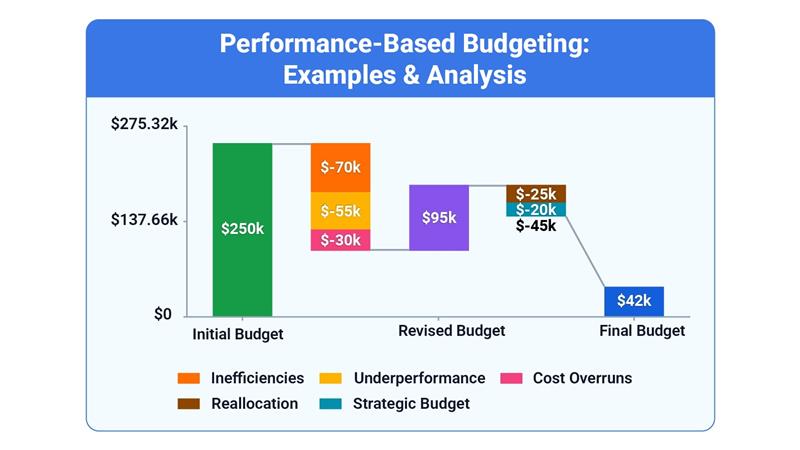
Performance-Based Budgeting: Examples & Analysis

Performance-based budgeting (PBB) is a results-driven approach that connects spending directly to measurable outcomes. Instead of focusing only on how much is spent, it evaluates what that spending actually achieves.

Performance-Based Budgeting

This method helps organizations improve accountability, allocate resources more efficiently, and align financial planning with strategic objectives. By linking budgets to performance, businesses and public sector organizations can make smarter, data-backed decisions.

What is Performance-Based Budgeting (PBB)?

Definition: Performance-based budgeting (PBB) is a financial planning method that links resource allocation directly to measurable outcomes. Instead of focusing only on expenses, it evaluates whether spending achieves the intended results.

The main goal of performance budgeting is to improve accountability, increase efficiency, and support data-driven decision-making. It helps organizations ensure that every dollar contributes to measurable value rather than just covering operational costs.

By focusing on outputs, outcomes, and real-world impact, this approach transforms budgeting from a routine financial task into a strategic decision-making process.

Why Performance-Based Budgeting Is Important for Organizations

A performance-based budget is important because it ensures every dollar spent delivers measurable results. Instead of focusing only on expenses, organizations can evaluate real impact and improve financial decision-making.

  1. Links spending to outcomes: Budget decisions are based on measurable results, not just activity.
  2. Improves accountability and transparency: Every allocation is tied to clear performance indicators.
  3. Supports data-driven decisions: Leaders rely on metrics and comparisons like budget vs. forecast to guide spending.
  4. Aligns budgets with strategic goals: Resources are directed toward high-impact initiatives.
  5. Evaluates program effectiveness: Helps determine whether programs deliver expected results.
  6. Optimizes resource allocation: Funds are shifted to areas with the highest returns.

Key Components of a Performance-Based Budget

A strong performance-based budget framework relies on clear structures and measurable systems to ensure every resource decision aligns with organizational goals. The essential components include:

  • Clear performance objectives: Define specific, verifiable goals that indicate successful program execution.
  • Defined outputs and outcomes: Distinguish between completed activities (outputs) and the tangible results they produce (outcomes).
  • Performance indicators and KPIs: Use quantifiable metrics to track efficiency, effectiveness, and progress at each stage of the budget cycle.
  • Program-based budgeting structure: Allocate resources around programs instead of traditional line-item expenses, similar to structured business budget templates.
  • Monitoring and reporting mechanisms: Track ongoing performance using tools like operating budget to identify deviations early.
  • Evaluation and feedback loops: Regularly assess results to refine strategies and improve resource allocation in future cycles.
  • Responsibility and ownership assignment: Assign each outcome to a team or individual to establish clear accountability for performance.

Techniques for Performance-Based Budgeting (PBB)

Achieving consistent results with performance-based budgeting requires structured methods and ongoing evaluation. These techniques help organizations link spending to measurable outcomes and make informed resource decisions:

  • Define measurable performance targets: Set clear, quantifiable goals for each program or initiative, providing a benchmark to evaluate success at the end of the budget cycle.
  • Track results using KPIs: Monitor efficiency, productivity, and effectiveness through key performance indicators, ensuring programs stay aligned with objectives.
  • Link funding to outcomes: Adjust allocations each cycle based on whether prior spending produced the intended results, reinforcing accountability and impact.
  • Benchmark against past performance: Compare outcomes across time periods to identify trends, recurring variances, and areas for improvement. Tools like budget vs. forecast analysis help pinpoint inefficiencies.
  • Conduct cost-benefit analysis: Evaluate whether each initiative delivers value that justifies its financial commitment and resource use.
  • Implement continuous performance reviews: Regularly assess results to refine strategies, improve decision-making, and ensure resources remain aligned with organizational targets.

Common PBB Frameworks

Organizations adopt different performance-based budgeting frameworks depending on strategic priorities and operational context. Choosing the right type ensures resources are allocated efficiently and outcomes are maximized. Key types include:

  • Program-based budgeting: Allocates resources by program or function rather than traditional line-item expenses, helping teams focus on program-level results.
  • Outcome-based budgeting: Directs funding toward initiatives expected to achieve measurable impact, placing results at the center of all decisions.
  • Results-oriented budgeting: Links expenditures directly to performance achievements, emphasizing both operational efficiency and effectiveness throughout each budget cycle.
  • Zero-based performance budgeting: Requires every expense to be justified based on merit and expected outcomes, with no automatic carry-forward from previous allocations.
  • Activity-based budgeting: Allocates resources by analyzing the cost of individual operational activities, similar to cost planning in a structured budget spreadsheet.

Real-World Applications of Performance-Based Budgeting (PBB)

Here are some key applications:

  • Government budgeting: Funds are allocated based on public service outcomes and the measurable impact of policies, ensuring taxpayers’ money delivers real value.
  • Healthcare: Budgets are linked to patient outcomes, service quality, and operational efficiency, helping hospitals and clinics prioritize effective interventions.
  • Education: Funding decisions are tied to student performance, graduation rates, and institutional effectiveness, enabling schools to focus on measurable results.
  • Corporate finance: Companies align budgets with KPIs, profitability targets, and strategic objectives, ensuring resources are invested in initiatives that drive measurable business outcomes.

Performance Budget Template With Examples

These real-world scenarios illustrate how performance budgeting connects financial decisions to measurable outcomes. Each example includes visual aids to make insights clear and actionable.

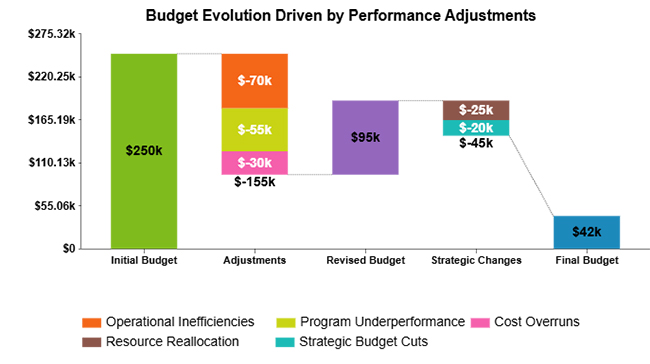
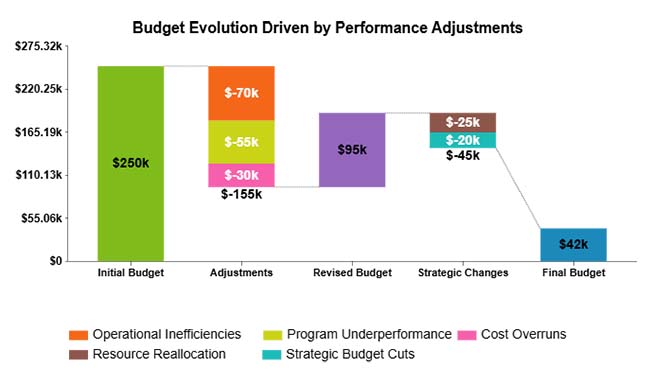
Budget Evolution Driven by Performance Adjustments

The budget evolution driven by performance adjustments example traces how a chain of operational inefficiencies and corrective actions reduces the allocation from $250K down to a final figure of $42K.

  • Example Insight: Shows how performance reviews can drastically refine budget allocations.

Performance-Based Budgeting

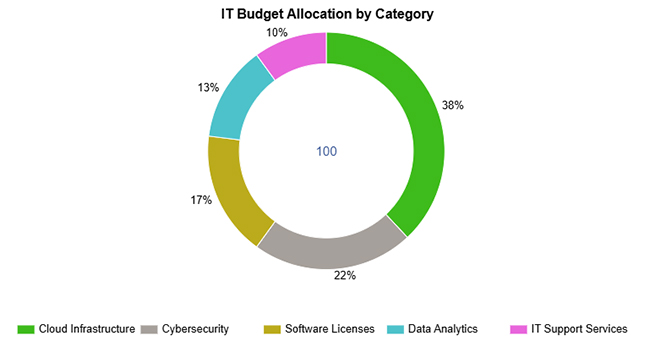
IT Budget Allocation by Category

The IT budget allocation by category example shows how financial resources are spread across key technology areas, supporting data-driven planning and investment decision-making.

  • Example Insight: Highlights which IT initiatives receive priority funding based on expected impact.
Performance-Based Budgeting

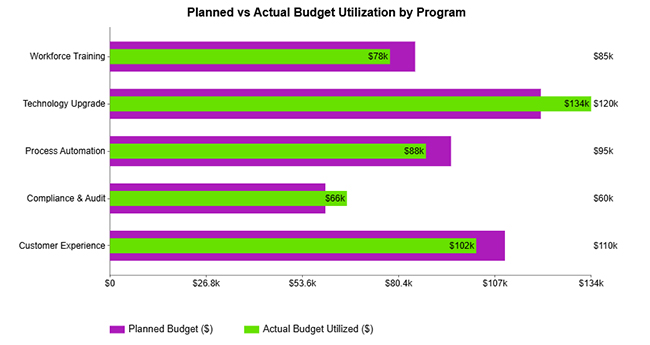
Planned vs Actual Budget Utilization by Program

The planned vs actual budget utilization by program example exposes spending variances across programs, highlighting areas where funds were exceeded or used with notable efficiency.

  • Example Insight: Identifies programs exceeding budgets or achieving higher efficiency.
Performance-Based Budgeting

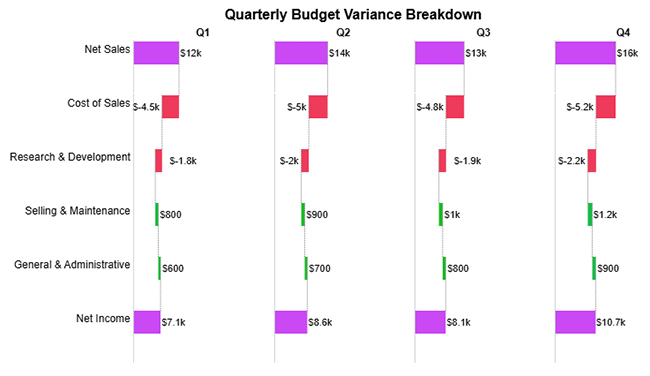
Quarterly Budget Variance Breakdown

The quarterly budget variance breakdown example maps how category-level cost fluctuations affect net income across quarters, revealing where financial performance diverges from the plan.

  • Example Insight: Flags trends and deviations to guide corrective measures.
Performance-Based Budgeting

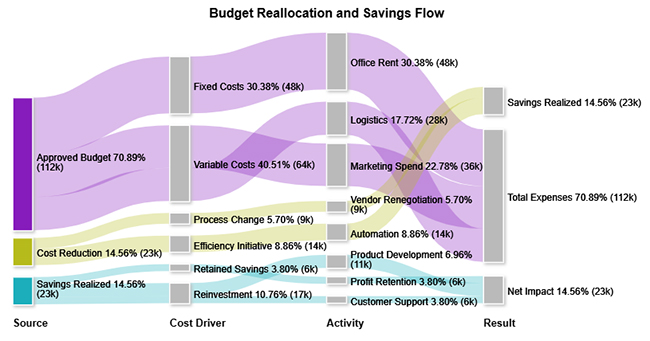
Budget Reallocation and Savings Flow

The budget reallocation and savings flow example traces how cost reductions, efficiency initiatives, and reinvestments reshape spending patterns to generate measurable net savings.

  • Example Insight: Demonstrates how strategic reallocations can create measurable net savings.

Performance-Based Budgeting

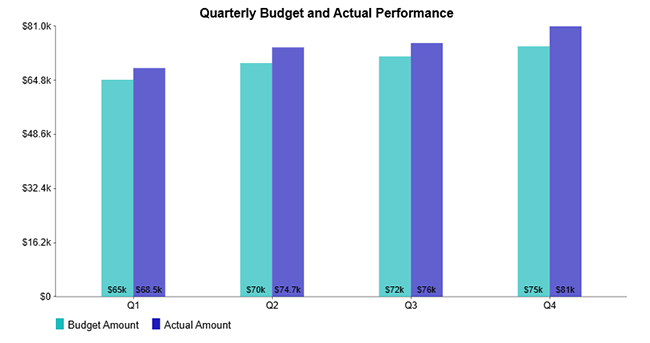
Quarterly Budget and Actual Performance

The quarterly budget and actual performance example places planned and actual spending side by side across quarters, surfacing variance trends and gaps in performance consistency.

  • Example Insight: Visualizes trends and gaps in performance consistency.
Performance-Based Budgeting

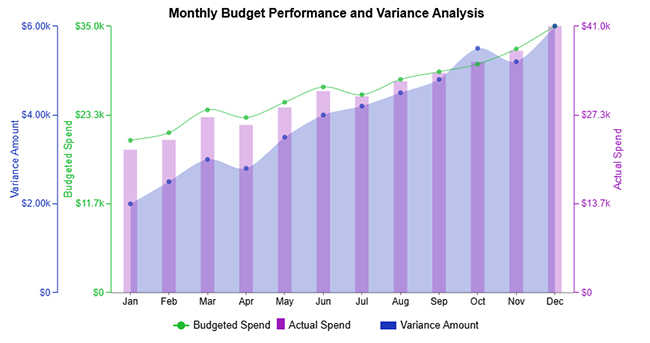
Monthly Budget Performance and Variance Analysis

The monthly budget performance and variance analysis example shows month-by-month spending patterns, contrasting budgeted amounts with actuals and flagging recurring variance trends.

  • Example Insight: Helps identify timing issues in budget execution.
Performance-Based Budgeting

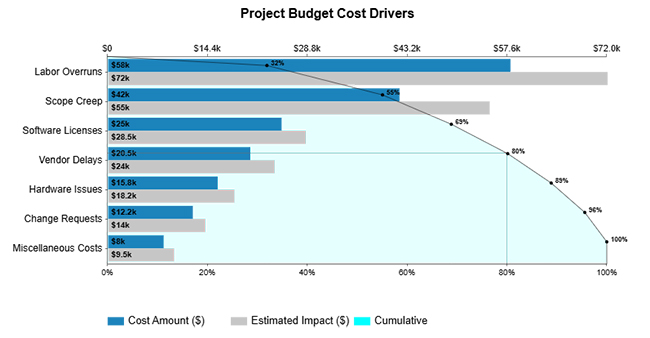
Project Budget Cost Drivers

The project budget cost drivers example identifies the small set of factors with the greatest budget impact, enabling targeted cost control and more focused resource decisions.

  • Example Insight: Enables targeted cost control and more focused resource decisions.
Performance-Based Budgeting

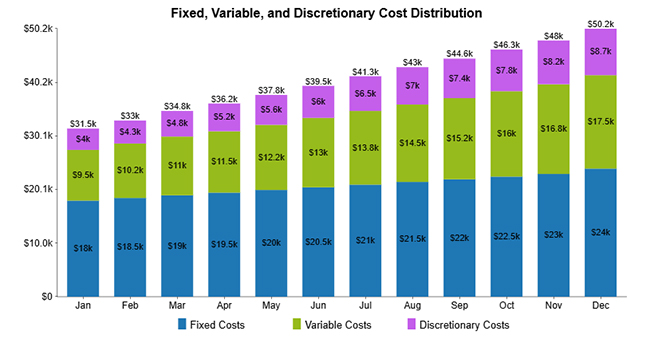
Fixed, Variable, and Discretionary Cost Distribution

The fixed, variable, and discretionary cost distribution example shows how each cost category contributes to monthly expenditure, informing cost control strategy and allocation choices.

  • Example Insight: Supports informed allocation and cost control strategies.

Performance-Based Budgeting

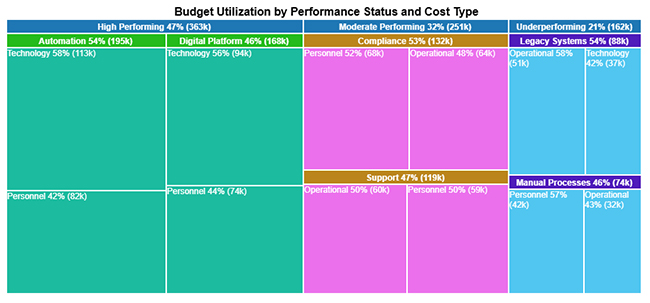
Budget Utilization by Performance Status and Cost Type

The budget utilization by performance status and cost type example reveals that high-performing programs absorb the bulk of the budget, while utilization decreases in underperforming areas.

  • Example Insight: Links financial allocation to program performance, reinforcing accountability.
Performance-Based Budgeting

Performance-Based Budgeting vs Traditional Budgeting

Here’s a clear comparison between key factors.

Feature PBB Traditional Budgeting
Focus Outcomes & results Expenses
Decision Basis Data & KPIs Historical spending
Flexibility High Low
Accountability Strong Limited
Goal Alignment Strategic Operational

How to Implement Performance-Based Budgeting in Excel

Implementing performance-based budgeting (PBB) requires planning, data analysis, and alignment across departments. Follow these steps to get started:

Step 1: Define Strategic Goals

  • Identify the organization’s objectives and priorities.
  • Clarify what outcomes matter most, such as improving efficiency, service quality, or revenue generation.

Step 2: Link Spending to Outcomes

  • Assign budget allocations to specific programs, projects, or departments based on expected results.
  • Ensure every dollar has a measurable outcome attached.

Step 3: Establish Performance Metrics

  • Decide how success will be measured.
  • Use quantitative metrics like cost per output, revenue growth, or service delivery time, and qualitative metrics if needed.

Step 4: Collect and Analyze Data

  • Gather historical spending data and performance results.
  • Identify areas where spending aligns or diverges from desired outcomes.

Step 5: Set Performance Targets

  • Establish realistic benchmarks and targets for each program or initiative.
  • Ensure targets are specific, measurable, and time-bound.

Step 6: Allocate Budgets Based on Results

  • Distribute resources according to expected performance and priorities.
  • Use a flexible approach, allowing adjustments based on progress toward outcomes.

Step 7: Monitor, Evaluate, and Adjust

  • Continuously track performance against targets.
  • Adjust budgets and strategies as needed to optimize results.
  • Use dashboards or tools like Excel or ChartExpo to visualize outcomes and spending efficiency.

Step 8: Communicate and Train Teams

  • Share performance data and budgeting decisions with stakeholders.
  • Train teams to understand how spending impacts results and encourage accountability.
Performance-Based Budgeting

Benefits of a Performance-Based Budget

It helps organizations improve both financial governance and operational outcomes. Key benefits include:

1. Improves Financial Transparency

  • Clear visibility into how funds are allocated and what results each allocation produces builds trust with stakeholders and supports informed decision-making.

2. Enhances Operational Efficiency

  • Linking spending to measurable outcomes encourages teams to maximize value from every dollar, reducing waste and improving productivity.

3. Strengthens Accountability

  • Each budget decision is tied to specific performance outcomes, giving leadership a clear view of responsibilities and areas needing attention.

4. Supports Strategic Planning

  • Budgets align with long-term organizational goals, ensuring that resources are directed toward initiatives that reinforce strategic priorities.

5. Encourages Continuous Improvement

  • Regular monitoring and evaluation create a feedback loop, refining program design and improving the quality of future budget cycles.

6. Improves Resource Utilization

  • Funds are focused on programs that consistently deliver measurable impact, ensuring the highest return on investment across the organization.

Common Challenges of Performance-Based Budgeting

While highly effective, this approach comes with challenges organizations should anticipate:

1. Difficulty Defining Measurable Outcomes

  • Converting strategic goals into concrete, quantifiable metrics is rarely straightforward and often involves subjective judgment.

2. Data Collection and Quality Issues

  • Poor or incomplete data undermines performance evaluations and can distort resource allocation decisions over time.

3. Resistance to Change

  • Staff and stakeholders accustomed to traditional budgeting may push back against new processes and governance structures.

4. High Implementation Effort

  • Building and sustaining a performance framework requires significant time, expertise, and ongoing organizational commitment.

5. Limited Analytical Capabilities

  • Many organizations lack the internal tools or skilled personnel to carry out rigorous performance assessments at scale.

6. Risk of Focusing on Metrics Only

  • Overemphasis on numerical targets can crowd out qualitative considerations and the broader strategic context in budget decisions.

FAQs

What are the pros and cons of performance-based budgeting?

It improves transparency, accountability, and resource allocation. However, it also requires reliable data, clearly defined metrics, and strong organizational commitment for effective implementation.

Is performance-based budgeting suitable for small businesses?

Yes, PBB can be highly effective for small businesses. It helps prioritize spending by focusing on measurable results, ensuring limited resources are used efficiently. Even with simple tools like Excel, small businesses can track key metrics, evaluate performance, and make data-driven budget decisions without complex systems.

Wrap Up

When financial decisions are tied to measurable outcomes, organizations move beyond simple cost control toward true performance-driven management.

Performance-based budgeting provides this structure, turning the budget cycle into a continuous, feedback-driven process where every allocation is evaluated against real results.

By combining structured analysis in Excel with clear data visualization, finance teams can identify trends, detect variances early, and continuously refine resource allocation strategies.

The result is a budgeting approach that remains dynamic, transparent, and closely aligned with organizational goals.

Start applying performance budgeting today by structuring your data in Excel and using visualization tools to uncover actionable insights.

How much did you enjoy this article?

GSAd1
Start Free Trial!
159971

Related articles

next previous
Data Analytics10 min read

Pay Equity Analysis: Smart Ways to Analyze Pay Gaps

Pay equity analysis uncovers hidden salary gaps. Learn how to measure compensation fairness, close pay disparities, and build trust. Read on!

Data Analytics10 min read

What Are Sales KPIs: Sales Metrics Made Easy

What are sales KPIs, and why should every business track them? Learn the top indicators, how to measure them, and improve results. Read on!

Data Analytics10 min read

Calculating Revenue Growth for Better Growth Analysis

Calculating revenue growth reveals where your business stands. Learn the formula, types, and steps to track performance accurately. Read on!

Data Analytics9 min read

Consulting Report Template: A Complete Guide

Consulting Report Template: structure insights, drive decisions, and deliver standout results. Discover how to build better reports now!

Data Analytics10 min read

Event Budget Template for Event Budget Insights

Event budget template keeps event finances clear and controlled. Use one to track costs, compare spending, and stay on budget. Learn more!

ChartExpo logo

Turn Data into Visual
Stories

CHARTEXPO

  • Home
  • Gallery
  • Videos
  • Services
  • Pricing
  • Contact us
  • FAQs
  • Privacy policy
  • Terms of Service
  • Sitemap

TOOLS

  • ChartExpo for Google Sheets
  • ChartExpo for Microsoft Excel
  • Power BI Custom Visuals by ChartExpo
  • Word Cloud

CATEGORIES

  • Bar Charts
  • Circle Graphs
  • Column Charts
  • Combo Charts
  • Comparison Charts
  • Line Graphs
  • PPC Charts
  • Sentiment Analysis Charts
  • Survey Charts

TOP CHARTS

  • Sankey Diagram
  • Likert Scale Chart
  • Comparison Bar Chart
  • Pareto Chart
  • Funnel Chart
  • Gauge Chart
  • Radar Chart
  • Radial Bar Chart
  • Sunburst Chart
  • see more
  • Scatter Plot Chart
  • CSAT Survey Bar Chart
  • CSAT Survey Chart
  • Dot Plot Chart
  • Double Bar Graph
  • Matrix Chart
  • Multi Axis Line Chart
  • Overlapping Bar Chart
  • Control Chart
  • Slope Chart
  • Clustered Bar Chart
  • Clustered Column Chart
  • Box and Whisker Plot
  • Tornado Chart
  • Waterfall Chart
  • Word Cloud
  • see less

RESOURCES

  • Blog
  • Resources
  • YouTube
SIGN UP FOR UPDATES

We wouldn't dream of spamming you or selling your info.

© 2026 ChartExpo, all rights reserved.