• Home
  • Tools dropdown img
    • Spreadsheet Charts

      • ChartExpo for Google Sheets
      • ChartExpo for Microsoft Excel
    • Power BI Charts

      • Power BI Custom Visuals by ChartExpo
    • Word Cloud

  • Charts dropdown img
    • Chart Category

      • Bar Charts
      • Circle Graphs
      • Column Charts
      • Combo Charts
      • Comparison Charts
      • Line Graphs
      • PPC Charts
      • Sentiment Analysis Charts
      • Survey Charts
    • Chart Type

      • Box and Whisker Plot
      • Clustered Bar Chart
      • Clustered Column Chart
      • Comparison Bar Chart
      • Control Chart
      • CSAT Survey Bar Chart
      • CSAT Survey Chart
      • Dot Plot Chart
      • Double Bar Graph
      • Funnel Chart
      • Gauge Chart
      • Likert Scale Chart
      • Matrix Chart
      • Multi Axis Line Chart
      • Overlapping Bar Chart
      • Pareto Chart
      • Radar Chart
      • Radial Bar Chart
      • Sankey Diagram
      • Scatter Plot Chart
      • Slope Chart
      • Sunburst Chart
      • Tornado Chart
      • Waterfall Chart
      • Word Cloud
    • Google Sheets
      Microsoft Excel
  • Services
  • Pricing
  • Contact us
  • Blog
  • Support dropdown img
      • Gallery
      • Videos
      • Contact us
      • FAQs
      • Resources
    • Please feel free to contact us

      atsupport@chartexpo.com

Categories
All Data Visualizations Data Analytics Surveys
Add-ons/
  • Google Sheets
  • Microsoft Excel
  • Power BI
All Data Visualizations Data Analytics Surveys
Add-ons
  • Google Sheets
  • Microsoft Excel
  • Power BI

We use cookies

This website uses cookies to provide better user experience and user's session management.
By continuing visiting this website you consent the use of these cookies.

Ok

ChartExpo Survey


Home > Blog > Data Visualization

Ranking Chart Maker for Better Insights

A ranking chart maker solves this by organizing data into a clear, ordered visual format.

It helps you compare performance, highlight top and bottom results, and present rankings in a way that is easy to understand.
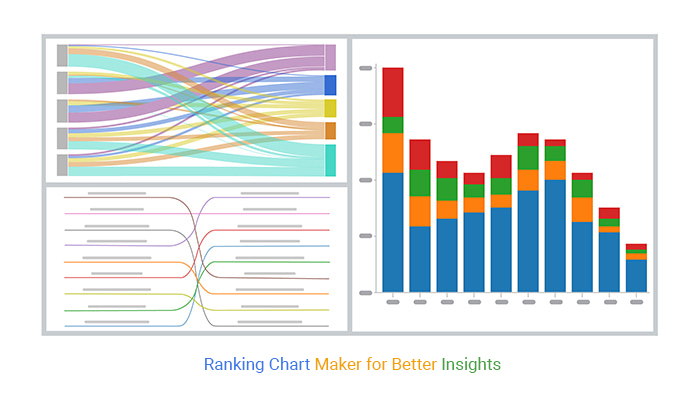
ranking chart maker

Whether you’re creating a leaderboard, product comparison, or performance report, ranking charts make it easier to turn raw data into meaningful insights that support faster decisions.

A ranking chart maker is a tool that organizes data into ranked visuals such as leaderboards or performance lists.

It helps compare items based on value, performance, or priority to quickly identify top and bottom performers.

What is a Ranking Chart Maker?

Definition: A ranking chart maker is a tool that converts raw data into a ranked visual format, allowing you to compare items based on performance, value, or priority.

It automatically organizes data into ordered charts, making it easy to identify top performers, low performers, and overall trends.

It is commonly used for leaderboards, product comparisons, survey rankings, and performance analysis, where clear ordering and quick comparison are essential.

When to Use a Ranking Chart Maker

A ranking chart maker is most useful when you need to compare performance, prioritize results, or clearly show order in data.

  • Comparing top and bottom performers across sales, products, or teams
  • Creating leaderboards for rankings based on scores, revenue, or KPIs
  • Analyzing competitive data to see which option performs better
  • Presenting survey results where responses need a clear ranking
  • Tracking changes in ranking over time, like SEO, sales, or market positions
  • Simplifying complex datasets into clear, structured visuals for reporting

Top 3 Ranking Chart Examples

Not all charts are designed specifically for ranking, but some can be effectively used to analyze position, compare performance, and track ranking changes when structured correctly.

Below are three commonly used charts that can help visualize data and uncover meaningful insights.

  • Stacked Column Chart

A Stacked Column Chart displays how different categories contribute to a total while also allowing comparison across groups or time periods.

When data is ordered properly, it can help highlight relative ranking within each category.

It is useful when you want to compare how different segments perform while still understanding their contribution to the whole.

Use it when:

  • Comparing ranked performance across multiple categories
  • Analyzing the contribution along with the position
  • Tracking how the ranking distribution changes over time
stacked column chart ranking chart maker
  • Slope Chart

A Slope Chart is designed to show how rankings change between two points in time. It connects values with lines, making it easy to track movement in position.

This makes it highly effective for identifying which items improved, declined, or remained stable in rankings.

Use it when:

  • Tracking ranking changes over time
  • Comparing before vs after performance
  • Identifying upward or downward movement in position
slope chart ranking chart maker
  • Sankey Diagram

A Sankey Diagram visualizes the flow of data between different stages or categories. While not a traditional ranking chart, it can be used to understand how items move between positions or categories.

It is especially useful for analyzing transitions, such as how users, products, or segments shift across different stages.

Use it when:

  • Analyzing movement between ranked categories
  • Understanding the flow behind ranking changes
  • Identifying drop-offs or transitions in performance
sankey chart ranking chart maker

Top 5 Ranking Chart Maker Tools (Free & Paid)

Choosing the right ranking chart maker depends on how you plan to use it—whether for quick visuals, detailed analysis, or automated dashboards.

Below are some of the most effective tools based on different use cases.

1. Canva (Best for Quick Visual Ranking Charts)

Canva is ideal for creating simple and visually appealing ranking charts without technical skills.

Its drag-and-drop interface and ready-made templates make it easy to design leaderboards, top lists, and comparison visuals.

Best for:

  • Quick presentations
  • Marketing visuals
  • Non-technical users

2. Visme (Best for Interactive Presentations)

Visme is designed for creating engaging and interactive ranking visuals. It supports animations, data imports, and custom styling, making it useful for reports and presentations that require more visual impact.

Best for:

  • Interactive reports
  • Presentation-ready charts
  • Visual storytelling

3. Google Sheets (Best for Simple and Collaborative Ranking)

Google Sheets is a practical option for creating basic ranking charts using formulas and built-in visuals. It allows real-time collaboration and easy sharing across teams.

Best for:

  • Team collaboration
  • Simple ranking charts
  • Cloud-based workflows

4. Microsoft Excel (Best for Advanced Data Analysis)

Excel provides strong data handling and charting capabilities for ranking analysis. With formulas, sorting, and advanced formatting, it’s suitable for detailed and structured reporting.

Best for:

  • Large datasets
  • Detailed analysis
  • Business reporting

5. ChartExpo (Best for Advanced Ranking Chart Maker)

ChartExpo extends Excel and Google Sheets by offering specialized charts and ready-made templates for ranking analysis.

It simplifies complex visualizations and helps present ranking data in a clearer and more structured way.

Best for:

  • Advanced ranking charts
  • Faster visualization without coding
  • Enhanced data insights

How to Create a Ranking Chart in Excel (Step-by-Step)

Creating a ranking chart in Excel involves organizing your data, assigning ranks, and visualizing the results in a clear format.

Step 1: Prepare Your Data

  • Enter your data in a table format with clear columns (e.g., Name, Category, Value).
  • This ensures your data is structured and ready for ranking.

Step 2: Assign Rankings

  • Use the RANK or RANK.EQ function to assign positions based on values.
  • This automatically orders your data from highest to lowest (or vice versa).

Step 3: Sort the Data

  • Sort your dataset based on rank or value to display items in the correct order.
  • This makes your ranking visually meaningful.

Step 4: Insert a Chart

  • Select your data and insert a chart (Bar Chart or Column Chart works best for rankings).
  • This converts your ranked data into a visual format.

Step 5: Format the Chart for Clarity

  • Adjust labels, colors, and axis titles to highlight ranking positions clearly.
  • Keep the design simple, so the top and bottom performers stand out.

Step 6: Add Filters or Highlights (Optional)

  • Use filters or conditional formatting to emphasize key insights like top performers or trends.
  • This improves readability and analysis.

Step 7: Enhance with Advanced Visualization

  • For more advanced and interactive ranking charts, you can use tools like ChartExpo to create more structured and visually clear ranking visuals beyond Excel’s default charts.
ranking chart creator

Benefits of Using a Ranking Chart Maker

A ranking chart maker helps simplify data comparison and makes it easier to identify performance differences across categories.

1. Clear Performance Comparison

  • It organizes data into a ranked format, making it easy to compare top and bottom performers at a glance.

2. Faster Decision-Making

  • By highlighting rankings visually, it helps you quickly identify what is working and where action is needed.

3. Simplifies Complex Data

  • Large datasets become easier to understand when converted into ordered visuals instead of raw tables or spreadsheets.

4. Improves Reporting Clarity

  • Ranking charts make reports more structured and easier to interpret for stakeholders, especially in presentations.

5. Highlights Trends and Gaps

  • It helps uncover patterns, performance gaps, and opportunities that may not be obvious in unorganized data.

Tips for Using a Ranking Chart Maker

Using a ranking chart maker effectively is not just about creating visuals—it’s about making rankings clear, accurate, and easy to interpret.

1. Define Clear Ranking Criteria

  • Decide what metric you are ranking (e.g., revenue, score, performance). Clear criteria ensure accurate and meaningful rankings.

2. Sort Data Before Visualization

  • Always organize your data in ascending or descending order so the ranking is immediately clear in the chart.

3. Keep the Chart Simple

  • Avoid adding too many categories or elements. A clean chart makes it easier to identify top and bottom performers.

4. Use Consistent Labels and Scales

  • Ensure labels, units, and scales are consistent across the chart to avoid confusion and misinterpretation.

5. Highlight Key Performers

  • Use colors or markers to emphasize top performers, low performers, or important thresholds for better insights.

Ranking Chart Maker – FAQs

How to show ranking in a chart?

Sort your data by value and assign ranks using a function like RANK or RANK.EQ. Then visualize it using a bar or column chart arranged from highest to lowest so the ranking is easy to compare at a glance.

How to create a ranking table?

Organize your data in structured columns, apply a ranking formula to assign positions based on values, and sort the table in ascending or descending order to clearly display the final ranked list.

Wrap Up

A ranking chart maker is most effective when data needs to be compared, ordered, or prioritized in a clear visual format.

It removes manual sorting and helps turn raw data into structured insights that are easier to interpret.

This makes it easier to identify top and bottom performers, understand patterns, and support faster decision-making in reporting, analysis, and performance tracking.

When combined with tools like ChartExpo, ranking charts become more visual and structured, helping users build clearer insights without complex setup.

How much did you enjoy this article?

ExcelAd1
Start Free Trial!
124125

Related articles

next previous
Data Analytics10 min read

Change Management KPIs: You Should Track for Success

Change Management KPIs are the key to tracking adoption, performance, and ROI during transitions. Find out which metrics matter. Read on!
Data Analytics11 min read

Data Collection Methods and Techniques: A Complete Guide

Data collection methods and techniques determine the quality of every insight you act on. Explore key approaches for gathering reliable data. Read on!

Data Visualization11 min read

Segmented Bar Graph: Make Layered Data Understandable

Unlock the power of data with this guide to Segmented Bar Graphs. Learn its types, pros and cons, and when to use it for clear data visualization in Excel.

Data Visualization10 min read

How to Visualize Data Using Exponential Growth Chart?

Explore exponential growth, its real-world applications, and how to visualize it in Excel. Includes examples, chart types, and key limitations for better data insights.

Data Analytics11 min read

Measuring Workforce Productivity for Insightful Analysis

Measuring Workforce Productivity helps businesses track performance and boost efficiency. Explore key methods, formulas, and metrics. Read on!

ChartExpo logo

Turn Data into Visual
Stories

CHARTEXPO

  • Home
  • Gallery
  • Videos
  • Services
  • Pricing
  • Contact us
  • FAQs
  • Privacy policy
  • Terms of Service
  • Sitemap

TOOLS

  • ChartExpo for Google Sheets
  • ChartExpo for Microsoft Excel
  • Power BI Custom Visuals by ChartExpo
  • Word Cloud

CATEGORIES

  • Bar Charts
  • Circle Graphs
  • Column Charts
  • Combo Charts
  • Comparison Charts
  • Line Graphs
  • PPC Charts
  • Sentiment Analysis Charts
  • Survey Charts

TOP CHARTS

  • Sankey Diagram
  • Likert Scale Chart
  • Comparison Bar Chart
  • Pareto Chart
  • Funnel Chart
  • Gauge Chart
  • Radar Chart
  • Radial Bar Chart
  • Sunburst Chart
  • see more
  • Scatter Plot Chart
  • CSAT Survey Bar Chart
  • CSAT Survey Chart
  • Dot Plot Chart
  • Double Bar Graph
  • Matrix Chart
  • Multi Axis Line Chart
  • Overlapping Bar Chart
  • Control Chart
  • Slope Chart
  • Clustered Bar Chart
  • Clustered Column Chart
  • Box and Whisker Plot
  • Tornado Chart
  • Waterfall Chart
  • Word Cloud
  • see less

RESOURCES

  • Blog
  • Resources
  • YouTube
SIGN UP FOR UPDATES

We wouldn't dream of spamming you or selling your info.

© 2026 ChartExpo, all rights reserved.