• Home
  • Tools dropdown img
    • Spreadsheet Charts

      • ChartExpo for Google Sheets
      • ChartExpo for Microsoft Excel
    • Power BI Charts

      • Power BI Custom Visuals by ChartExpo
    • Word Cloud

  • Charts dropdown img
    • Chart Category

      • Bar Charts
      • Circle Graphs
      • Column Charts
      • Combo Charts
      • Comparison Charts
      • Line Graphs
      • PPC Charts
      • Sentiment Analysis Charts
      • Survey Charts
    • Chart Type

      • Box and Whisker Plot
      • Clustered Bar Chart
      • Clustered Column Chart
      • Comparison Bar Chart
      • Control Chart
      • CSAT Survey Bar Chart
      • CSAT Survey Chart
      • Dot Plot Chart
      • Double Bar Graph
      • Funnel Chart
      • Gauge Chart
      • Likert Scale Chart
      • Matrix Chart
      • Multi Axis Line Chart
      • Overlapping Bar Chart
      • Pareto Chart
      • Radar Chart
      • Radial Bar Chart
      • Sankey Diagram
      • Scatter Plot Chart
      • Slope Chart
      • Sunburst Chart
      • Tornado Chart
      • Waterfall Chart
      • Word Cloud
    • Google Sheets
      Microsoft Excel
  • Services
  • Pricing
  • Contact us
  • Blog
  • Support dropdown img
      • Gallery
      • Videos
      • Contact us
      • FAQs
      • Resources
    • Please feel free to contact us

      atsupport@chartexpo.com

Categories
All Data Visualizations Data Analytics Surveys
Add-ons/
  • Google Sheets
  • Microsoft Excel
  • Power BI
All Data Visualizations Data Analytics Surveys
Add-ons
  • Google Sheets
  • Microsoft Excel
  • Power BI

We use cookies

This website uses cookies to provide better user experience and user's session management.
By continuing visiting this website you consent the use of these cookies.

Ok

ChartExpo Survey


Home > Blog > Data Analytics

Data Collection Methods and Techniques: A Complete Guide

Reliable information is the foundation of every decision worth making. Data collection methods and techniques give researchers, businesses, and analysts the structured frameworks they need to gather information that actually reflects reality.
Data Collection Methods and Techniques

When the wrong approach is chosen, even sophisticated analysis tools produce misleading conclusions that can cost time, money, and organizational credibility.

This guide covers the major methods, core techniques, and practical steps involved in gathering high-quality data at scale. You will also find ten real-world examples and a step-by-step walkthrough for organizing and analyzing your results in Google Sheets, moving you from raw inputs to clear, actionable findings.

What are Data Collection Methods and Techniques?

Definition: Data collection methods and techniques are the systematic frameworks organizations use to gather, record, and measure information from targeted sources. They provide the structure that keeps gathered data accurate, relevant, and ready for analysis.

Put simply, a method determines the overall approach, such as conducting a survey, while a technique describes the specific tool used within that approach, such as a questionnaire. Both work together across research, business intelligence, and data analytics to produce structured, meaningful results.

Why are Data Collection Methods and Techniques Important?

Choosing the right data collection methods and techniques is what separates trustworthy findings from misleading ones. Flawed approaches at the collection stage create problems that no amount of downstream analysis can fix.

Key reasons why they matter:

  • Improve decision-making: Gives organizations a factual basis for choices, cutting through guesswork and opinion.
  • Ensure data accuracy: Reduces collection errors so the information gathered reflects actual conditions.
  • Support research analysis: Builds a solid foundation that makes downstream data analysis structured and credible.
  • Identify patterns and trends: Surfaces recurring behaviors and signals that point toward future developments.
  • Enhance business insights: Deepens understanding of customers, markets, and operations beyond surface-level observation.
  • Reduce bias and errors: Limits subjective influence and improves objectivity throughout the entire collection process.
  • Strengthen reporting quality: Produces clear, reliable reports that give stakeholders the evidence they need for planning.

For instance, teams applying quantitative market research are better positioned to pinpoint customer needs and sharpen product strategy.

Types of Data Collection Methods

Different data collection methods serve different goals. Knowing the range of available options lets you match your approach to your objectives, available resources, and the kind of market research methods best suited to your situation.

Common types include:

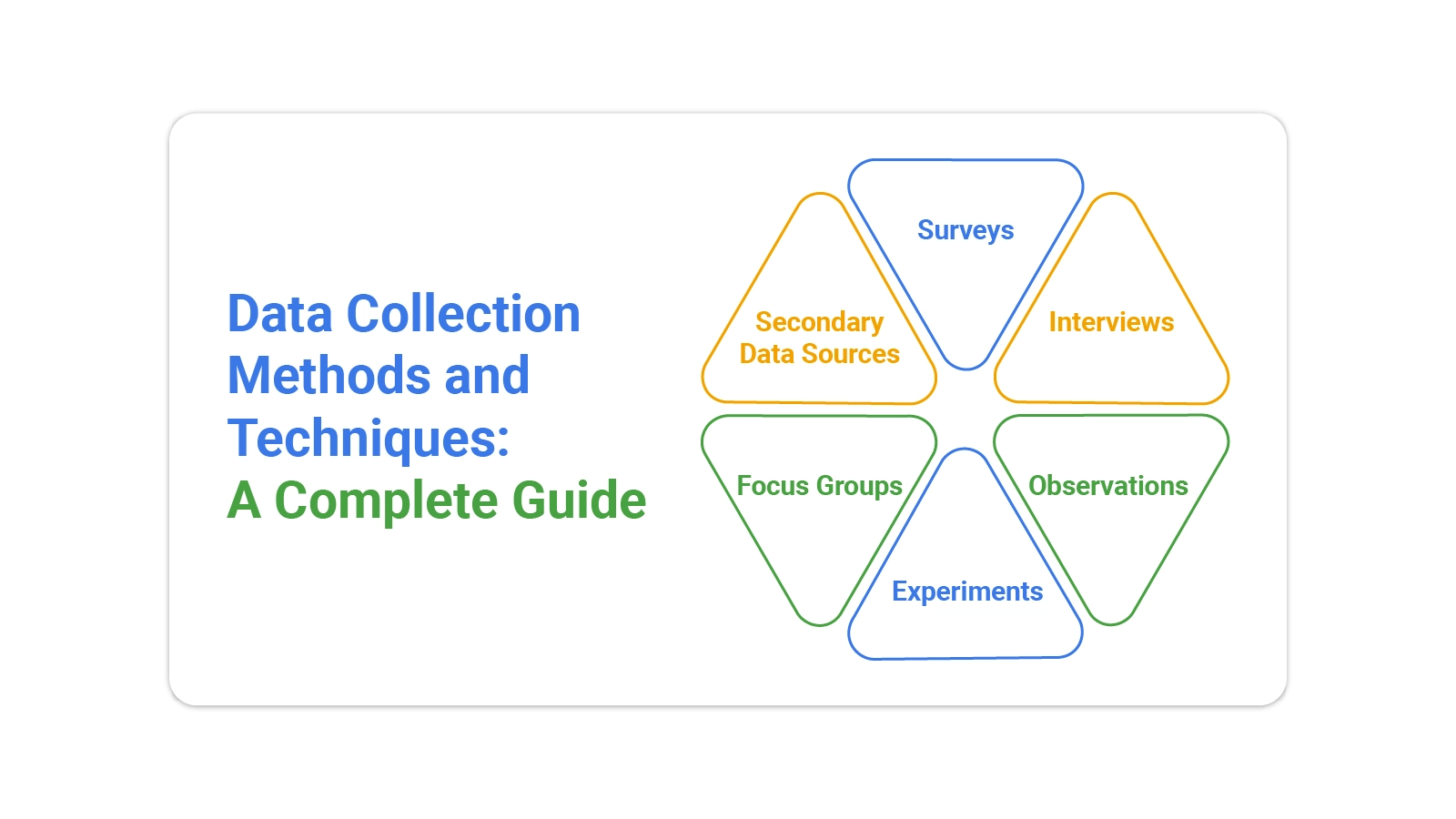
  • Surveys: Collect structured responses from a broad audience using predefined questions.
  • Interviews: Yield detailed perspectives through one-on-one or group conversations.
  • Observations: Capture real-time behaviors or events without directly interacting with participants.
  • Experiments: Test cause-and-effect relationships by manipulating variables in a controlled setting.
  • Focus groups: Generate rich feedback by guiding structured discussion among small groups.
  • Secondary data sources: Draw on existing reports, databases, or studies to supplement primary collection.

Common Data Collection Techniques

If methods represent the strategy, data collection techniques are the specific execution tools. Selecting the right technique for each situation keeps the collection efficient and the resulting data consistent.

Popular techniques include:

  • Questionnaires: Present a fixed set of questions to all respondents, enabling straightforward comparison of answers.
  • Online forms: Capture input digitally via web-based interfaces, allowing fast deployment and large-scale response collection.
  • Field observations: Document activities and behaviors directly where they occur, preserving contextual detail lost in other techniques.
  • Structured interviews: Follow a predetermined question script to keep responses consistent and comparable across all participants.
  • Document analysis: Review existing records, files, or reports to pull relevant information without requiring new respondents.
  • Sensor data tracking: Automatically gather real-time readings from GPS units, IoT devices, or wearable equipment.

Mastering these techniques matters whether you work with quantitative and qualitative data, because the right execution method shapes the overall value of every dataset you produce.

Choosing the Right Data Collection Method

No single approach fits every scenario. The right data collection methods and techniques for your project depend on what you need to learn, how you plan to use the findings, and what constraints exist on time and budget.

Consider the following factors:

  • Define research objectives: Write out your goals before anything else, so every subsequent decision stays aligned with what you actually need.
  • Identify data type needed: Determine whether qualitative insights, quantitative data, or a mix of both will best address your research question.
  • Evaluate time and budget: Weigh available resources against collection options to land on an approach that is both feasible and cost-effective.
  • Ensure data reliability: Pick approaches known to produce consistent, repeatable results under your specific conditions.
  • Consider sample size: Decide how many participants or data points are needed to make your findings statistically meaningful and representative.

A quantitative research design works best when you need measurable, statistically comparable data, while qualitative approaches are better suited to exploring motivations and context.

Essential Steps in the Data Collection Process

A repeatable process prevents gaps and inconsistencies. Applying structured data collection methods and techniques throughout these six steps helps you analyze and interpret results with confidence, from initial planning through final validation.

  • Step 1: Define research goals

Clearly identify what you want to achieve to guide the entire data collection process.

  • Step 2: Select data sources

Choose whether to collect data from primary sources, secondary sources, or both.

  • Step 3: Choose the collection method

Decide on the most suitable method, such as surveys, interviews, or observations.

  • Step 4: Design data tools

Create questionnaires, forms, or templates to ensure structured and consistent data gathering.

  • Step 5: Collect and record data

Systematically gather and store data in an organized format for easy access and analysis.

  • Step 6: Review and validate data

Check the collected data for accuracy, completeness, and reliability before analysis.

Top 10 Examples of Data Collection Methods and Techniques

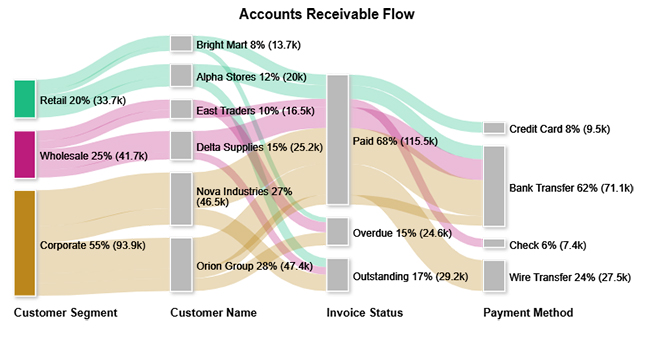
  • Accounts Receivable Flow

This Sankey Chart tracks how income from retail, wholesale, and corporate segments flows across clients and payment statuses, mapping the full distribution picture.

Example Insight: Uncovers payment bottlenecks and collection patterns so teams can improve cash flow and focus on high-value clients.
Data Collection Methods and Techniques
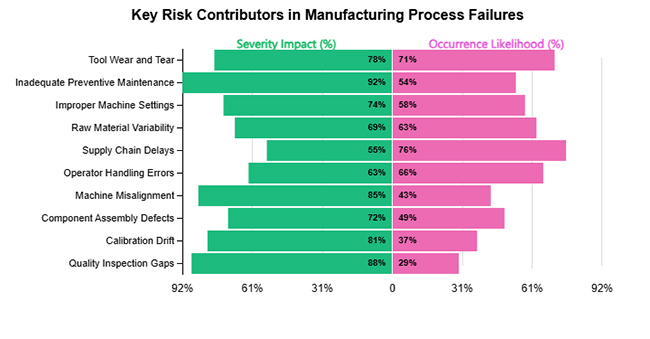
  • Manufacturing Process Risk Analysis

This Tornado Chart plots failure factors against two dimensions: how severe their impact would be and how often they are likely to occur, revealing where risk concentrates.

Example Insight: Identifies which risks combine high impact with high probability, allowing preventive resources to target the right failure points.
Data Collection Methods and Techniques
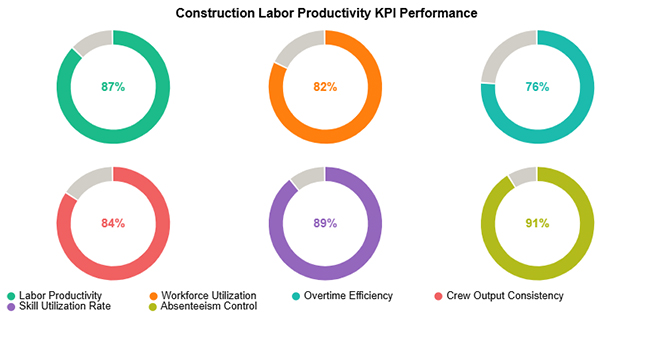
  • Construction Labor Productivity KPI Performance

This Progress Circle Chart maps workforce metrics such as productivity, utilization, efficiency, and absenteeism into a single visual snapshot of operational health.

Example Insight: Pinpoints strong performance areas while surfacing workforce efficiency gaps that hold back project timelines.
Data Collection Methods and Techniques
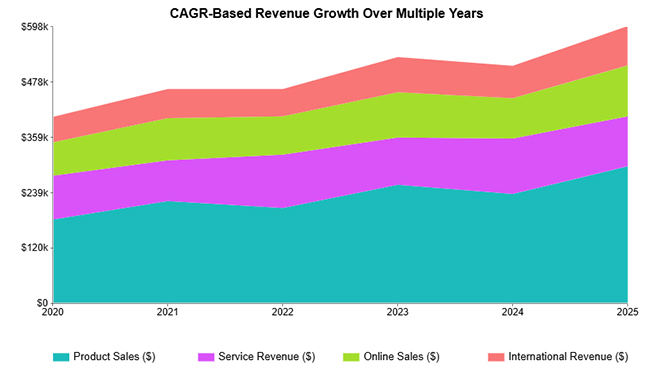
  • CAGR-based Revenue Growth

This Stacked Area Chart plots how individual revenue streams compound over multiple years, showing their cumulative contribution to total business growth.

Example Insight: Reveals consistent growth trends and identifies which streams drive long-term expansion.
Data Collection Methods and Techniques
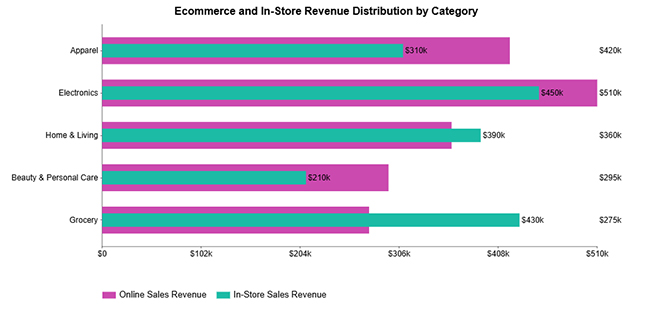
  • E-commerce and In-Store Revenue Distribution

This Overlapping Bar Chart measures channel performance side by side across product categories, contrasting digital and physical sales contribution within each segment.

Example Insight: Shows which categories perform better online versus in-store, informing channel investment and sales strategy.
Data Collection Methods and Techniques
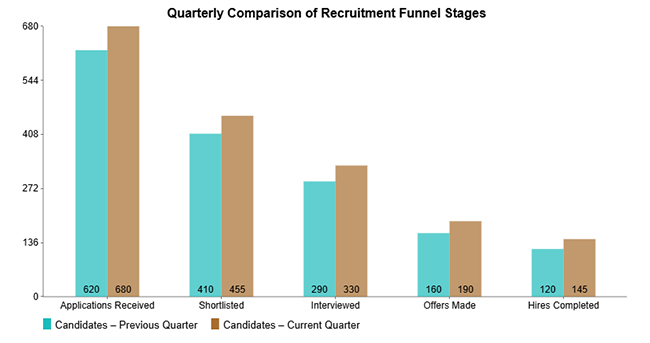
  • Recruitment Funnel Comparison

This Clustered Column Chart tracks candidate progression through each hiring stage, comparing last quarter’s figures against the current quarter to assess process improvement.

Example Insight: Reveals where applicants drop off and where conversion improved, giving recruiters a clear lens for process optimization.
Data Collection Methods and Techniques
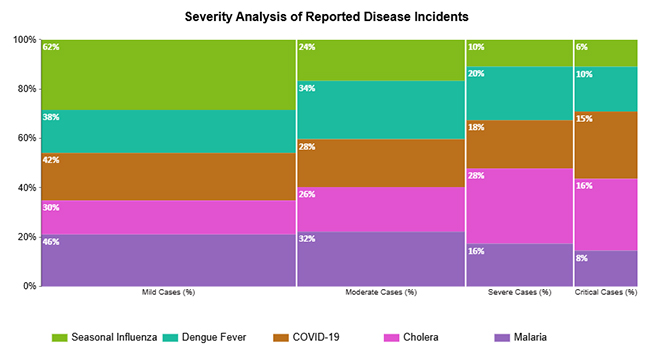
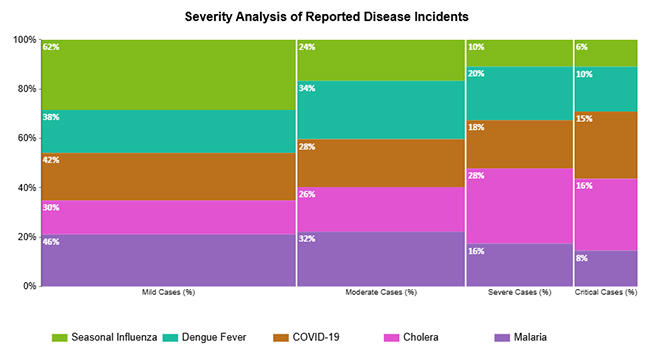
  • Disease Severity Analysis

This Mosaic Plot distributes illnesses across severity levels, from mild through critical, showing how each disease contributes to each tier of patient impact.

Example Insight: Highlights which diseases drive severe and critical case volumes, helping healthcare teams prioritize resource allocation.
Data Collection Methods and Techniques
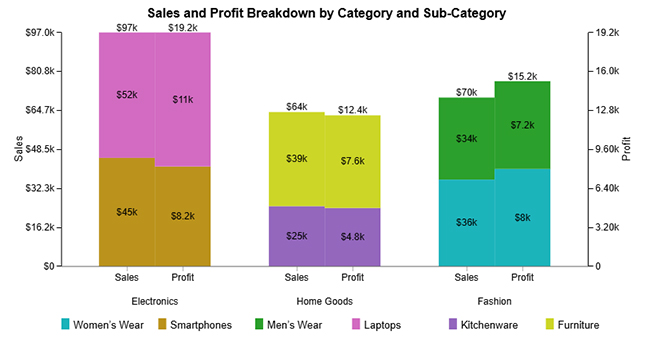
  • Sales and Profit Breakdown

This Clustered Stacked Bar Chart places revenue and profit side by side across product categories and sub-categories, revealing where margin gaps exist within revenue.

Example Insight: Identifies both high-performing segments and low-margin categories to sharpen pricing and product mix decisions.
Data Collection Methods and Techniques
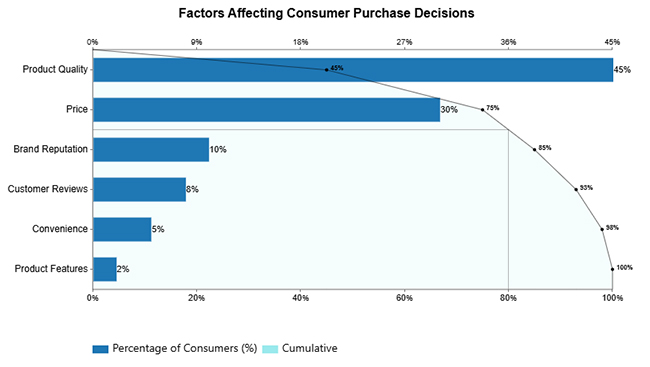
  • Consumer Purchase Decision Factors

This Pareto Bar Chart ranks the factors that drive buying behavior by relative weight, making it easy to see which drivers dominate and which play a secondary role.

Example Insight: Shows that product utility and price lead purchase decisions, while other factors carry considerably less influence.
Data Collection Methods and Techniques
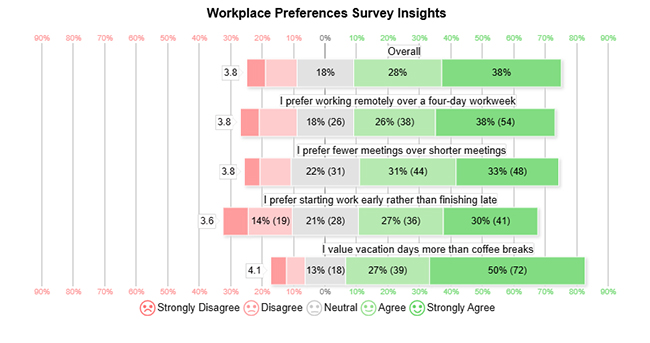
  • Workplace Preferences Survey

This Likert Scale Chart converts employee survey responses on work styles and benefits into a layered view of satisfaction distribution across the workforce.

Example Insight: Surveys majority preferences alongside areas of disagreement, giving HR clear signals for culture and policy refinement.
Data Collection Methods and Techniques

How to Analyze Collected Data Using Google Sheets?

Google Sheets provides an accessible starting point for applying data collection methods and techniques to raw information. The steps below show how to move from a messy dataset to a clear, visual output using built-in formulas and charts.

  • Step 1: Organize Collected Data Properly

Start by arranging your collected data with clear headings, consistent formats, and well-defined categories.

Ensure all entries are standardized to make further analysis easier and more accurate.

Tip: Remove duplicates and fix errors before moving forward.

  • Step 2: Identify Key Data Points for Analysis

Determine which variables and metrics are most relevant to your research objectives.

Focus on selecting data points that align with your goals for better clarity and direction.

Tip: Avoid unnecessary data to keep your analysis focused.

  • Step 3: Apply Formulas to Process Data

Use basic formulas like SUM, AVERAGE, and COUNT to calculate important values from your dataset.

These functions help in summarizing and simplifying large volumes of collected data.

Tip: Always verify formulas to ensure correct results.

  • Step 4: Summarize Data Using Pivot Tables

Use pivot tables to group and organize data into meaningful summaries.

This helps in comparing different categories and identifying patterns efficiently.

Tip: Pivot tables are useful for handling large datasets quickly.

  • Step 5: Visualize Data for Better Understanding

Create charts such as bar graphs, pie charts, or line charts to represent your data visually.

You can also use tools like ChartExpo to enhance your visual analysis with advanced charts.

Tip: Choose visuals that clearly highlight trends and comparisons.
Data Collection Methods and Techniques

Key Insights

  • Seasonal influenza and dengue account for the bulk of mild cases, pointing to a pattern where most infections stay at low severity.
  • Moderate and severe cases distribute more evenly across diseases, with dengue and COVID-19 standing out as significant contributors.
  • Critical cases represent a smaller share of the total, yet COVID-19 and dengue are the primary drivers, reflecting their higher-risk potential.

Benefits of Using Data Collection Methods and Techniques

A well-designed data collection approach pays dividends throughout the entire research or business cycle. When paired with careful data interpretation, the advantages reach far beyond simply having more numbers on hand.

Key benefits include:

  • Improve data quality: Keeps collected information accurate, internally consistent, and ready to support rigorous analysis.
  • Support evidence-based decisions: Ground every major choice in verified facts rather than untested assumptions or intuition.
  • Increase research efficiency: Trims wasted time and resources by streamlining the entire collection and processing workflow.
  • Identify hidden insights: Uncovers patterns and variable relationships that would remain invisible without organized collection.
  • Enhance reporting clarity: Produces structured, readable outputs that stakeholders can quickly interpret and act on.
  • Enable data-driven strategies: Creates the factual foundation from which teams can develop targeted strategies built on real trends.

Challenges and Limitations of Data Collection Methods

Even well-planned data collection methods and techniques have real-world limits. Understanding these constraints matters especially when working with types of qualitative research design, where the researcher’s interpretation can affect results.

Common limitations include:

  • Data collection bias: Subjective choices in question wording, sample selection, or recording can skew results in ways that are hard to detect afterward.
  • Limited sample size: Too few participants reduce the statistical power of findings and limit how broadly conclusions can be applied.
  • High collection costs: Large-scale or in-person data gathering can consume a significant budget, especially when specialized tools or facilities are required.
  • Time-consuming processes: Manual collection approaches and complex study designs often demand more time than initially anticipated.
  • Data privacy concerns: Collecting personal or sensitive information carries legal and ethical obligations that require strict compliance and careful governance.
  • Inconsistent data quality: Mixing data sources or switching methods mid-project often introduces variation that undermines overall dataset reliability.

FAQs

What are the 5 methods of data collection?

The five primary methods are surveys, interviews, observations, experiments, and secondary data sources. Each one suits different goals within the broader framework of data collection methods and techniques for gathering reliable information.

What are the techniques and tools for data collection?

Core techniques include questionnaires, online forms, structured interviews, field observations, and document analysis. Supporting tools range from basic spreadsheet software to dedicated data management and analysis platforms.

What are the 4 principles of data collection?

The four guiding principles are accuracy, reliability, validity, and consistency. Together, they ensure that whatever data collection methods are applied, the resulting dataset is trustworthy enough to inform sound decisions.

Wrap Up

The quality of any analysis rests on the quality of the data feeding it. That is why data collection methods and techniques deserve serious attention at every stage, from defining what you need to validating what you gathered. Choosing the right approach reduces noise, cuts wasted effort, and makes findings far easier to act on.

Whether you are a researcher designing a study or a business team tracking performance, structured collection practices produce results you can rely on. The frameworks covered in this guide, combined with tools like Google Sheets, give you a practical path from raw information to real insight.

How much did you enjoy this article?

PBIAd1
Start Free Trial!
161385

Related articles

next previous
Data Analytics11 min read

Measuring Workforce Productivity for Insightful Analysis

Measuring Workforce Productivity helps businesses track performance and boost efficiency. Explore key methods, formulas, and metrics. Read on!

Data Analytics10 min read

Software Testing Metrics: A Modern Approach

Software testing metrics measure quality, track defects, and guide release decisions. Explore formulas, KPIs, and examples. Read on!

Data Analytics8 min read

Economic Indicators Examples: A Complete Guide

Economic indicators examples reveal how economies grow, contract, and shift. Learn types, top indicators, and how to visualize data. Read on!

Data Analytics10 min read

How to Calculate Closing Costs: Easy Formula and Visuals

How to calculate closing costs correctly before any deal closes. Compare fees, plan your budget, and stay in control. Read on now!

Data Analytics10 min read

How to Normalize Data: Step-by-Step Guide

How to normalize data transforms raw datasets into reliable insights. Explore methods, best practices, and step-by-step techniques. Read on!

ChartExpo logo

Turn Data into Visual
Stories

CHARTEXPO

  • Home
  • Gallery
  • Videos
  • Services
  • Pricing
  • Contact us
  • FAQs
  • Privacy policy
  • Terms of Service
  • Sitemap

TOOLS

  • ChartExpo for Google Sheets
  • ChartExpo for Microsoft Excel
  • Power BI Custom Visuals by ChartExpo
  • Word Cloud

CATEGORIES

  • Bar Charts
  • Circle Graphs
  • Column Charts
  • Combo Charts
  • Comparison Charts
  • Line Graphs
  • PPC Charts
  • Sentiment Analysis Charts
  • Survey Charts

TOP CHARTS

  • Sankey Diagram
  • Likert Scale Chart
  • Comparison Bar Chart
  • Pareto Chart
  • Funnel Chart
  • Gauge Chart
  • Radar Chart
  • Radial Bar Chart
  • Sunburst Chart
  • see more
  • Scatter Plot Chart
  • CSAT Survey Bar Chart
  • CSAT Survey Chart
  • Dot Plot Chart
  • Double Bar Graph
  • Matrix Chart
  • Multi Axis Line Chart
  • Overlapping Bar Chart
  • Control Chart
  • Slope Chart
  • Clustered Bar Chart
  • Clustered Column Chart
  • Box and Whisker Plot
  • Tornado Chart
  • Waterfall Chart
  • Word Cloud
  • see less

RESOURCES

  • Blog
  • Resources
  • YouTube
SIGN UP FOR UPDATES

We wouldn't dream of spamming you or selling your info.

© 2026 ChartExpo, all rights reserved.