Categories

It is exciting to create charts that display information in an eye-catching way. However, it can be frustrating when the labels on the axes are missing or look dull.
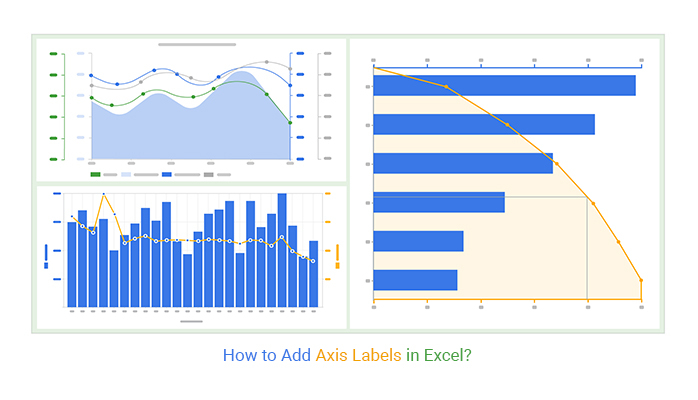


Honestly, nobody wants to spend their precious time trying to decipher a chart that resembles hieroglyphics.
Adding axis labels might seem like a mundane task. But it can make a significant difference in the effectiveness and interest of your charts.
It is like giving your chart a voice – it allows your audience to understand what’s being presented. Furthermore, it makes your chart more informative and engaging.
This guide will show you how to effortlessly add axis labels to your chart.
Yes, you read that right. You can make your charts look as sharp as a tack with a few clicks.
We’ll not only show you how to add axis labels in Excel. You’ll also learn how to create custom labels and format text and numbers.
Charts and graphs in Excel are often used interchangeably to refer to a visual representation of data. Simply put, a chart plots data points on an axis to show trends, proportions, and comparisons. On the other hand, a graph is a type of chart that depicts the relationship between two variables.
Excel offers a variety of chart types that can be used for data analysis, presentation, and reporting. Choosing the right chart can make all the difference in effectively communicating your data to your audience. Here are the best Excel charts for data analysis.
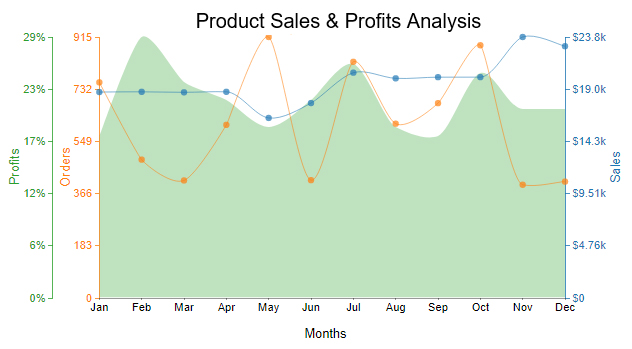
A Multi-Axis Line Chart is a versatile visualization that showcases numerous data sets simultaneously. The chart has a single x-axis that represents time or any other variable. Each data set has its y-axis, which is distinctly labeled. Furthermore, each line is plotted against its corresponding y-axis, providing a comprehensive representation of large data sets.
Below is a product’s sales and profits data.
| Months | Orders | Sales | Profits |
| Jan | 756 | 18766 | 18 |
| Feb | 485 | 18788 | 29 |
| Mar | 412 | 18743 | 24 |
| Apr | 607 | 18788 | 22 |
| May | 915 | 16406 | 19 |
| Jun | 413 | 17765 | 22 |
| Jul | 828 | 20532 | 26 |
| Aug | 611 | 20016 | 19 |
| Sep | 683 | 20122 | 18 |
| Oct | 886 | 20125 | 25 |
| Nov | 397 | 23783 | 21 |
| Dec | 408 | 22942 | 21 |
Here is the Multi-Axis Line Chart visualization of this data.
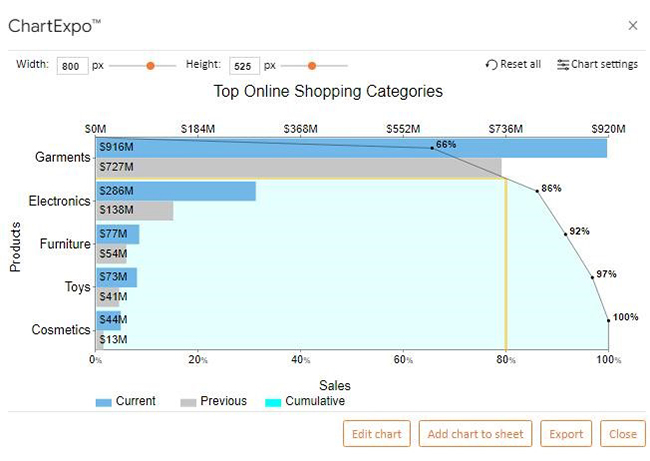
A Pareto Chart combines a bar graph and a line graph to display data hierarchically. It is named after Vilfredo Pareto, who invented the 80/20 rule. He noticed that 80% of the wealth in Italy was owned by 20% of the population.
This chart helps to identify the most significant factors in a data set. The bars represent the size of each category, while the line represents the cumulative percentage.
Below are sales data for the current and previous year’s products.
| Products | Current | Previous |
| Garments | 916 | 727 |
| Electronics | 286 | 138 |
| Cosmetics | 44 | 13 |
| Toys | 73 | 41 |
| Furniture | 77 | 54 |
You can observe how the Pareto Chart maps this data to an insightful visualization.
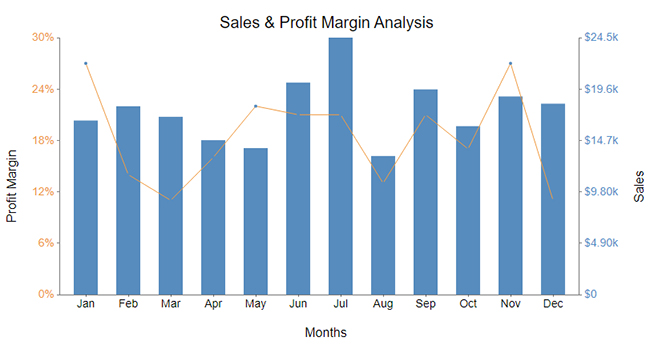
The Double Axis Line Graph and Bar Chart combines a Line Graph and a Bar Chart. It boasts dual y-axes positioned on either side for enhanced clarity. The left y-axis is dedicated to the Bar Chart, while the right y-axis is for the Line Graph. This chart is ideal for displaying two sets of data with different measurement units.
Let’s say you have the monthly revenue data below.
| Months | Sales | Profit Margin % |
| Jan | 16600 | 27 |
| Feb | 17964 | 14 |
| Mar | 16955 | 11 |
| Apr | 14726 | 16 |
| May | 13972 | 22 |
| Jun | 20216 | 21 |
| Jul | 24506 | 21 |
| Aug | 13216 | 13 |
| Sep | 19569 | 21 |
| Oct | 16064 | 17 |
| Nov | 18897 | 27 |
| Dec | 18205 | 11 |
Below is the Double Axis Line Graph and Bar Chart of your data.
Are you tired of wrestling with complex data and struggling to create eye-catching charts in Excel?
I have a solution for you – ChartExpo for Excel.
Say goodbye to mundane spreadsheets and embrace a whole new world of charting possibilities with ChartExpo. ChartExpo revolutionizes your Excel experience by taking you into the realm of creativity and visualization. You can effortlessly create insightful charts that will leave your audience mesmerized.
Benefits of Using ChartExpo
How to Install ChartExpo in Excel?
ChartExpo charts and graphs are available both in Google Sheets and Microsoft Excel. Please use the following CTA’s to install the tool of your choice and create beautiful visualizations in a few clicks in your favorite tool.

Let’s say you have sales and profit margin data below.
| Months | Sales | Profit Margin % |
| Jan | 16600 | 27 |
| Feb | 17964 | 14 |
| Mar | 16955 | 11 |
| Apr | 14726 | 16 |
| May | 13972 | 22 |
| Jun | 20216 | 21 |
| Jul | 24506 | 21 |
| Aug | 13216 | 13 |
| Sep | 19569 | 21 |
| Oct | 16064 | 17 |
| Nov | 18897 | 27 |
| Dec | 18205 | 11 |
This data has a secondary axis. Therefore, we use the Double Axis Line Graph and Bar Chart to analyze it efficiently.
How?
Follow these steps to create a Double Axis Line Graph and Bar Chart in Excel with ChartExpo.
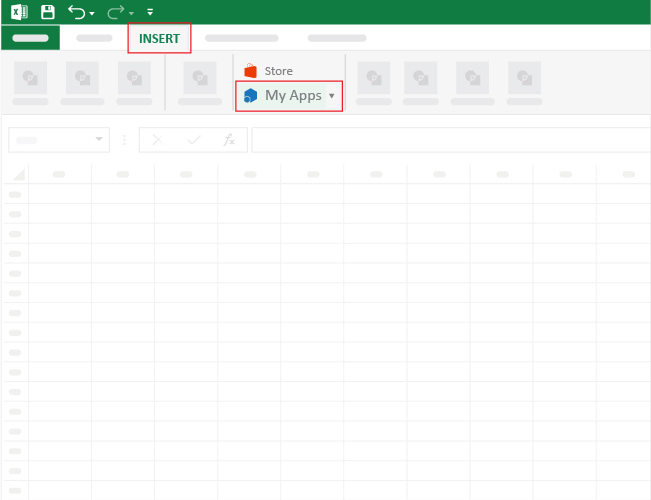
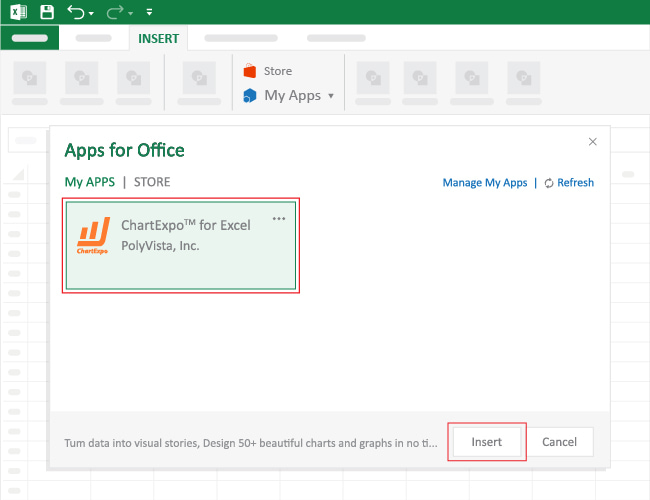


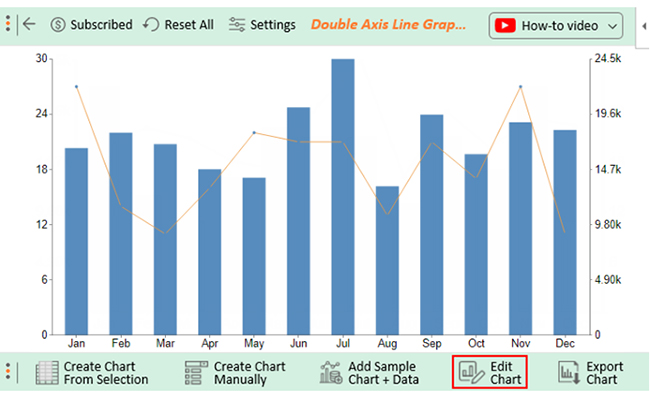
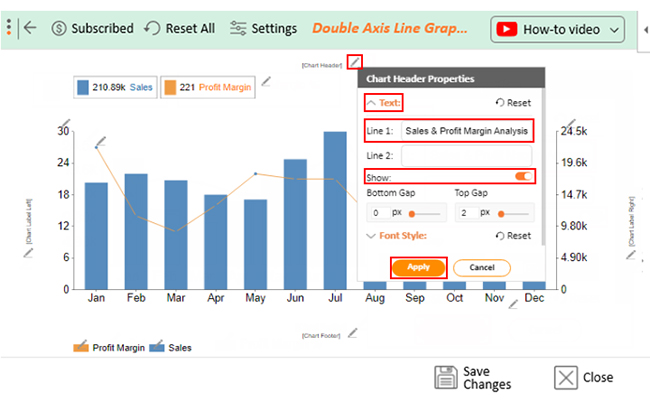
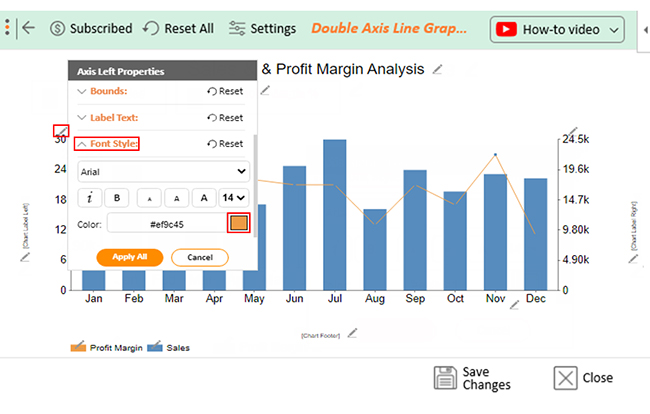
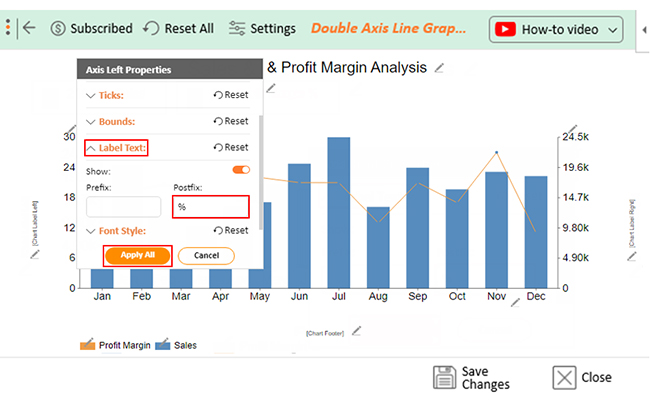
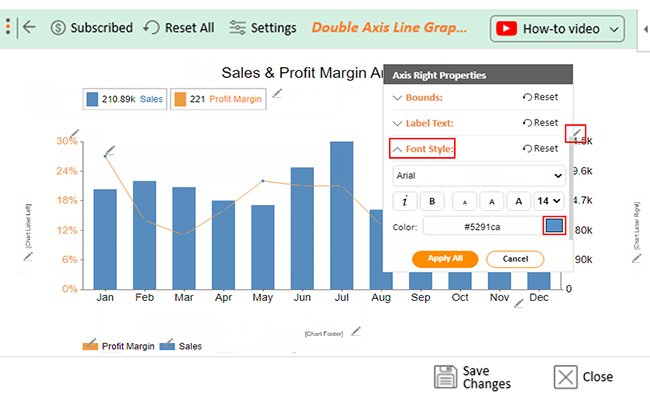
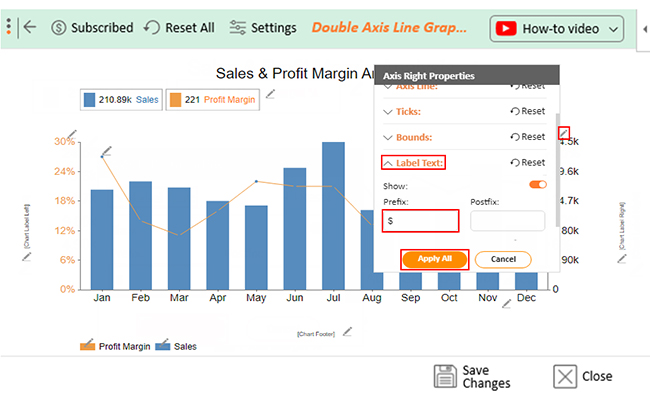
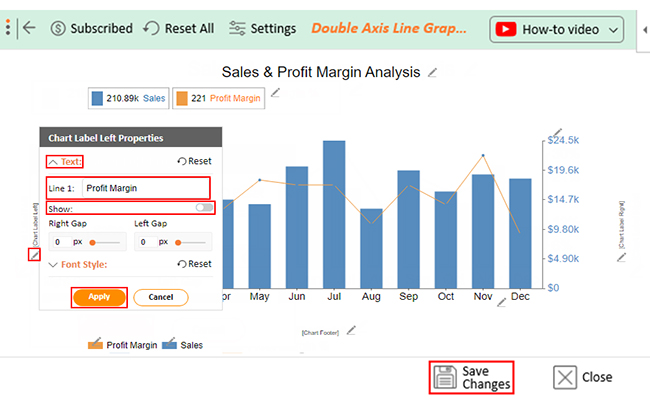
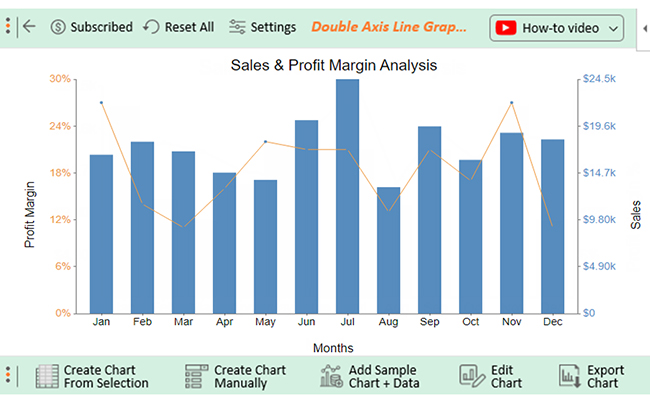


To add axis data labels, use ChartExpo for Excel. ChartExpo allows you to input or modify the labels to represent your data accurately. As a result, this enhances the clarity and comprehension of your charts.
Axis labels on a graph are the textual descriptions assigned to the horizontal (x-axis) and vertical (y-axis) lines. They provide context and clarity to the plotted data points, helping to identify the represented variables.
To add a legend to your chart in Excel:
In conclusion, adding axis labels in Excel is fundamental to creating clear and meaningful charts. Axis labels provide context and understanding of the data points displayed on the chart. This enables viewers to interpret and analyze the information effectively.
You can easily add axis labels to your Excel charts by following the steps outlined in this guide. Consequently, enhance their clarity and usability.
Remember to choose descriptive and easily understandable labels. Also, customize the appearance of the labels to align with your chart’s design. Finally, consider adding additional information or explanations to provide further context.
Additionally, we explored some of the best Excel charts for data analysis. These include the Multi-Axis Line Chart, Pareto Chart, Double Axis Line Graph, and Bar Chart. Each chart type has its unique purpose and can be used to convey different insights effectively.
To simplify the chart creation process and unlock a world of creative possibilities, use ChartExpo for Excel.
Why ChartExpo?
It has a user-friendly interface, diverse chart types, extensive customization options, and affordable pricing.
How much did you enjoy this article?


Imagine you have missing values in a dataset and must estimate them accurately. What do you do? I have a solution – interpolation in Excel. It helps fill the gaps between known data points, making calculations smoother.

What are dynamic tables in Excel, and why do they matter? Excel remains a cornerstone for managing and analyzing information in today’s data-driven age. Dynamic tables are a powerful tool. They make it easier to organize, filter, and analyze data precisely.

Too many plans stay in your head or get lost in long email threads. That’s a recipe for missed deadlines and crossed wires. An action plan template for Excel gives structure to your tasks so you can actually finish what you start.