Categories

Employee turnover rate is a key metric that helps organizations understand how frequently employees leave and are replaced within a specific period.
It reflects not only workforce stability but also the overall health of a company’s culture, management practices, and employee satisfaction.
A high turnover rate may indicate underlying issues such as poor engagement, limited growth opportunities, or ineffective leadership, while a low rate often signals a supportive and well-managed work environment.
Monitoring employee turnover rate allows businesses to identify patterns, address challenges, and make informed decisions to retain top talent. It also plays a crucial role in workforce planning, budgeting, and improving organizational performance.
By analyzing this metric, companies can take proactive steps to enhance employee experience and build a more productive and committed workforce.
Definition: Employee turnover rate is a metric that measures the percentage of employees who leave an organization during a specific period and are replaced by new hires.
It helps businesses understand how often staff changes occur within their workforce. This rate includes both voluntary exits, such as resignations, and involuntary ones, like terminations.
By tracking employee turnover rate, organizations can evaluate workforce stability, identify potential issues, and take steps to improve employee retention and overall workplace satisfaction.
Employee turnover rate directly reflects how stable and efficient an organization is in managing its workforce. It impacts overall performance, costs, and the ability to sustain long-term growth.
Employee turnover can occur for many reasons, and understanding its different types helps organizations identify underlying issues and improve retention strategies. Each type provides insight into employee behavior and business performance.
Use this calculation to measure Employee Turnover Rate and judge retention results. The math is direct, but leaders still need timing and context before acting.
Employee Turnover Rate = Employees Who Left / Average Number of Employees x 100
Follow these calculation steps:
Count all separations within the selected period.
Add the starting and ending headcount, then divide by two.
Divide departures by average headcount.
Multiply the result by 100.
Short-term spikes may differ from yearly trends.
Exclude temporary or irrelevant contract changes.
Numbers alone do not explain underlying causes.
If 12 employees leave and the average headcount is 240:
(12/240) x 100 = 5%
These examples show how Employee Turnover Rate shifts by industry, workforce mix, and operating model.
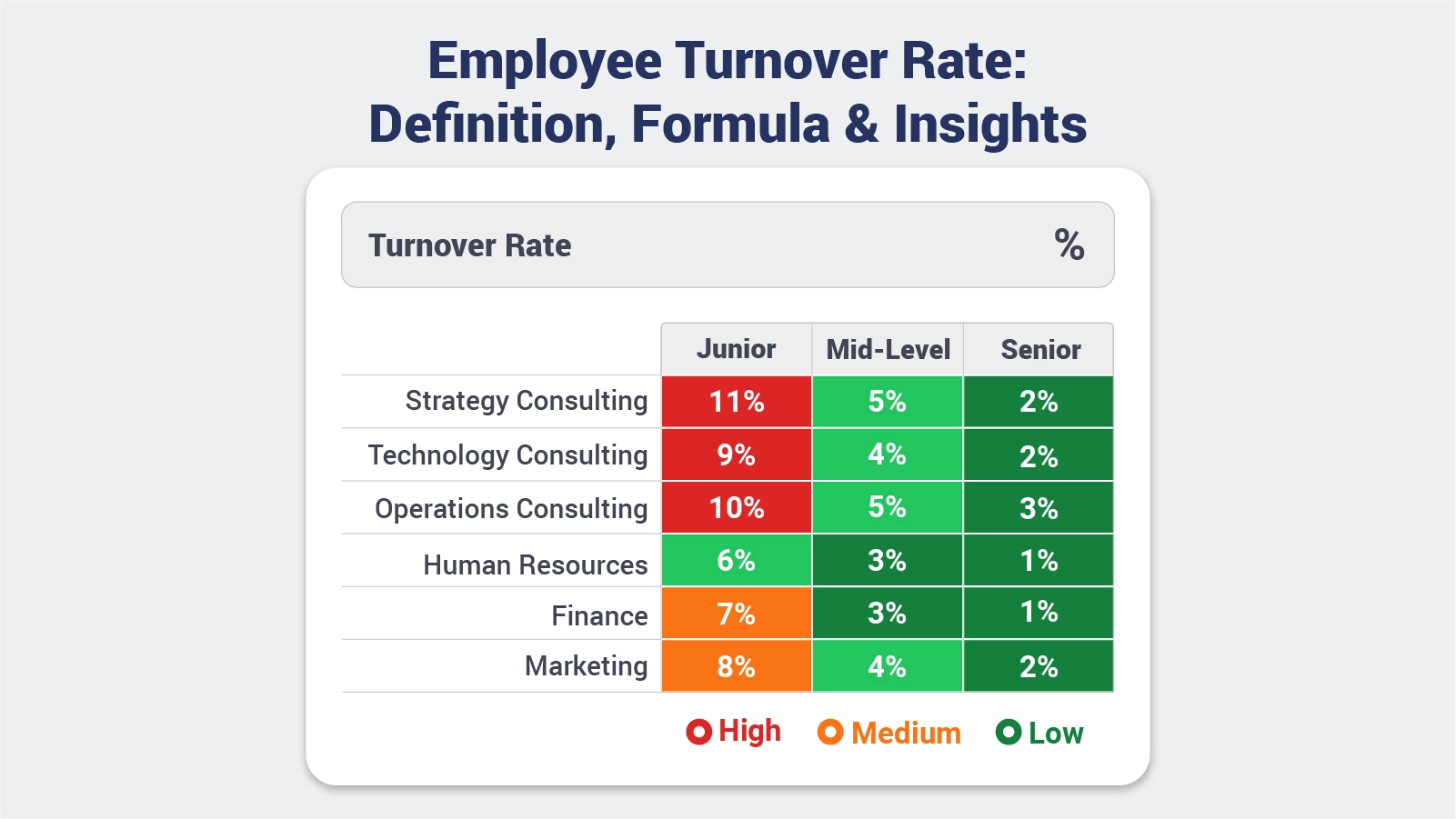
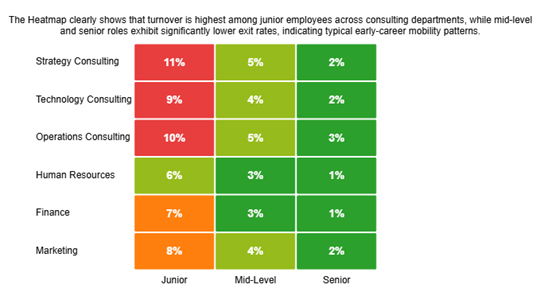
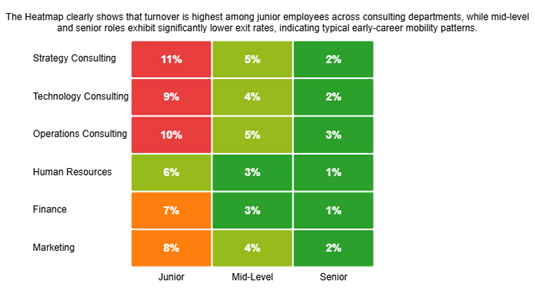
A consulting firm posts a 6% annual Employee Turnover Rate. A department Heatmap shows most exits in junior roles, which suggests early mobility instead of broad dissatisfaction.
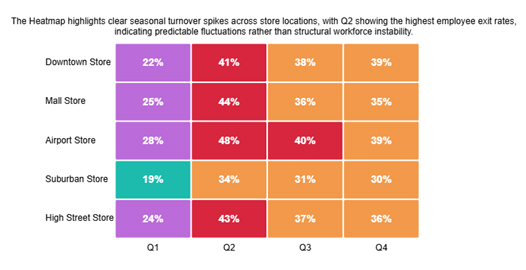
A retail chain reports a 35% annual Employee Turnover Rate. Store comparisons show seasonal peaks, pointing to expected cycles instead of a deeper structural problem.
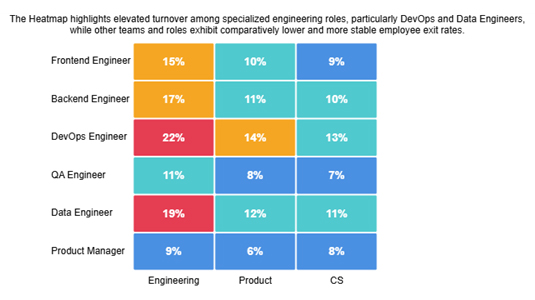
A growing SaaS company records a 14% annual Employee Turnover Rate. Role views show more exits among specialized engineers, which pushes leaders to review pay, workload, and support.
Analyzing employee turnover rate in Excel helps HR teams understand workforce trends and make data-driven decisions. Follow these simple steps to calculate and visualize turnover effectively:
Collect relevant data such as employee join and exit dates, departments, and roles.
Input the data into a clean table with columns for Employee Name, Join Date, Exit Date, and Department.
Use the formula: Turnover Rate (%)=Average Number of EmployeesNumber of Departures×100
Apply filters or PivotTables to identify trends in specific teams or months.
Create charts or graphs in Excel to make patterns and insights easy to interpret.
High employee turnover can significantly impact an organization’s productivity, morale, and bottom line. Understanding the root causes is essential for retaining top talent and improving workplace stability.
Here are the main reasons behind a high employee turnover rate:
Reducing employee turnover is essential for maintaining a productive and stable workforce. High turnover not only increases hiring costs but can also disrupt team dynamics and affect overall business performance. By implementing strategic measures, companies can retain top talent and foster long-term growth.
Here are seven effective ways to reduce employee turnover rate:
Tracking Employee Turnover Rate gives leaders more than a simple exit total. It supports better choices across staffing, cost control, retention planning, and day-to-day workforce management.
Consistent methods help teams calculate employee turnover rate correctly and read changes with confidence. The metric matters most when results stay comparable across periods.
There is no single ideal ratio. A suitable level depends on industry, role mix, and labor conditions, and knowledge-based teams usually aim lower.
Divide departures by average headcount, then multiply by 100 to get the percentage.
Retail, hospitality, and service sectors often report higher turnover, while specialized and technology teams usually see lower rates with sharper impact.
Employee Turnover Rate becomes useful when leaders treat it as an operating signal, not a backward report. It shows where exits collect, when risk grows, and which teams need support before turnover disrupts hiring plans, budgets, service levels, manager focus, project continuity, and customer coverage.
Once the metric is measured the same way each time, teams can compare periods, explain shifts, and respond with better pay, clearer management, stronger culture, or tighter planning across the business. The goal is not to force a single number. The goal is to understand movement, assign owners, and act with evidence instead of assumptions.
How much did you enjoy this article?



Primary vs secondary research shapes data quality and analytical outcomes. Learn the key differences and when to use each method. Discover now!

Staff onboarding template: discover how to build, track, and analyze a process that gets new hires productive from day one. Read on!
What are DORA Metrics? Discover the four KPIs every engineering team needs to track delivery speed, stability, and reliability. Read on!