• Home
  • Tools dropdown img
    • Spreadsheet Charts

      • ChartExpo for Google Sheets
      • ChartExpo for Microsoft Excel
    • Power BI Charts

      • Power BI Custom Visuals by ChartExpo
    • Word Cloud

  • Charts dropdown img
    • Chart Category

      • Bar Charts
      • Circle Graphs
      • Column Charts
      • Combo Charts
      • Comparison Charts
      • Line Graphs
      • PPC Charts
      • Sentiment Analysis Charts
      • Survey Charts
    • Chart Type

      • Box and Whisker Plot
      • Clustered Bar Chart
      • Clustered Column Chart
      • Comparison Bar Chart
      • Control Chart
      • CSAT Survey Bar Chart
      • CSAT Survey Chart
      • Dot Plot Chart
      • Double Bar Graph
      • Funnel Chart
      • Gauge Chart
      • Likert Scale Chart
      • Matrix Chart
      • Multi Axis Line Chart
      • Overlapping Bar Chart
      • Pareto Chart
      • Radar Chart
      • Radial Bar Chart
      • Sankey Diagram
      • Scatter Plot Chart
      • Slope Chart
      • Sunburst Chart
      • Tornado Chart
      • Waterfall Chart
      • Word Cloud
    • Google Sheets
      Microsoft Excel
  • Services
  • Pricing
  • Contact us
  • Blog
  • Support dropdown img
      • Gallery
      • Videos
      • Contact us
      • FAQs
      • Resources
    • Please feel free to contact us

      atsupport@chartexpo.com

Categories
All Data Visualizations Data Analytics Surveys
Add-ons/
  • Google Sheets
  • Microsoft Excel
  • Power BI
All Data Visualizations Data Analytics Surveys
Add-ons
  • Google Sheets
  • Microsoft Excel
  • Power BI

We use cookies

This website uses cookies to provide better user experience and user's session management.
By continuing visiting this website you consent the use of these cookies.

Ok

ChartExpo Survey


Home > Blog > Microsoft Excel

How to Create Control Chart in Excel?

Ever seen a process stay stable for days, then suddenly break without warning? That’s where a Control chart in Excel becomes useful.

It tracks data over time using a center line (mean) and control limits (UCL and LCL) to show whether variation is expected or signals a real issue. Instead of reacting after problems appear, it helps you catch changes early.

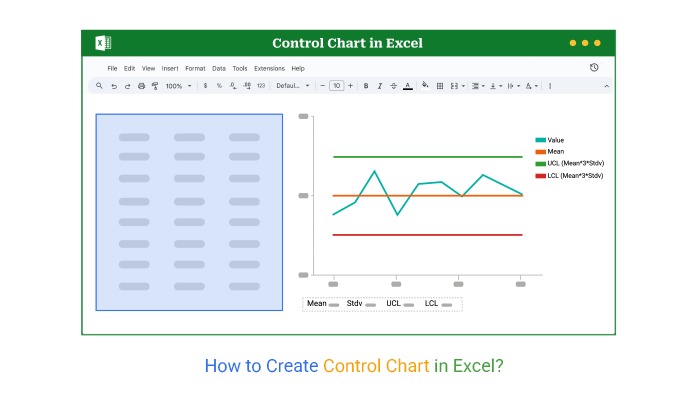
Control Chart in Excel

Because it can be built with simple formulas and standard charts, Excel makes this approach accessible without needing specialized tools.

This guide explains what it is, when to use it, how to build it step by step, and how to read it with confidence.

What is a Control Chart in Excel?

Definition: A Control chart in Excel is a time-based chart used to monitor process performance by plotting data points against a center line (average) and control limits (UCL and LCL).

It helps distinguish between normal variation and unusual changes that may indicate a problem.

Control limits represent the expected range of routine variation. When data points fall outside these limits or form consistent patterns, it signals that the process may no longer be stable.

Excel is commonly used for this analysis because it allows quick setup, flexible calculations, and easy updates as new data is added.

Why Using an Excel Control Chart is Essential?

An Excel Control chart helps teams understand whether a process is stable or starting to shift. Instead of reacting to every fluctuation, it provides a clear signal of when action is actually needed.

A few practical reasons:

  • Early detection of issues: Identifies small variations before they turn into defects, rework, or customer complaints
  • Consistent quality monitoring: Keeps performance aligned across different teams, shifts, and locations using a shared reference
  • Data-driven decisions: Replaces assumptions with measurable evidence, especially in high-pressure situations
  • Faster trend visibility: Highlights shifts and patterns without waiting for delayed reports or summaries
  • Accessible and flexible setup: Can be built, updated, and shared easily without relying on specialized tools
  • Adaptable to different processes: Works across manufacturing, service operations, and business metrics with minimal adjustments

Key Components of a Control Chart in Excel

Data Points

  • Individual measurements collected in sequence, such as daily output, defects, or response times. These points show how the process performs at each moment.

Center Line

  • The average of all data points represents the typical process performance. It acts as a reference to identify shifts or consistent changes over time.

Control Limits (UCL & LCL)

  • Statistical boundaries, usually set at ±3 standard deviations from the mean, that define the expected range of normal variation. Points outside these limits indicate that the process may be experiencing unusual changes.

Common Types of Control Charts in Excel

Control charts in Excel are not one-size-fits-all. Each type is designed for a specific kind of data structure. Choosing the right one depends on how your data is collected and what you want to monitor.

  • I-MR Chart (Individual and Moving Range)

Best for tracking single data points collected over time.

It is commonly used when data is not grouped into batches, such as daily sales, response times, or machine readings.

The I chart shows individual values, while the MR chart tracks how much variation occurs between consecutive points.

  • X-bar and R Chart

Used when data is collected in small subgroups, such as multiple samples from the same batch.

The X-bar chart tracks the average of each subgroup, while the R chart measures the variation within those subgroups.

This type is useful for monitoring consistency within production or repeated sampling processes.

  • P Chart (Proportion Chart)

Used to track the percentage of defective items in a process.

It is based on proportions rather than raw counts, making it useful for quality control situations where results are classified as pass or fail.

It works best when sample sizes are relatively consistent over time.

  • C Chart (Count of Defects)

Used when you are counting the number of defects in a fixed sample size.

For example, tracking the number of errors in reports or defects per inspection unit.

This chart assumes the sample size remains constant across all measurements.

  • U Chart (Defects per Unit)

Used when the number of defects is tracked, but sample sizes vary.

It standardizes defects per unit, making it suitable for processes where volume is not consistent, such as service requests or transaction-based systems.
How to Create a Control Chart in Excel: 7 Easy Steps

The manual build is simple, but it rewards consistency. A Control chart in Excel delivers the most value when formulas, limits, and formatting follow the same structure every time.

The steps below walk through a standard Excel-based setup using built-in functions, resulting in a chart that is statistically sound and easy to maintain.

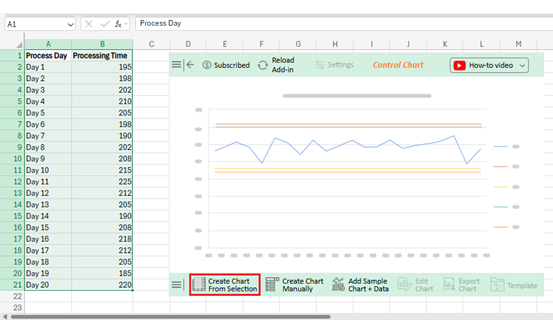
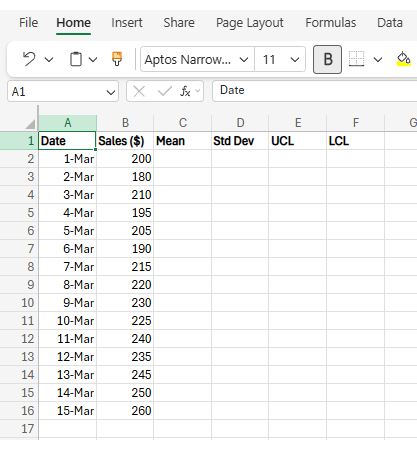
Step 1: Prepare the Data

Start by laying out the values in clear columns. Use a time marker (date, batch, sample number) and the measured results in the next column.

This chart behaves better when the series is clean—no mixed units, no blank rows hiding in the middle.

Control Chart in Excel

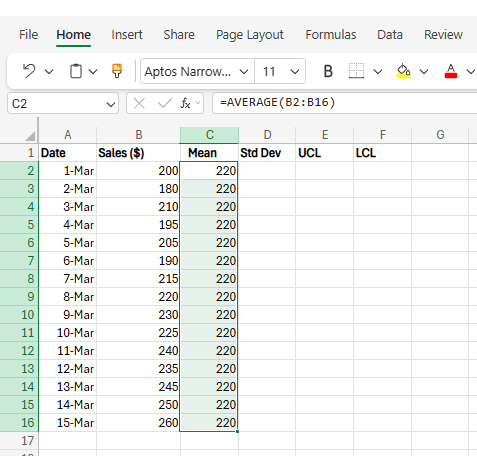
Step 2: Calculate the Center Line (Mean)

Compute the mean of the measured values to set the center line. That average becomes the baseline for the chart, so it needs to reflect the same stable period being monitored.

The chart looks convincing even with bad baselines, so double-check the range before moving on.

Formula used:
=AVERAGE(range)

Control Chart in Excel

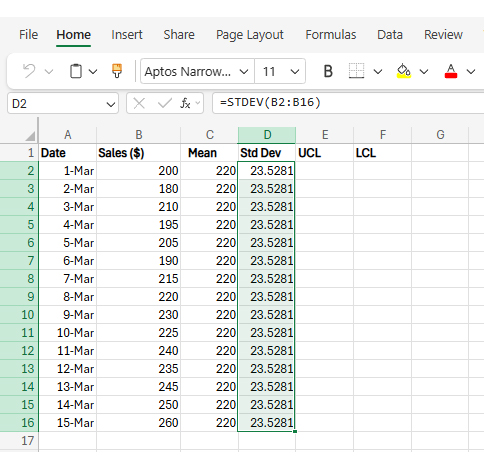
Step 3: Calculate the Standard Deviation

Next, calculate the standard deviation with =STDEV(range) (or =STDEV.S in newer Excel versions).

That value describes how widely the points are spread around the mean, and it feeds the limit calculations. ‘

Without it, the chart can’t place limits that actually reflect the process.

Control Chart in Excel

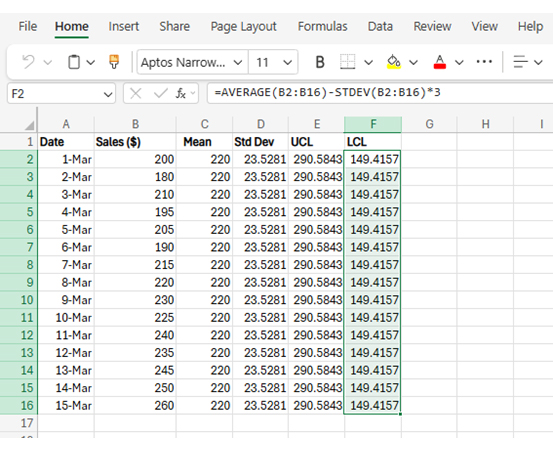
Step 4: Calculate the Control Limits (UCL & LCL)

Set the limits using the mean plus or minus three standard deviations. UCL: =AVERAGE(range) + (STDEV(range) * 3). LCL: =AVERAGE(range) − (STDEV(range) * 3). In a Control chart in Excel, these lines act as guardrails around the mean and help flag behavior that’s outside normal variation.

Control Chart in Excel

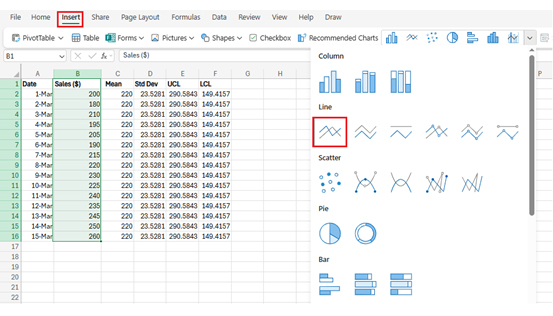
Step 5: Create the Chart

Build the baseline chart from the dataset (Insert → Chart → Line). For anyone searching for how to add a chart in Excel, that menu path is the usual starting point.

The mean and limit lines should be added as separate series, not as hand-drawn shapes.

Control Chart in Excel

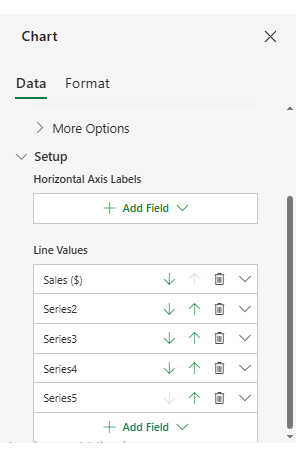
Step 6: Add series for mean, UCL, and LCL

Right-click the chart and choose Select Data, then add series for the mean, UCL, and LCL. If the question is how to select data for a chart in Excel, the key is matching each series name to the correct value range.

Keep the ranges aligned so every line spans the same time axis. That discipline is also how to update a chart in Excel later, without breaking the series when new rows get added.

Control Chart in Excel

Step 7: Customize and Format the Chart

Clean up the presentation: tighten the title, label the axes, and place the legend where it doesn’t block the data.

Use line styles that read well at a glance, such as dashed limit lines and a solid mean line. Convert the source range into an Excel Table so the chart refreshes when new data gets appended.

For teams that need consistent formatting across multiple charts, tools like Chartexpo can help standardize visuals and reduce manual adjustments.

Control Chart in Excel

Key Insights

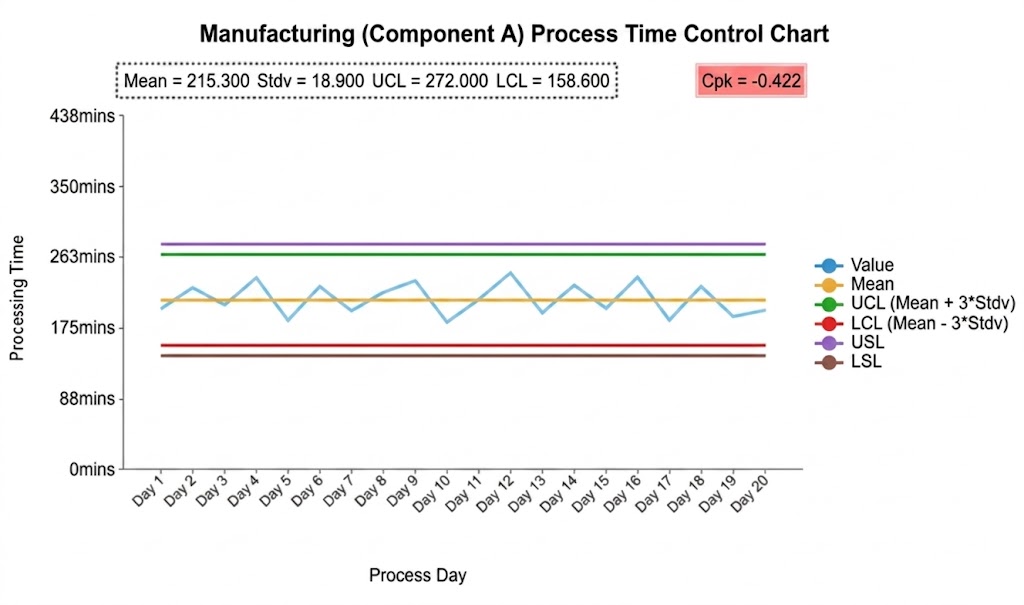
  • All points stay inside the limits, which suggests short-term stability with ordinary variation overall.
  • The mean line sits below the spec midpoint, so the process isn’t centered where it needs to be.
  • A negative Cpk usually means the process is off-center relative to the spec limits and needs adjustment to meet capability targets.

When to Use and When to Avoid the Control Chart in Excel

When to Use It

Use this chart when you need to track how a process behaves over time.

  • Data is time-based: Daily, hourly, or batch-level measurements with a clear sequence
  • You want to monitor stability: To check whether the variation is normal or signals a problem
  • Early detection matters: When small shifts can lead to defects, delays, or cost increases
  • Process consistency is important: Useful in quality control, operations, and performance tracking
  • You need ongoing monitoring: Not just one-time analysis, but continuous observation

When to Avoid It

Avoid using this chart when the data or goal doesn’t match its purpose.

  • No time sequence in data: If data is not ordered over time, patterns become meaningless
  • Comparing categories or groups: Use bar charts or comparison charts instead
  • Looking for totals or summaries only: These charts are not designed for aggregation
  • Very small or inconsistent datasets: Limits become unreliable with insufficient data
  • One-time analysis: If you don’t need ongoing monitoring, simpler charts work better

Examples of the Control Chart in Excel

An SPC chart in Excel applies far beyond factory floors. Any workflow that produces repeatable measurements, such as time, volume, defects, or delay,s can be monitored using the same approach.

Manufacturing

Used to track defects per shift or batch.

  • Detects sudden spikes caused by tooling issues, material changes, or machine calibration
  • Helps prevent the continued production of defective output
Manufacturing Control Chart

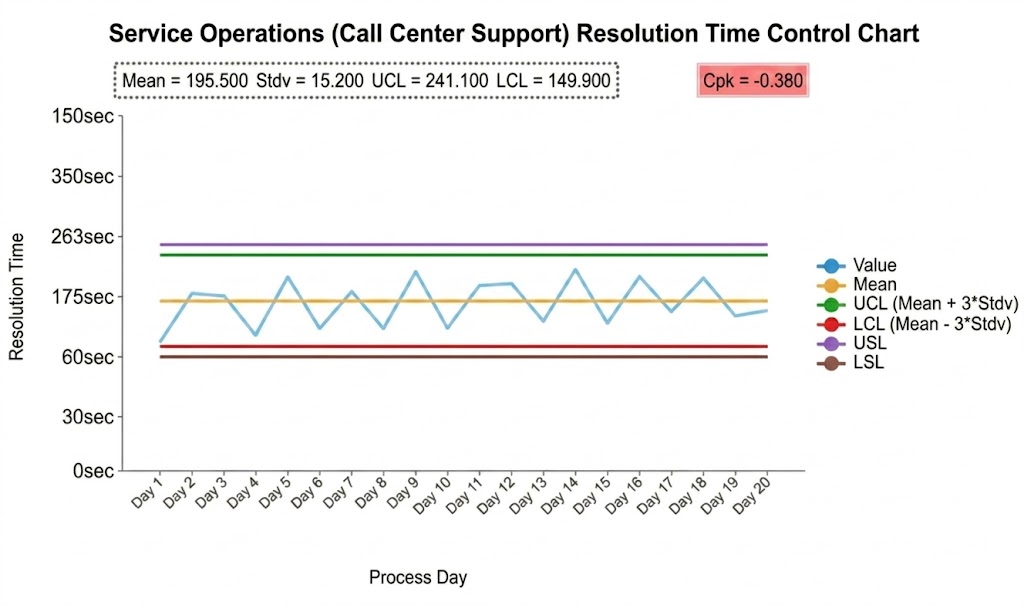
Service Operations

Used to monitor response time or cycle time.

  • Identifies gradual delays caused by staffing gaps or system slowdowns
  • Highlights performance drops before service levels are affected
Service Operations Control Chart

Sales and Operations

Used to track daily orders, call volume, or fulfillment time.

  • Separates normal fluctuations from real demand shifts
  • Helps evaluate the impact of promotions, policy changes, or capacity limits
Sales and Operations Control Chart

How to Read a Control Chart in Excel?

Building this Excel chart is only half the work. Reading it well is where teams earn the benefit, because the goal is spotting real signals without chasing noise.

Look for these signals when reviewing the plot:

  • Points outside control limits

When data points fall above or below the UCL or LCL, it indicates special-cause variation. This usually requires immediate investigation to identify the root cause.

  • Runs on one side of the center line

A sequence of points consistently above or below the mean suggests a shift in the process, even if values remain within limits.

  • Upward or downward trends

A steady increase or decrease over time often signals gradual process drift rather than random variation.

  • Repeating or unusual patterns

Cycles, clusters, or irregular gaps can indicate external influences such as seasonal effects, system changes, or workflow interruptions.

Once these patterns are understood, teams can choose when to intervene and when to let the process run. Overreacting is expensive. Ignoring real signals is worse.

Mistakes to Avoid When Creating an Excel Control Chart

Excel is flexible, but it isn’t a statistics platform. Manual charts can work well, yet the approach starts to creak as the dataset grows and the audience widens.

  • Frequent manual updates

Rebuilding formulas or adjusting ranges every time new data is added increases the risk of errors and makes the process hard to maintain.

  • Weak statistical handling

Excel can calculate basic limits, but it lacks deeper SPC capabilities. This can lead to oversimplified analysis when more advanced interpretation is required.

  • Performance issues with large datasets

As data grows, workbooks can slow down, making charts harder to update, refresh, and troubleshoot efficiently.

  • Formula and range errors

Manually defined limits and copied formulas can silently break when ranges shift, leading to incorrect signals without an obvious warning.

  • Poor collaboration structure

When multiple users edit the same file, version conflicts, inconsistent updates, and approval issues often reduce reliability.

Best Practices for Creating an Excel Control Chart

  • Keep data in a strict time sequence

Always arrange data in chronological order (date, batch, or sample number). If the sequence is incorrect, trends and signals become misleading.

  • Use clean and consistent datasets

Avoid mixed units, missing values, or irregular intervals. Clean data ensures that variation reflects the process, not data quality issues.

  • Separate raw data from calculations

Keep input data, calculations (mean, standard deviation), and chart outputs in different sections. This reduces formula errors and makes updates easier.

  • Use dynamic ranges or Excel Tables

Convert your dataset into an Excel Table so new rows automatically update the chart. This prevents manual range adjustments and reduces setup errors.

  • Don’t confuse control limits with targets

Control limits (UCL and LCL) represent natural process variation, not performance goals. Mixing them with business targets leads to incorrect decisions.

FAQs

Can I make a Control chart in Excel?

Yes. Excel can build it with formulas and line charts, and a Control Chart template in Excel can speed the setup. The tradeoff is that the workflow stays mostly manual unless an add-in is used.

How to create a moving range Control chart in Excel?

To create a moving range:

  1. List your data in order.
  2. Calculate the moving ranges (difference between consecutive points).
  3. Compute the average and control limits for the moving range.
  4. Insert a line chart with your data points.
  5. Add the average line and UCL/LCL for the moving range as separate series.
  6. Format for clarity—title, axes, and legend.

Wrap Up

A Control chart in Excel is a practical way to monitor performance and detect variation before it turns into a real issue. By using the mean, standard deviation, and control limits, it becomes easier to distinguish normal fluctuation from signals that need attention.

Excel also makes it simple to update the chart as new data is added, which supports ongoing tracking without rebuilding the setup each time. However, accuracy depends on clean inputs and correct formulas. If the data structure is weak, the output can easily become misleading.

For teams working with multiple processes or repeated reporting, consistency becomes important. Add-ins like ChartExpo can help standardize charts, reduce manual effort, and improve visual clarity across datasets.

Overall, a well-built control graph supports better decision-making by turning raw data into a clear view of process behavior, helping teams stay focused on real issues instead of noise.

How much did you enjoy this article?

ExcelAd2
Start Free Trial!
157858

Related articles

next previous
Microsoft Excel8 min read

Frequency Chart in Excel: Easy Methods Explained

Learn how to create and use frequency charts in Excel to simplify data analysis, visualize distributions, and make better business decisions with clear insights.

Microsoft Excel9 min read

How to Identify Box Plot Outliers? Easy Steps

Learn what box plot outliers in Excel are, how to detect them using the IQR method, and how to interpret them with real-world examples and Excel use cases.

Microsoft Excel11 min read

Data Validation in Excel: A Complete Guide

Data validation in Excel prevents errors before they spread. Explore types, setup steps, removal, and benefits for cleaner data. Read on!

Microsoft Excel9 min read

How to Use SUMPRODUCT in Excel: Formula & Insights

How to use SUMPRODUCT in Excel for weighted averages, conditionals, and multi-range calculations. Master the syntax and examples. Read on!

Microsoft Excel9 min read

15 Financial Charts Every Business Should Use

Explore 15 best financial charts to track revenue, costs, and profits, simplifying analysis and helping businesses make smarter financial decisions.

ChartExpo logo

Turn Data into Visual
Stories

CHARTEXPO

  • Home
  • Gallery
  • Videos
  • Services
  • Pricing
  • Contact us
  • FAQs
  • Privacy policy
  • Terms of Service
  • Sitemap

TOOLS

  • ChartExpo for Google Sheets
  • ChartExpo for Microsoft Excel
  • Power BI Custom Visuals by ChartExpo
  • Word Cloud

CATEGORIES

  • Bar Charts
  • Circle Graphs
  • Column Charts
  • Combo Charts
  • Comparison Charts
  • Line Graphs
  • PPC Charts
  • Sentiment Analysis Charts
  • Survey Charts

TOP CHARTS

  • Sankey Diagram
  • Likert Scale Chart
  • Comparison Bar Chart
  • Pareto Chart
  • Funnel Chart
  • Gauge Chart
  • Radar Chart
  • Radial Bar Chart
  • Sunburst Chart
  • see more
  • Scatter Plot Chart
  • CSAT Survey Bar Chart
  • CSAT Survey Chart
  • Dot Plot Chart
  • Double Bar Graph
  • Matrix Chart
  • Multi Axis Line Chart
  • Overlapping Bar Chart
  • Control Chart
  • Slope Chart
  • Clustered Bar Chart
  • Clustered Column Chart
  • Box and Whisker Plot
  • Tornado Chart
  • Waterfall Chart
  • Word Cloud
  • see less

RESOURCES

  • Blog
  • Resources
  • YouTube
SIGN UP FOR UPDATES

We wouldn't dream of spamming you or selling your info.

© 2026 ChartExpo, all rights reserved.