• Home
  • Tools dropdown img
    • Spreadsheet Charts

      • ChartExpo for Google Sheets
      • ChartExpo for Microsoft Excel
    • Power BI Charts

      • Power BI Custom Visuals by ChartExpo
    • Word Cloud

  • Charts dropdown img
    • Chart Category

      • Bar Charts
      • Circle Graphs
      • Column Charts
      • Combo Charts
      • Comparison Charts
      • Line Graphs
      • PPC Charts
      • Sentiment Analysis Charts
      • Survey Charts
    • Chart Type

      • Box and Whisker Plot
      • Clustered Bar Chart
      • Clustered Column Chart
      • Comparison Bar Chart
      • Control Chart
      • CSAT Survey Bar Chart
      • CSAT Survey Chart
      • Dot Plot Chart
      • Double Bar Graph
      • Funnel Chart
      • Gauge Chart
      • Likert Scale Chart
      • Matrix Chart
      • Multi Axis Line Chart
      • Overlapping Bar Chart
      • Pareto Chart
      • Radar Chart
      • Radial Bar Chart
      • Sankey Diagram
      • Scatter Plot Chart
      • Slope Chart
      • Sunburst Chart
      • Tornado Chart
      • Waterfall Chart
      • Word Cloud
    • Google Sheets
      Microsoft Excel
  • Services
  • Pricing
  • Contact us
  • Blog
  • Support dropdown img
      • Gallery
      • Videos
      • Contact us
      • FAQs
      • Resources
    • Please feel free to contact us

      atsupport@chartexpo.com

Categories
All Data Visualizations Data Analytics Surveys
Add-ons/
  • Google Sheets
  • Microsoft Excel
  • Power BI
All Data Visualizations Data Analytics Surveys
Add-ons
  • Google Sheets
  • Microsoft Excel
  • Power BI

We use cookies

This website uses cookies to provide better user experience and user's session management.
By continuing visiting this website you consent the use of these cookies.

Ok

ChartExpo Survey


Home > Blog > Surveys

7-Point Likert Scale: Step by Step Guide

The 7-point Likert Scale is a versatile survey tool used to measure the intensity of opinions, attitudes, and perceptions.

With seven response options ranging from Strongly Disagree to Strongly Agree, it captures subtle differences in participant viewpoints.

Main Image 7 Point Likert Scale

This scale provides granular insights, helping researchers detect small shifts in sentiment and understand nuanced perspectives.

Widely used across disciplines, the 7-point scale is ideal for surveys, research studies, and feedback analysis, offering a clear and structured way to quantify opinions.

In this blog, you’ll learn:

What is a 7-point Likert Scale?

Definition: A 7-point Likert scale is a survey tool that measures attitudes or agreement with seven options, from Strongly Disagree (1) to Strongly Agree (7), including a neutral midpoint. This expanded range provides higher precision, sensitivity, and insights into subtle differences in opinions, making it ideal for research and surveys.

Common 7-Point Scale Structure:

You’re likely to recommend our brand to your family and friends.

  • 1 = Strongly Disagree
  • 2 = Disagree
  • 3 = Partially Disagree
  • 4 = Neutral
  • 5 = Partially Agree
  • 6 = Agree
  • 7 = Strongly Agree

Why is using a Seven-point Response Scale Effective?

A seven-point response scale is used because it offers a balanced range of response options, capturing a broader spectrum of attitudes, opinions, and behaviors.

This scale allows for greater granularity and precision in data, making it easier to detect subtle differences and providing more reliable and valid results in research studies. Additionally, it reduces central tendency bias and enables respondents to express their feelings more accurately.

How to Create a 7-point Likert Scale?

A 7-point rating scale captures opinions with more nuance than a 5-point scale. Follow these steps to create an effective survey:

Step 1: Define Your Questions

List clear, focused statements. Example:

  • “The product met my expectations.”
  • “I am likely to recommend this product.”

Step 2: Assign Response Options

Label options from negative to positive:

  1. Strongly Disagree
  2. Disagree
  3. Somewhat Disagree
  4. Neutral
  5. Somewhat Agree
  6. Agree
  7. Strongly Agree

Step 3: Number Responses

Assign numeric values for analysis:

Option Value
Strongly Disagree 1
Disagree 2
Somewhat Disagree 3
Neutral 4
Somewhat Agree 5
Agree 6
Strongly Agree 7

Step 4: Layout & Test

  • Organize in rows (questions) and columns (responses).
  • Test with a small group to ensure clarity and accuracy.

Step 5: Analyze

  • Use mean, median, mode, or visual charts to summarize results.
  • Tools like ChartExpo make visualization fast and professional.

Seven-Point Response Scale Examples and Use Cases

Employee Training Survey Analysis

This 7-point agreement scale analysis shows a strong positive response to the employee training program, with most ratings concentrated in the upper agreement levels (5–7). Overall sentiment indicates high satisfaction, particularly regarding instructor knowledge and training facilities.

Note the difference after visualizing the survey data below.
7-point Likert scale in excel

Product Development Survey Analysis

This 7-point agreement scale analysis indicates generally positive customer sentiment toward the product, with most responses clustered in the higher agreement levels (5–7). Confidence in product quality and purchase intent are strong, though recommendation intent shows slightly more varied opinions.

7-point Likert scale chart

How to Analyze and Interpret a 7-Point Agreement Scale?

Analyzing a 7-point scale involves converting responses into numbers, summarizing trends, and visualizing survey results. Here’s a simple process:

Assign Numeric Values

  • Label responses from 1 (Strongly Disagree) to 7 (Strongly Agree).

Tally Responses

  • Count how many respondents selected each option for every question.

Calculate Central Tendency

  • Mode: Most frequent response.
  • Median: Middle response.
  • Mean: Average score (use cautiously with ordinal data).

Interpret the Results

  • 1–3 → Negative / Disagreement
  • 4 → Neutral
  • 5–7 → Positive / Agreement

Visualize Your Data

  • Tools like ChartExpo in Excel or Google Sheets make it easy to create charts for quick insights.

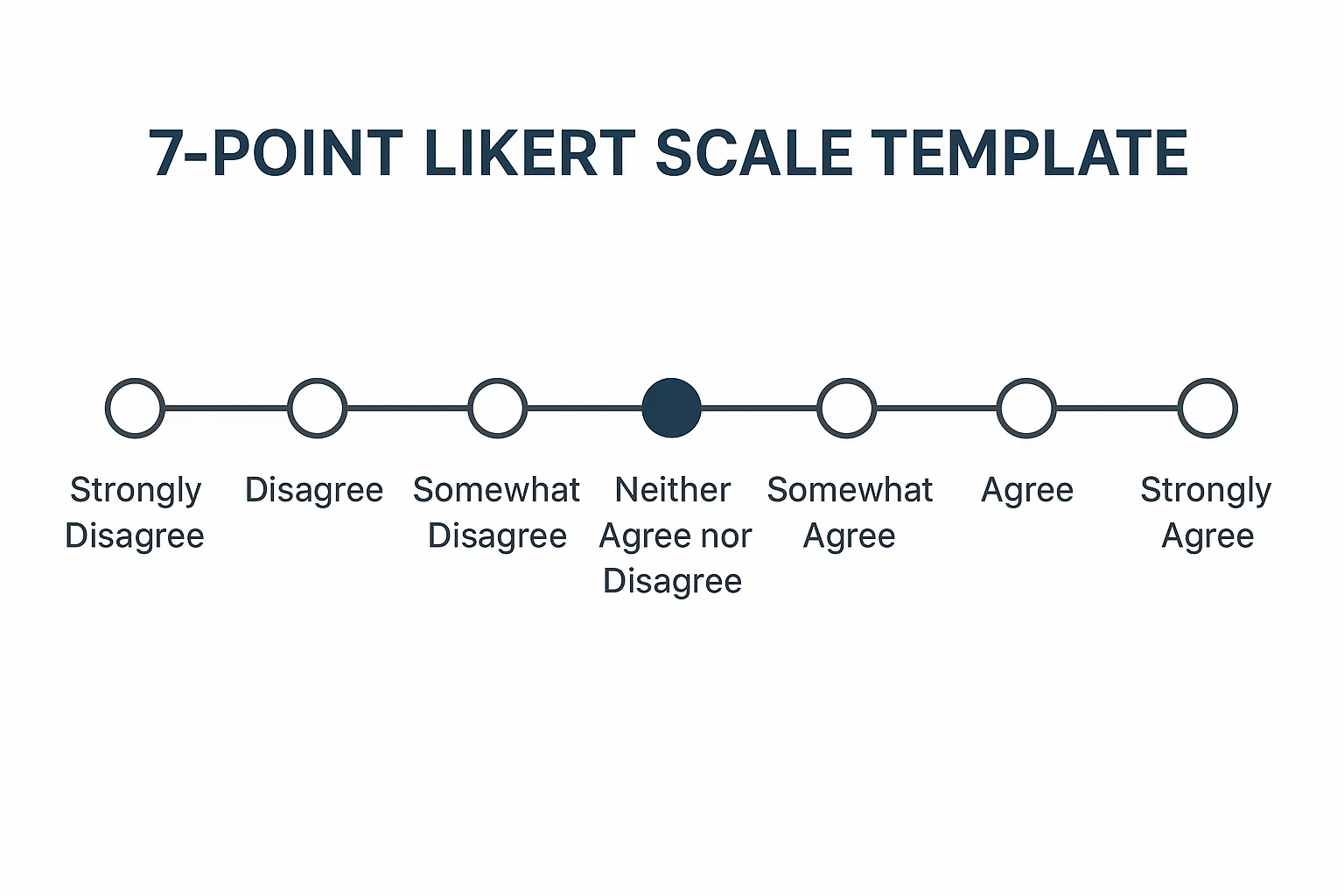
What is a 7-Point Response Scale Template?

The following template provides a ready-to-use structure for a 7-point response scale. You can use it to collect opinions, satisfaction ratings, or feedback efficiently:

7-point Likert scale template

7-Point Sentiment Scale: Best Practices for Interpretation

Group Responses into Meaningful Ranges

  • 1–3: Disagreement
  • 4: Neutral
  • 5–7: Agreement

Clustering simplifies trends and highlights overall sentiment.

Label Each Point Clearly

  • Use consistent labels: Strongly Disagree, Disagree, Somewhat Disagree, Neutral, Somewhat Agree, Agree, Strongly Agree.

Avoid Over-Interpreting Small Differences

  • Minor shifts (e.g., 0.2 in average score) may not be meaningful.
  • Use statistical tests for subtle changes.

Use the Midpoint Meaningfully

  • Treat point 4 as true Neutral.
  • Indicates indecision, lack of knowledge, or genuine neutrality.

Support Interpretation with Visuals

  • Use Likert charts, stacked columns, or heatmaps.
  • Helps reveal patterns, trends, and outliers quickly.

How to score a 7-Level Rating Scale?

  • Assign Numerical Values: Each response option on the scale is assigned a numerical value. For example:
    • Strongly Disagree: 1
    • Disagree: 2
    • Somewhat Disagree: 3
    • Neutral: 4
    • Somewhat Agree: 5
    • Agree: 6
    • Strongly Agree: 7
  • Collect Responses: Collect the responses from your survey or questionnaire.
  • Calculate Individual Scores: For each question, note the numerical value corresponding to the respondent’s answer.
  • Sum or Average Scores: To analyze the data, you can either sum the scores for each respondent to get a total score or average the scores to get a mean score.
  • Interpret Scores: Higher scores typically indicate stronger agreement or a more positive attitude, while lower scores indicate stronger disagreement or a more negative attitude.

Pros and Cons of a 7-point Rating Scale

Advantages

  • Enhanced Sensitivity: More response options detect subtle opinion differences.
  • Neutral Midpoint: Explicit neutral option (point 4) prevents default middle responses.
  • Flexibility: Captures nuanced opinions for complex or multifaceted attitudes.
  • Statistical Analysis: Produces ordinal data suitable for means, medians, and trends.
  • Ease of Interpretation: Balanced structure makes responses intuitive.
  • Consistency Across Studies: A standardized tool allows comparison and meta-analysis.
  • Time Efficiency: Offers depth while remaining concise, keeping respondents engaged.

Disadvantages

  • Limited Differentiation: Responses may still lack precision.
  • Central Tendency Bias: Tendency to choose the midpoint.
  • Acquiescence Bias: Respondents may agree without consideration.
  • Response Set Bias: Patterns in responding can skew results.
  • Interpretation Challenges: Neutral responses may be ambiguous.
  • Cultural Variations: Language and culture can affect responses.
  • Order Effects: Question or option order can influence answers.

FAQs

What does a 7 point scale mean?

A 7-point scale is a type of rating scale that offers seven response options, typically ranging from strongly negative to strongly positive. It’s commonly used in surveys to measure attitudes, satisfaction, or agreement levels.

For example:

  • 1 = Strongly Disagree
  • 2 = Disagree
  • 3 = Slightly Disagree
  • 4 = Neutral
  • 5 = Slightly Agree
  • 6 = Agree
  • 7 = Strongly Agree

What is the 7-point rating system?

A 7-point rating system is a survey scale with seven options, ranging from one extreme to another, like “Strongly Disagree” to “Strongly Agree.” It offers more nuance than a 5-point scale, capturing subtle differences in opinions.

Wrap Up

Analyzing survey responses doesn’t have to be overwhelming. Surveys often include both textual and numerical data, which requires a clear strategy for analysis. A 7-point rating scale simplifies this process by capturing nuanced opinions while remaining easy to interpret. This scale is widely used by data visualization experts to extract actionable insights from survey results.

How much did you enjoy this article?

ExcelAd1
Start Free Trial!
122279

Related articles

next previous
Surveys11 min read

5 Point Likert Scale: Analysis, Interpretation and Examples

Learn how to analyze and interpret a 5-point Likert scale with examples, charts, and step-by-step methods to turn survey responses into actionable insights.

Surveys8 min read

Income Survey Questions: A Detailed Guide

Income survey questions capture financial data while protecting privacy. Master bracket design, response analysis, and visualization tactics. Learn more!

Surveys11 min read

Google Forms Free Online Surveys for Personal Use

Learn how to create and analyze Google Forms free online surveys for personal use. This guide also has valuable tips for creating effective surveys.

Surveys7 min read

Education Survey Questions: From Survey to Visual Report

Education Survey Questions help schools collect structured feedback from students, parents, and staff, with examples, timing, and Power BI analysis.

Surveys11 min read

Likert Satisfaction Scale for Structured Response Analysis

Discover what a Likert Satisfaction Scale is, its structure, and why it’s used in customer and employee feedback surveys.

ChartExpo logo

Turn Data into Visual
Stories

CHARTEXPO

  • Home
  • Gallery
  • Videos
  • Services
  • Pricing
  • Contact us
  • FAQs
  • Privacy policy
  • Terms of Service
  • Sitemap

TOOLS

  • ChartExpo for Google Sheets
  • ChartExpo for Microsoft Excel
  • Power BI Custom Visuals by ChartExpo
  • Word Cloud

CATEGORIES

  • Bar Charts
  • Circle Graphs
  • Column Charts
  • Combo Charts
  • Comparison Charts
  • Line Graphs
  • PPC Charts
  • Sentiment Analysis Charts
  • Survey Charts

TOP CHARTS

  • Sankey Diagram
  • Likert Scale Chart
  • Comparison Bar Chart
  • Pareto Chart
  • Funnel Chart
  • Gauge Chart
  • Radar Chart
  • Radial Bar Chart
  • Sunburst Chart
  • see more
  • Scatter Plot Chart
  • CSAT Survey Bar Chart
  • CSAT Survey Chart
  • Dot Plot Chart
  • Double Bar Graph
  • Matrix Chart
  • Multi Axis Line Chart
  • Overlapping Bar Chart
  • Control Chart
  • Slope Chart
  • Clustered Bar Chart
  • Clustered Column Chart
  • Box and Whisker Plot
  • Tornado Chart
  • Waterfall Chart
  • Word Cloud
  • see less

RESOURCES

  • Blog
  • Resources
  • YouTube
SIGN UP FOR UPDATES

We wouldn't dream of spamming you or selling your info.

© 2026 ChartExpo, all rights reserved.