• Home
  • Tools dropdown img
    • Spreadsheet Charts

      • ChartExpo for Google Sheets
      • ChartExpo for Microsoft Excel
    • Power BI Charts

      • Power BI Custom Visuals by ChartExpo
    • Word Cloud

  • Charts dropdown img
    • Chart Category

      • Bar Charts
      • Circle Graphs
      • Column Charts
      • Combo Charts
      • Comparison Charts
      • Line Graphs
      • PPC Charts
      • Sentiment Analysis Charts
      • Survey Charts
    • Chart Type

      • Box and Whisker Plot
      • Clustered Bar Chart
      • Clustered Column Chart
      • Comparison Bar Chart
      • Control Chart
      • CSAT Survey Bar Chart
      • CSAT Survey Chart
      • Dot Plot Chart
      • Double Bar Graph
      • Funnel Chart
      • Gauge Chart
      • Likert Scale Chart
      • Matrix Chart
      • Multi Axis Line Chart
      • Overlapping Bar Chart
      • Pareto Chart
      • Radar Chart
      • Radial Bar Chart
      • Sankey Diagram
      • Scatter Plot Chart
      • Slope Chart
      • Sunburst Chart
      • Tornado Chart
      • Waterfall Chart
      • Word Cloud
    • Google Sheets
      Microsoft Excel
  • Services
  • Pricing
  • Contact us
  • Blog
  • Support dropdown img
      • Gallery
      • Videos
      • Contact us
      • FAQs
      • Resources
    • Please feel free to contact us

      atsupport@chartexpo.com

Categories
All Data Visualizations Data Analytics Surveys
Add-ons/
  • Google Sheets
  • Microsoft Excel
  • Power BI
All Data Visualizations Data Analytics Surveys
Add-ons
  • Google Sheets
  • Microsoft Excel
  • Power BI

We use cookies

This website uses cookies to provide better user experience and user's session management.
By continuing visiting this website you consent the use of these cookies.

Ok

ChartExpo Survey


Home > Blog > Data Visualization

How to Visualize Data Using Exponential Growth Chart?

Exponential growth happens when values increase at an accelerating rate over time.

Instead of growing by the same amount each time, the increase grows larger with each step.

For example, a value that doubles every year would grow from 2 to 4, then 8, 16, and beyond.

This type of growth is common in areas like population tracking, investment returns, website traffic, and business forecasting.
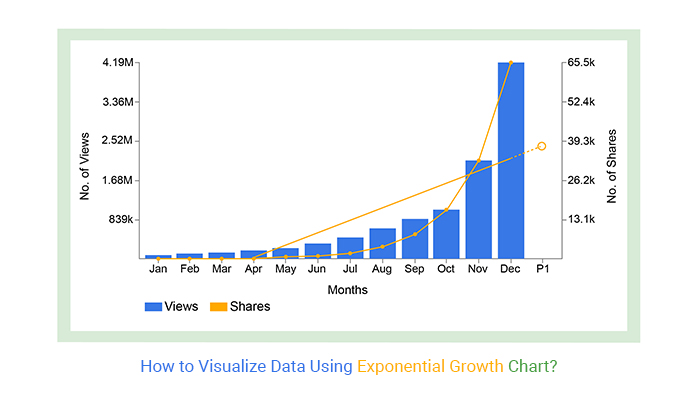
exponential growth chart

Because exponential data changes quickly, visualizing it in a table can make patterns difficult to interpret.

This is where an exponential growth chart becomes useful.

A line chart is one of the most effective ways to display exponential growth because it clearly shows how values accelerate over time.

In Excel, these charts help analysts and businesses track trends, compare growth patterns, and identify rapid changes more easily.

While Excel supports basic line charts, customizing them for clearer exponential trend analysis often requires additional formatting and design adjustments.

What is an Exponential Growth?

Definition: Exponential growth is a pattern where a value increases by the same percentage or factor over equal intervals of time.

Instead of adding a fixed amount each time, the growth builds on the previous value, causing the increase to accelerate as time progresses.

For example, if a value doubles each period, it may grow like this: 2, 4, 8, 16, and so on. Each step becomes larger because the increase is applied to a growing base.

This type of growth is commonly seen in real-world situations such as compound interest, population growth, viral content spread, and business scaling, where changes become more rapid over time rather than staying constant.

Why Exponential Growth Charts Matter

An exponential growth chart is important because it helps convert fast-changing numerical data into a clear visual pattern.

When values increase rapidly, it becomes difficult to perform trend analysis from raw numbers, but a chart makes the acceleration easy to see.

1. Makes Fast Growth Easy to Interpret

  • Converts complex, rapidly increasing data into a simple visual curve
  • Helps identify how quickly values are accelerating over time
  • Reduces confusion when working with large datasets

2. Improves Decision-Making

  • Helps businesses quickly recognize growth opportunities
  • Supports faster responses to trends in sales, traffic, or users
  • Makes it easier to compare performance over time

3. Enhances Forecasting Accuracy

  • Shows how growth is evolving, not just current values
  • Helps predict future outcomes based on trend direction
  • Useful in finance, marketing, and business planning

4. Simplifies Complex Data

  • Turns large datasets into an easy-to-read visual format
  • Reduces the need to scan long tables or spreadsheets
  • Improves clarity in reports and dashboards

Best Charts for Exponential Growth

Exponential growth is best visualized using charts that clearly show accelerating changes over time.

Since the values increase rapidly, the right graph makes it easier to identify growth patterns, trends, and sharp upward movement.

Here are the most effective charts for displaying exponential growth:

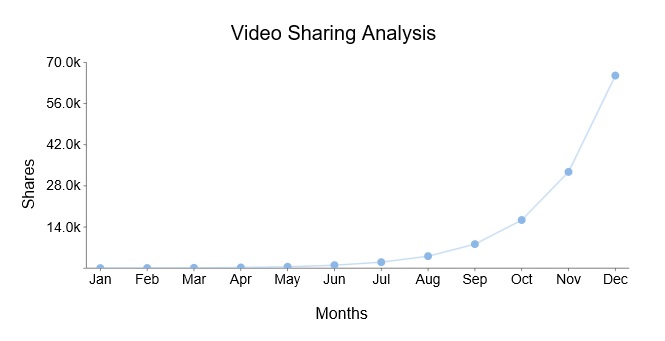
1. Line Chart

A Line Chart is one of the most effective ways to visualize exponential growth. It connects data points over time, making the accelerating curve easy to identify.

As the values increase, the line gradually becomes steeper, clearly showing how growth speeds up over time. This chart works well for:

  • Website traffic growth
  • Revenue forecasting
  • Population tracking
  • Investment performance

Line charts are widely used in Excel because they are simple, readable, and ideal for time-series analysis.
Line Chart

2. Scatter Plot

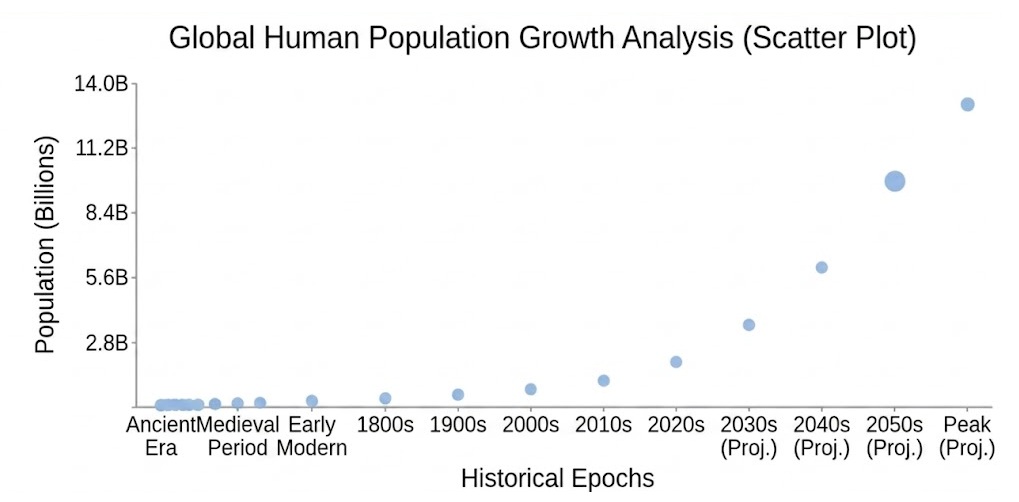
A Scatter Plot helps display exponential growth when analyzing relationships between variables. It shows how one variable changes as another increases.

This chart is useful in scientific analysis, forecasting models, and large datasets where identifying growth behavior is important.
Scatter Plot

How to Create An Exponential Growth Chart in Excel?

Follow these simple steps to build a growth chart in Excel using a Line Chart (Double Axis Line Chart) for better trend visibility:

Step 1: Prepare Your Dataset

Organize your data in a clean table format.

Example:

  • Time period (Month/Year)
  • Growth values (Revenue, users, population, etc.)

Make sure values show increasing progression for exponential behavior.

Step 2: Insert a Line Chart

  • Select your dataset
  • Go to the Insert tab → Line Chart
  • Choose a basic Line Chart or Double Axis Line Chart

This helps visualize rapid growth trends clearly over time.

Step 3: Convert to Double Axis Line Chart (If Needed)

If your dataset contains different scales:

  • Right-click on the second data series
  • Select Format Data Series
  • Enable Secondary Axis

This ensures both small and large values are visible without distortion.

Step 4: Highlight the Growth Pattern

  • Add markers to data points
  • Adjust line thickness for clarity
  • Use contrasting colors to emphasize acceleration

This makes the exponential curve easier to identify.

Step 5: Add Labels and Titles

  • Add chart title
  • Axis labels: Time (X-axis) and Growth Value (Y-axis)
  • Enable data labels if needed for clarity

Step 6: Improve Visualization with Advanced Tools

Excel’s default line charts are basic and often require manual formatting for better clarity.

To simplify this process and get ready-made visualization styles, you can use ChartExpo directly inside Excel for faster chart creation and cleaner design output.

create double axis line and bar chart in excel

Step 7: Final Review

  • Check axis scaling
  • Ensure the trend shows a clear upward acceleration
  • Remove unnecessary grid clutter for cleaner visualization
double axis line and bar chart in excel-036

Video Tutorial: How to Create an Exponential Growth Chart

Applications of the Exponential Growth Charts

Exponential growth appears in many real-world situations where values increase rapidly over time.

Instead of growing by a fixed amount, the growth compounds and becomes larger during each stage.

Here are three common real-life examples:

1. Compound Interest in Savings and Investments

Compound interest is one of the most recognizable examples of exponential growth. Interest is earned not only on the original amount but also on previously accumulated interest.

For example, if you invest money in a savings account with compound interest, your balance grows faster over time because each new interest calculation is based on a larger total.

This is why long-term investing and early retirement savings can grow significantly over time.
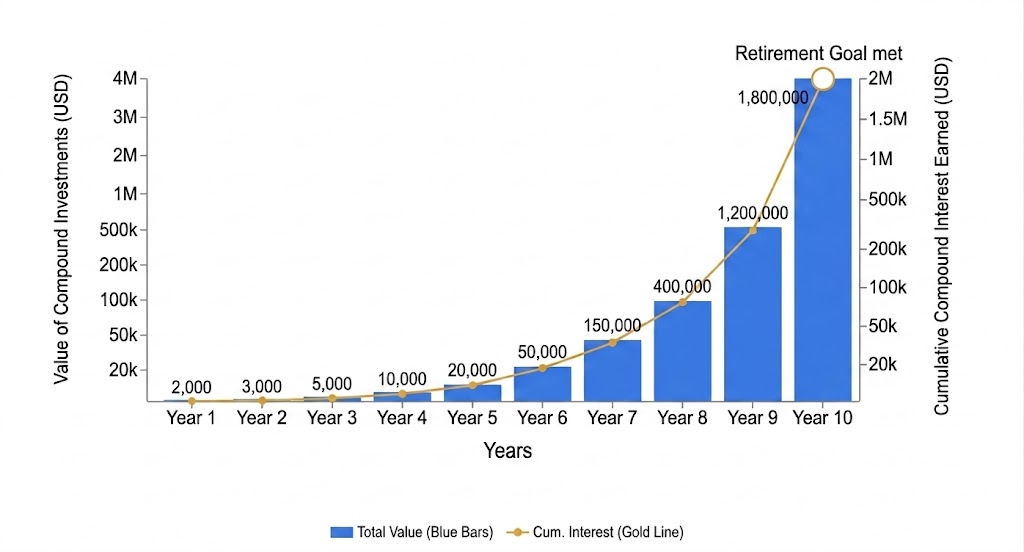
Compound Interest in Savings and Investments

2. Viral Social Media and Website Traffic Growth

Content on social media platforms can spread exponentially when users continue sharing it with others.

For example, a video shared by 100 people may reach thousands within days if each viewer shares it further.

Website traffic can behave similarly when content gains visibility through SEO, referrals, or viral campaigns.

This type of rapid audience expansion is commonly visualized using a chart.
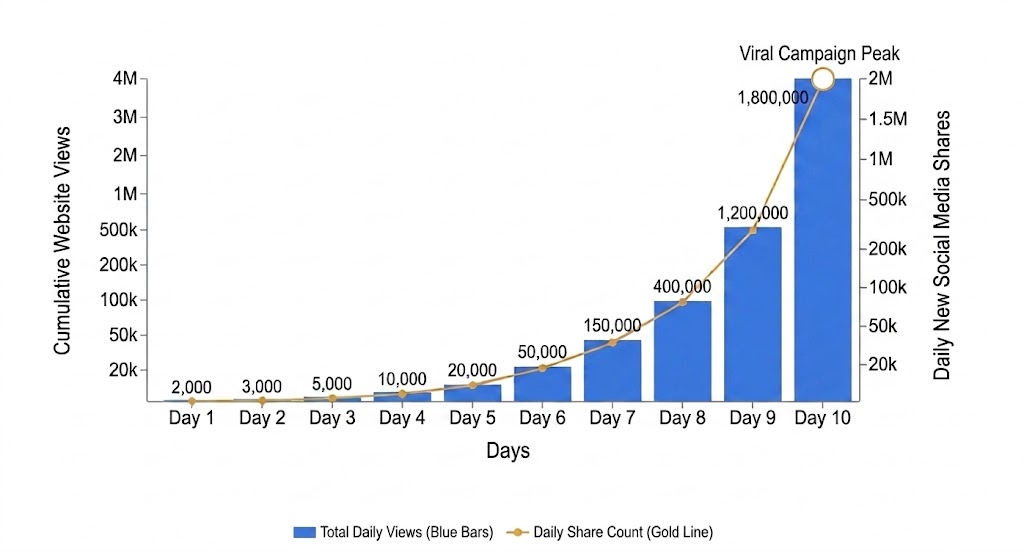
Viral Social Media and Website Traffic Growth

3. Population and Bacterial Growth

Population growth often follows an exponential pattern when resources are widely available. The same behavior can be seen in bacterial reproduction.

For example, a single bacterium can divide into two, then four, eight, and so on within a short period. Because the population doubles repeatedly, the growth accelerates very quickly.

Scientists and researchers use exponential growth models to study population trends, disease spread, and biological processes.
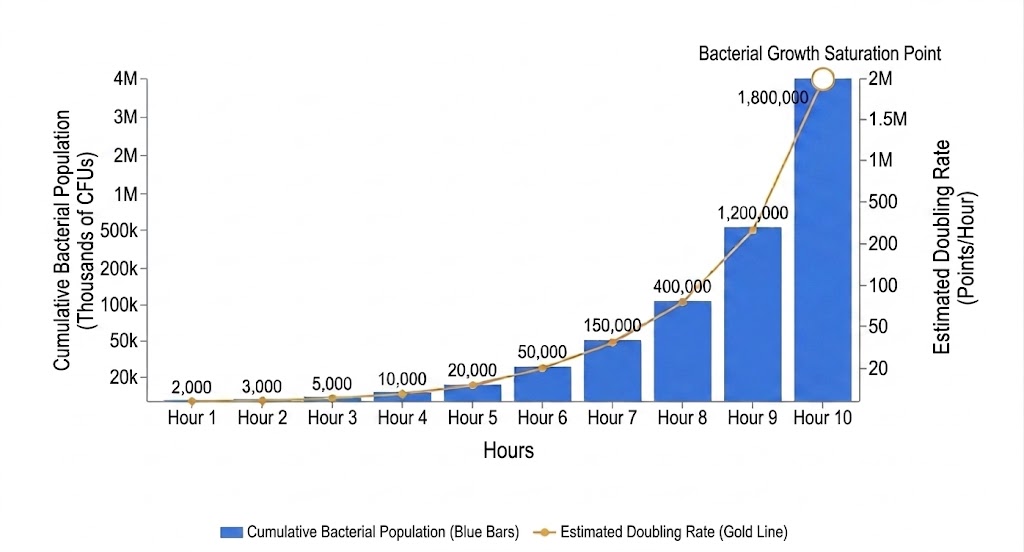
Population and Bacterial Growth

When NOT to Use Exponential Growth Charts

1. When the Data is Seasonal or Cyclical

Exponential growth charts are misleading when the pattern is driven by seasonal or repeating cycles instead of true acceleration.

For example:

  • E-commerce sales during Black Friday or Ramadan
  • Website traffic spikes during campaigns or holidays
  • Tourism data across seasons

In these cases, the sharp increases are temporary, not exponential. A line chart may show a “growth curve,” but it does not reflect real long-term acceleration.

2. When Growth is Linear, Not Accelerating

If data increases by a fixed amount each period, exponential charts become misleading and visually exaggerated.

For example:

  • Monthly salary increases by $200
  • Fixed subscription growth per month
  • Steady production output in manufacturing

Here, the pattern is predictable and stable, not compounding. Using a chart can falsely suggest acceleration where none exists.

3. When Comparing Unrelated Categories

Exponential growth charts should only be used for continuous, time-based data for a single metric.

They fail when you try to compare:

  • Different departments (Sales vs HR performance)
  • Unrelated metrics (Revenue vs Website bounce rate)
  • Multiple products with different growth behaviors

This creates visual distortion and makes the chart hard to interpret, especially in dashboards.

Best Practices for Creating Exponential Growth Charts

Exponential growth charts are most effective when they clearly highlight acceleration patterns without distortion or unnecessary complexity.

These practices help you build more accurate and readable visualizations in Excel.

1. Use Clean and Consistent Time Intervals

  • Ensure your data is recorded at equal time intervals (daily, monthly, yearly). Uneven intervals can distort the growth curve and make trends misleading.

2. Avoid Mixing Different Growth Scales

  • Keep all values in the same unit and scale within a single chart. If you mix large and small datasets without proper separation, the exponential pattern becomes unclear.

3. Choose Line Charts for Clarity

  • Line charts are the most effective way to represent exponential growth because they naturally show continuous change and acceleration over time.

4. Highlight the Acceleration Point Carefully

  • Focus only on key turning points such as sharp increases or rapid spikes. Over-marking too many data points can reduce readability and weaken the main insight.

5. Keep the Chart Simple and Uncluttered

  • Remove unnecessary gridlines, excessive colors, and heavy formatting. A clean design makes the exponential curve easier to interpret and improves decision-making speed.

Benefits of Using an Exponential Growth Chart

This chart helps transform rapidly increasing data into a clear visual pattern, making it easier to understand how values accelerate over time.

This improves analysis, forecasting, and decision-making.

1. Makes Rapid Growth Easy to Understand

  • Exponential data can be difficult to interpret in tables. A chart converts complex numerical jumps into a smooth upward curve, making growth patterns instantly visible.

2. Improves Forecasting Accuracy

  • By visually showing how values accelerate, exponential growth charts help analysts predict future outcomes more effectively in areas like sales, traffic, or population trends.

3. Highlights Early and Late-Stage Changes

  • These charts clearly show both slow initial growth and later sharp increases, helping users identify when acceleration begins.

4. Supports Better Business Decisions

  • Businesses can quickly spot fast-growing trends or warning signals, allowing faster reactions in pricing, marketing, or resource planning.

5. Enhances Data Storytelling in Reports

  • Exponential growth charts make reports more visual and easier to communicate. Instead of raw numbers, stakeholders see a clear growth story in a single view.

Limitations of Exponential Growth Chart

While charts are useful for visualizing accelerating trends, they are not suitable for every type of analysis.

Understanding their limitations helps ensure a more accurate interpretation of data.

1. Can Create Misleading Expectations

  • Exponential Growth Charts often assume that growth will continue at the same rate. In real-world scenarios, growth usually slows down due to market saturation, resource limits, or external factors.

2. Difficult to Interpret Large Values

  • When data grows very quickly, the curve can become extremely steep. This makes it harder to read exact values or compare points accurately, especially in dense datasets.

3. Not Suitable for All Data Types

  • These charts work best for time-based or continuously growing data. They are not effective for static comparisons, categorical data, or datasets without a clear growth pattern.

4. Ignores External Influencing Factors

  • Exponential Growth Charts focus only on numerical progression and do not account for real-world influences like competition, economic changes, or policy shifts that can impact growth trends.

FAQs

How does exponential growth happen?

  1. Happens when a value increases by a constant percentage or factor over time
  2. Each new value builds on the previous one (growth compounds)
  3. Growth becomes faster as the numbers get larger
  4. Common in population growth, compound interest, and viral trends
  5. Creates a curve that starts slowly and rises sharply

How do you calculate exponential growth?

  1. Use the formula:
    V = S(1 + R)^T
  2. S = starting value
  3. R = growth rate (in decimal form)
  4. T = time period
  5. V = final value after growth
  6. Multiply the starting value by the growth factor repeatedly over time
  7. Used to forecast future values in finance, business, and analytics

Wrap Up

Exponential growth helps you understand how data increases rapidly over time, forming a curve that becomes steeper as values accelerate.

In business and analytics, this pattern is commonly used to track trends like revenue growth, user acquisition, and performance scaling.

Visualizing it with a line chart makes these changes easier to interpret compared to raw numbers alone.

Excel provides basic tools for building these charts, but customizing them for clearer exponential trend analysis can require additional formatting and effort.

To simplify this process and make visualization faster, tools like ChartExpo can help you create more structured and ready-to-use growth charts directly inside Excel without complex setup or coding.

Used correctly, exponential growth charts make it easier to identify patterns early, track performance changes, and support better data-driven decisions.

How much did you enjoy this article?

PBIAd1
Start Free Trial!
118804

Related articles

next previous
Data Visualization11 min read

Segmented Bar Graph: Make Layered Data Understandable

Unlock the power of data with this guide to Segmented Bar Graphs. Learn its types, pros and cons, and when to use it for clear data visualization in Excel.

Data Analytics11 min read

Measuring Workforce Productivity for Insightful Analysis

Measuring Workforce Productivity helps businesses track performance and boost efficiency. Explore key methods, formulas, and metrics. Read on!

Data Visualization9 min read

Percentage Bar Graph: A Step-by-Step Guide

Learn how to create, calculate, and design a percentage bar graph using best practices to clearly visualize data proportions and comparisons for better decisions.

Data Analytics10 min read

Software Testing Metrics: A Modern Approach

Software testing metrics measure quality, track defects, and guide release decisions. Explore formulas, KPIs, and examples. Read on!

Data Analytics8 min read

Economic Indicators Examples: A Complete Guide

Economic indicators examples reveal how economies grow, contract, and shift. Learn types, top indicators, and how to visualize data. Read on!

ChartExpo logo

Turn Data into Visual
Stories

CHARTEXPO

  • Home
  • Gallery
  • Videos
  • Services
  • Pricing
  • Contact us
  • FAQs
  • Privacy policy
  • Terms of Service
  • Sitemap

TOOLS

  • ChartExpo for Google Sheets
  • ChartExpo for Microsoft Excel
  • Power BI Custom Visuals by ChartExpo
  • Word Cloud

CATEGORIES

  • Bar Charts
  • Circle Graphs
  • Column Charts
  • Combo Charts
  • Comparison Charts
  • Line Graphs
  • PPC Charts
  • Sentiment Analysis Charts
  • Survey Charts

TOP CHARTS

  • Sankey Diagram
  • Likert Scale Chart
  • Comparison Bar Chart
  • Pareto Chart
  • Funnel Chart
  • Gauge Chart
  • Radar Chart
  • Radial Bar Chart
  • Sunburst Chart
  • see more
  • Scatter Plot Chart
  • CSAT Survey Bar Chart
  • CSAT Survey Chart
  • Dot Plot Chart
  • Double Bar Graph
  • Matrix Chart
  • Multi Axis Line Chart
  • Overlapping Bar Chart
  • Control Chart
  • Slope Chart
  • Clustered Bar Chart
  • Clustered Column Chart
  • Box and Whisker Plot
  • Tornado Chart
  • Waterfall Chart
  • Word Cloud
  • see less

RESOURCES

  • Blog
  • Resources
  • YouTube
SIGN UP FOR UPDATES

We wouldn't dream of spamming you or selling your info.

© 2026 ChartExpo, all rights reserved.