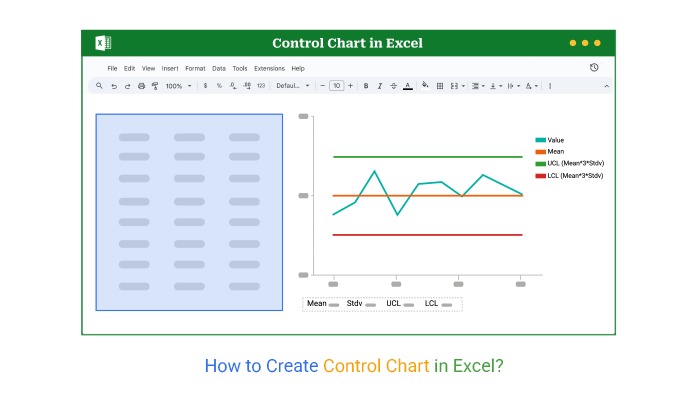
Ever seen a process drift for weeks, then blow up in one bad day? That’s the moment Control Charts in Excel were made for. Control Charts in Excel plot results in time order, park a mean line in the middle, and set UCL/LCL guardrails so noise doesn’t get mistaken for trouble.
When the dots start behaving oddly, the chart doesn’t stay quiet. The sections below cover what the chart is, why teams lean on it, how to build one in Excel, and where add-ins can save time.
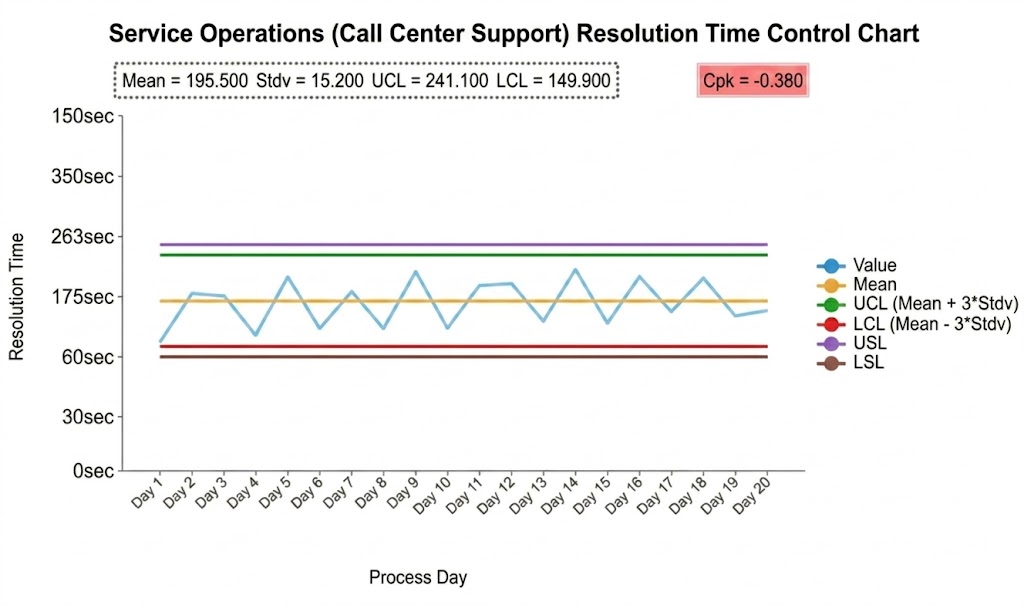
Definition: A Control Chart is a straightforward SPC view of a process over time. In Control Charts in Excel, the data points run in sequence, the center line shows the average, and two limits—UCL and LCL—mark the expected spread of routine variation. It’s built to answer one question fast: is the process acting normally, or is something off?
Those limits sketch the band where common-cause variation usually lives. Points that break the band, or patterns that keep repeating, can signal special-cause issues like setup changes, equipment wear, or a bad handoff. Excel works well here because it’s already on most desktops, it’s flexible, and it’s easy to tweak the view as the process changes.
Stable processes don’t happen by luck. Control Charts in Excel make day-to-day stability visible, using the numbers that are already being collected. Excel Control Charts are especially handy when a team needs a quick signal before small drift turns into a real defect.
Control Charts in Excel tend to pay off for a few practical reasons:
With clean data for Excel chart inputs, the picture turns from raw numbers into a readable signal. Control Charts in Excel help teams react faster, separate noise from real change, and keep improvement work pointed at the right problem.
Control Charts in Excel show up far beyond factory floors. Any workflow that produces repeatable measurements—time, volume, defects, delays—can be tracked the same way.
These examples all land on the same lesson: Control Charts in Excel don’t just plot history. They surface patterns that hit cost, throughput, and customer experience, so action can be taken while there’s still time.
The manual build is simple, but it rewards consistency. Control Charts in Excel are most useful when the formulas, limits, and formatting are set up the same way each time. The steps below walk through creating a control chart in Excel with standard functions, so the result is statistically sound and easy to maintain.
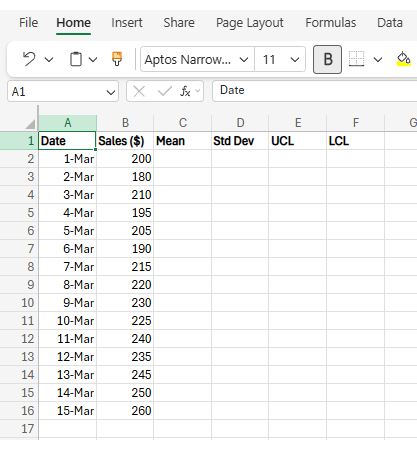
Start by laying out the values in clear columns. Use a time marker (date, batch, sample number) and the measured results in the next column. Control Charts in Excel behave better when the series is clean—no mixed units, no blank rows hiding in the middle.
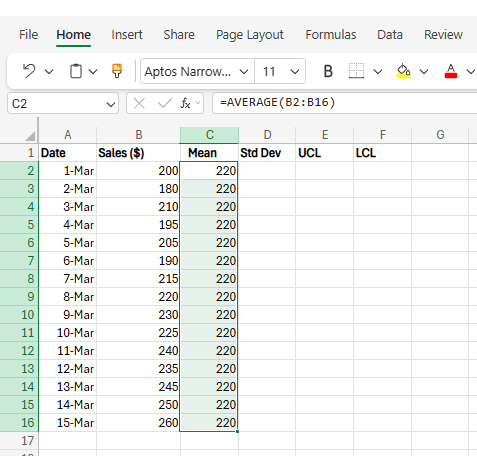
Compute the mean of the measured values to set the center line. That average becomes the baseline for the chart, so it needs to reflect the same stable period being monitored. Control Charts in Excel look convincing even with bad baselines, so double-check the range before moving on.
Formula used:
=AVERAGE(range)
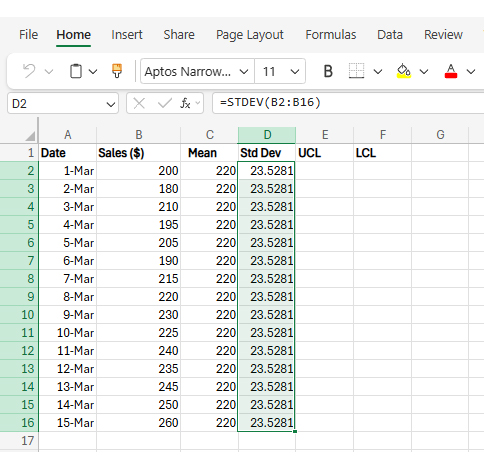
Next, calculate the standard deviation with =STDEV(range) (or =STDEV.S in newer Excel versions). That value describes how widely the points are spread around the mean, and it feeds the limit calculations. Without it, Control Charts in Excel can’t place limits that actually reflect the process.
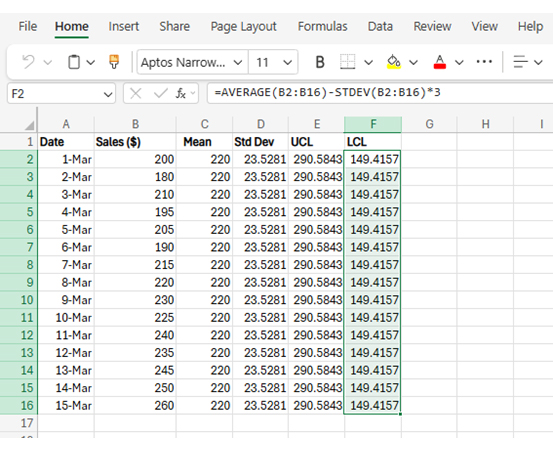
Set the limits using the mean plus or minus three standard deviations. UCL: =AVERAGE(range) + (STDEV(range) * 3). LCL: =AVERAGE(range) − (STDEV(range) * 3). In Control Charts in Excel, these lines act as guardrails around the mean and help flag behavior that’s outside normal variation.
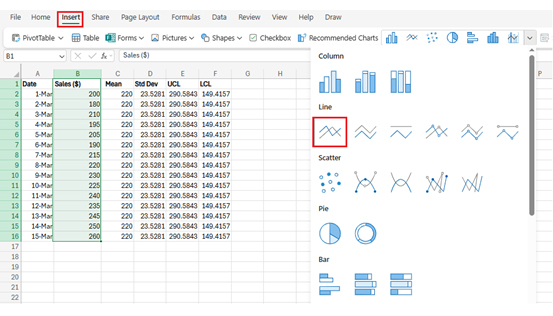
Build the baseline chart from the dataset (Insert → Chart → Line). For anyone searching for how to add a chart in Excel, that menu path is the usual starting point. In Control Charts in Excel, the mean and limit lines get layered on as separate series, not as hand-drawn shapes.
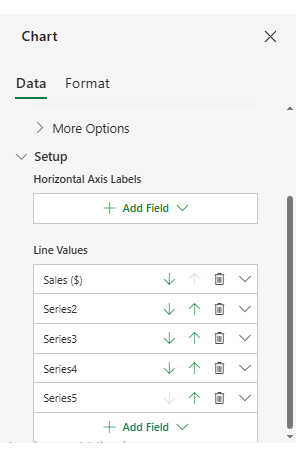
Right-click the chart and choose Select Data, then add series for the mean, UCL, and LCL. If the question is how to select data for a chart in Excel, the key is matching each series name to the correct value range. Keep the ranges aligned so every line spans the same time axis. That discipline is also how to update a chart in Excel later, without breaking the series when new rows get added.
Clean up the presentation: tighten the title, label the axes, and place the legend where it doesn’t block the data. Use line styles that read well at a glance, such as dashed limit lines and a solid mean line. Convert the source range into an Excel Table so the chart refreshes when new data gets appended.
Excel can do the job by hand, but manual charts invite small mistakes: the wrong range, a copied formula, a limit line that stops early. Tools like ChartExpo cut that risk and speed up setup, especially when teams need advanced Excel charts without babysitting every detail. It’s a practical shortcut for building Control Charts in Excel when repetition and consistency matter.
ChartExpo’s upside usually comes down to a few simple wins:
When the calculations and styling are handled for you, attention stays on the pattern, not the plumbing. That’s useful for creating a control chart in Excel at scale, where one small mistake can quietly ripple across dozens of sheets. Used well, ChartExpo keeps Control Charts in Excel fast to build and easier to trust.
How to install ChartExpo in Excel?
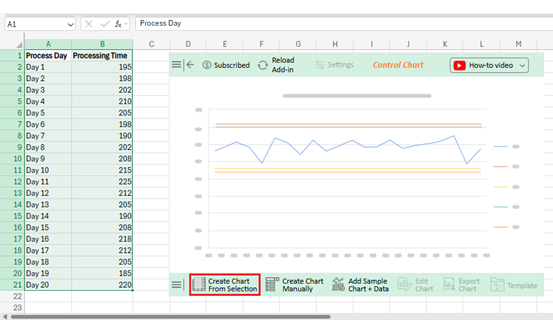
ChartExpo works in both Microsoft Excel and Google Sheets, which helps when teams mix desktop files and shared spreadsheets. The point is speed: pick the chart, select the range, and get cool Excel charts and graphs without building every element from scratch.
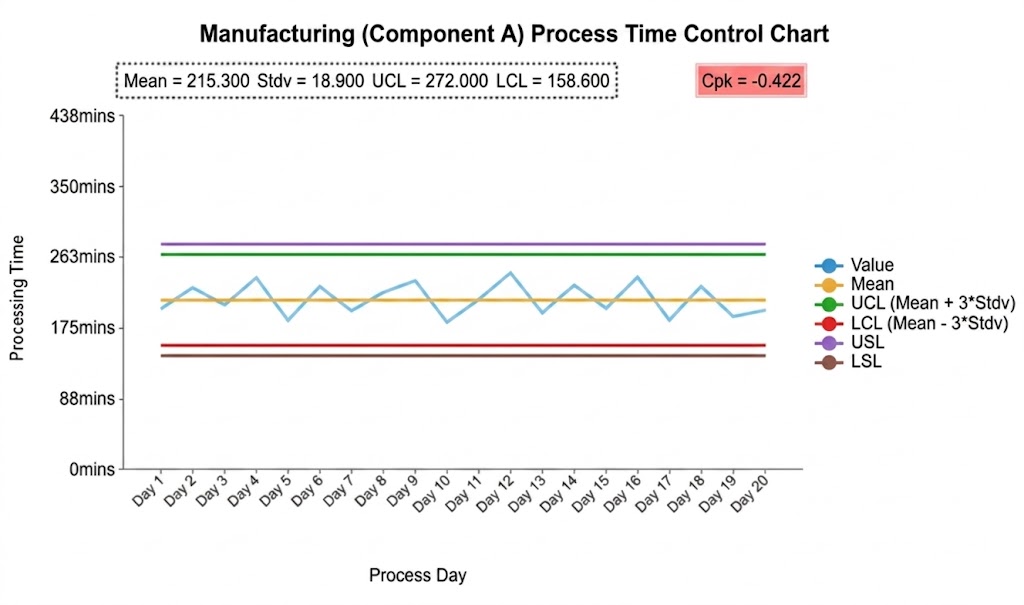
Use the sample dataset below to see what the chart looks like once everything is wired up.
|
Process Day |
Processing Time |
| Day 1 | 195 |
| Day 2 | 198 |
| Day 3 | 202 |
| Day 4 | 210 |
| Day 5 | 205 |
| Day 6 | 198 |
| Day 7 | 190 |
| Day 8 | 202 |
| Day 9 | 208 |
| Day 10 | 215 |
| Day 11 | 225 |
| Day 12 | 212 |
| Day 13 | 205 |
| Day 14 | 190 |
| Day 15 | 208 |
| Day 16 | 218 |
| Day 17 | 212 |
| Day 18 | 205 |
| Day 19 | 185 |
| Day 20 | 220 |
Key Insights
Building the chart is only half the work. Reading it well is where teams earn the benefit, because the goal is spotting real signals without chasing noise. Control Charts in Excel are meant to trigger questions at the right time, not create busywork.
Look for these signals when reviewing the plot:
Once these patterns are understood, teams can choose when to intervene and when to let the process run. Overreacting is expensive. Ignoring real signals is worse.
Excel is flexible, but it isn’t a statistics platform. Excel Control Charts can work well, yet the manual approach starts to creak as the dataset grows and the audience widens.
None of that makes Excel unusable. It just means scale needs discipline, like locked ranges, reviews, or a control chart template in Excel that standardizes the setup. Without that, reliability drops as complexity rises.
Excel can produce solid charts, but it often demands more manual work than teams expect. The comparison below highlights where a plain workbook differs from a ChartExpo-assisted approach.
| Feature | Control Charts in Excel | Control Charts with ChartExpo |
| Setup effort | Built by hand with formulas and repeated clicks | Generated with the add-in in a few steps |
| Control limit calculation | Limits computed manually | Limits computed automatically |
| Risk of errors | More room for typos and range mistakes | Less manual entry, fewer slip-ups |
| Visualization quality | Standard Excel look | Cleaner, more presentation-ready visuals |
| Scalability | It can get slow and fragile as rows grow | Stays workable as data expands |
| Updates with new data | Often needs range edits when new rows appear | Refreshes when new rows are added |
| Ease of interpretation | Takes more effort to interpret consistently | Easier for most readers to interpret |
ChartExpo shifts the work from manual setup to repeatable automation. Instead of retyping formulas and tweaking lines, the chart is generated in a consistent format with a few clicks. That’s helpful when multiple processes need the same treatment.
ChartExpo for Excel reduces human error by limiting hand-entered formulas and one-off formatting. ChartExpo for Google Sheets offers a similar workflow for teams that live in shared, cloud-based files.
Less time building charts means more time acting on what the pattern shows. When the setup is repeatable, reviews move faster, and improvement work stays focused. Fewer reworks. Fewer debates.
Several types exist, including X-bar, R, S, Individuals (I-MR), p, np, c, and u charts. Each one fits a different data type, such as variable measurements or attribute counts. The right choice depends on the data and sampling plan.
The goal is to monitor stability over time and separate routine variation from unusual change that needs action. It shows whether the process stays predictable and when the investigation should start.
Yes. Excel can build them with formulas and line charts, and a Control Chart template in Excel can speed the setup. The tradeoff is that the workflow stays mostly manual unless an add-in is used.
Control charts built in Excel are a practical way to monitor performance and spot variation before it becomes a real problem. With the mean, standard deviation, and control limits in place, it’s easier to tell ordinary fluctuation from a signal that needs attention. Excel’s flexibility also makes updates simple when new rows arrive. Just don’t skip data checks, or the picture lies. Lock key cells.
Add-ins like ChartExpo can make the charts cleaner and faster to produce, especially when many processes need the same view. Whether the metric is quality, sales, or cycle time, a well-built chart supports steadier operations, clearer decisions, and ongoing improvement. It also helps keep formatting consistent, so reviews don’t turn into debates.