• Home
  • Tools dropdown img
    • Spreadsheet Charts

      • ChartExpo for Google Sheets
      • ChartExpo for Microsoft Excel
    • Power BI Charts

      • Power BI Custom Visuals by ChartExpo
    • Word Cloud

  • Charts dropdown img
    • Chart Category

      • Bar Charts
      • Circle Graphs
      • Column Charts
      • Combo Charts
      • Comparison Charts
      • Line Graphs
      • PPC Charts
      • Sentiment Analysis Charts
      • Survey Charts
    • Chart Type

      • Box and Whisker Plot
      • Clustered Bar Chart
      • Clustered Column Chart
      • Comparison Bar Chart
      • Control Chart
      • CSAT Survey Bar Chart
      • CSAT Survey Chart
      • Dot Plot Chart
      • Double Bar Graph
      • Funnel Chart
      • Gauge Chart
      • Likert Scale Chart
      • Matrix Chart
      • Multi Axis Line Chart
      • Overlapping Bar Chart
      • Pareto Chart
      • Radar Chart
      • Radial Bar Chart
      • Sankey Diagram
      • Scatter Plot Chart
      • Slope Chart
      • Sunburst Chart
      • Tornado Chart
      • Waterfall Chart
      • Word Cloud
    • Google Sheets
      Microsoft Excel
  • Services
  • Pricing
  • Contact us
  • Blog
  • Support dropdown img
      • Gallery
      • Videos
      • Contact us
      • FAQs
      • Resources
    • Please feel free to contact us

      atsupport@chartexpo.com

Categories
All Data Visualizations Data Analytics Surveys
Add-ons/
  • Google Sheets
  • Microsoft Excel
  • Power BI
All Data Visualizations Data Analytics Surveys
Add-ons
  • Google Sheets
  • Microsoft Excel
  • Power BI

We use cookies

This website uses cookies to provide better user experience and user's session management.
By continuing visiting this website you consent the use of these cookies.

Ok

ChartExpo Survey


Home > Blog > Surveys

Product Survey Questions: Product Survey Made Visual

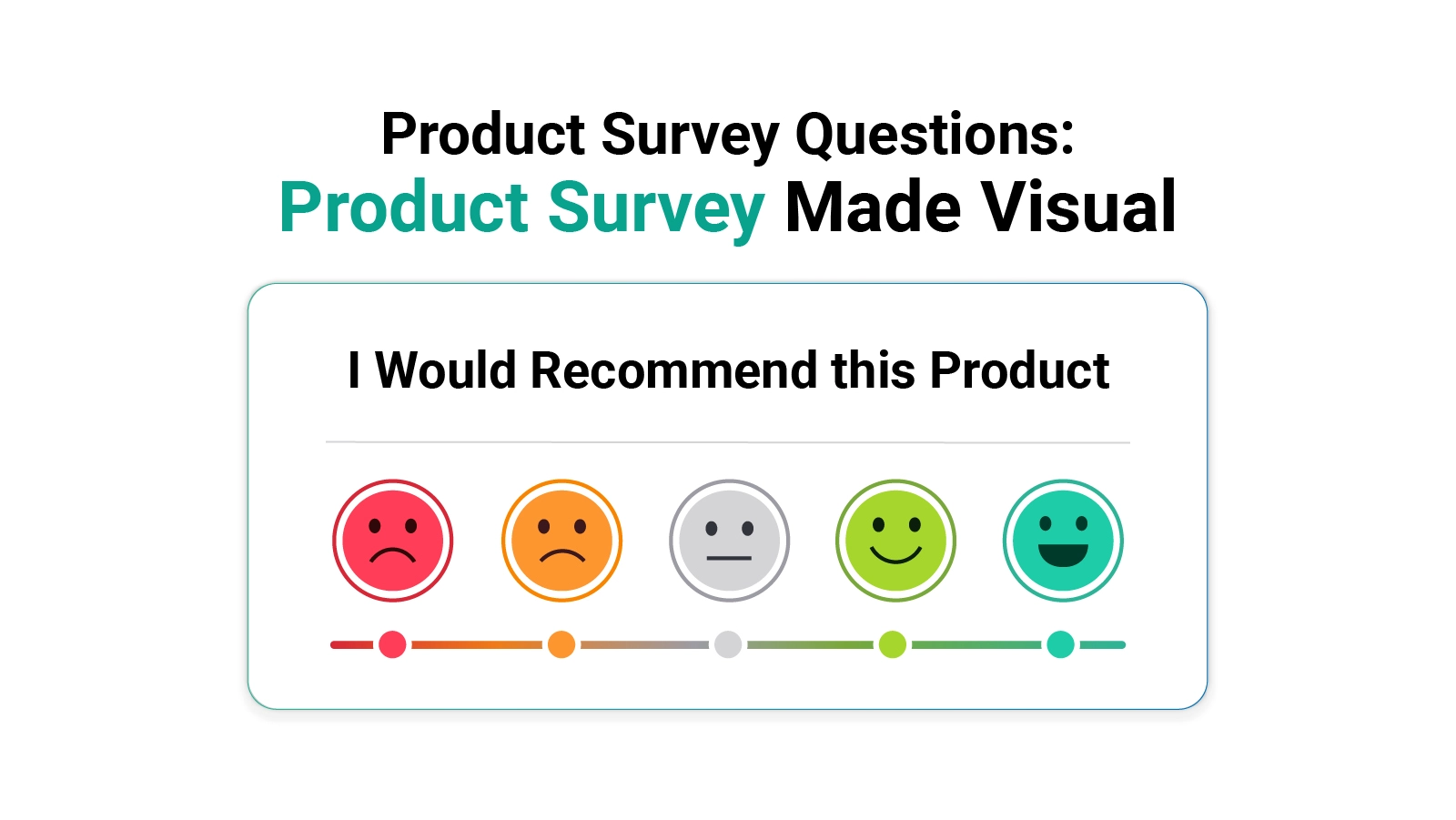
Customer opinions shape every great product decision, yet most businesses struggle to collect them effectively. Product survey questions give teams a direct line to user experience, satisfaction levels, and unmet needs. Without the right questions, feedback becomes noise rather than direction.
Product Survey Questions

This guide covers what a product survey is, why the questions you ask matter, which questions to include, and how to turn your results into better decisions.

Whether your team is launching something new or refining an existing offering, asking the right questions to ask customers about your product can make all the difference.

What is a Product Survey?

Definition: Product survey questions are the core of a structured process used to gather feedback from customers about a product, service, or specific feature. The primary goal is to measure satisfaction, surface unmet needs, and identify where improvements are most needed.

Product managers, marketers, and research teams rely on these surveys to ground their planning in real evidence rather than assumptions.

A well-designed product survey captures opinions, feature preferences, usage patterns, ratings, and open-ended ideas. This kind of data shapes product strategy by reflecting genuine user experience.

There are several formats to choose from, including satisfaction surveys, feature feedback surveys, and demographic survey questions, each suited to different stages of the product lifecycle.

Why Ask Product Survey Questions?

Gathering feedback without a clear purpose wastes both time and goodwill. Knowing exactly why to include questions to ask customers about your product shapes a more focused, useful survey. Each question should serve a specific purpose: uncover problems, generate ideas, or validate direction.

Key reasons to use product survey questions include:

  • Understand customer needs: Pinpoint exactly what users require so the product addresses their top priorities.
  • Improve product features: Determine which capabilities need enhancement or rethinking based on real usage patterns.
  • Measure satisfaction: Gauge how well the product is meeting customer expectations at any given time.
  • Identify pain points: Surface recurring friction points that prevent customers from getting full value.
  • Track market trends: Use surveys to monitor shifts in customer preferences and market demands over time.
  • Validate ideas: Test concepts with real users to reduce the risk of building the wrong thing.
  • Increase engagement: Asking for opinions signals to customers that their experience matters to the business.

Top 15 Product Survey Questions to Ask

A survey’s value comes down to one thing: whether the questions surface information worth acting on. Well-constructed product survey questions are specific, neutral, and tied to a clear decision your team needs to make.

Here are the top survey questions to include:

  1. Overall satisfaction: How satisfied are you with the product overall?
  2. Product usage frequency: How often do you use the product?
  3. Preferred features: Which features do you use the most?
  4. Missing features: What features do you think are missing?
  5. Product ease of use: How easy is the product to use?
  6. Likelihood to recommend: How likely are you to recommend this product to others?
  7. Competitor comparison: How does our product compare to similar products?
  8. Purchase intent: How likely are you to buy this product again?
  9. Price satisfaction: Are you satisfied with the product pricing?
  10. Customer support rating: How would you rate your support experience?
  11. Product quality perception: How do you rate the overall quality of the product?
  12. Improvement suggestions: What improvements would you like to see?
  13. Pain points: Did you face any problems while using the product?
  14. Feature importance ranking: Which features are most important to you?
  15. Open feedback: Do you have any additional feedback or suggestions?

Top 10 New Product Survey Questions Examples

New product launches carry higher stakes, which is why tailored product survey questions are especially important at this stage. Responses collected before or immediately after a launch reveal whether the product lands the way you intended.

Use these questions to ask customers about your product before or after launch:

  1. First impression: What is your first impression of the product?
  2. Interest level: How interested are you in using this product?
  3. Feature expectations: What features do you expect from this product?
  4. Purchase intent: How likely are you to purchase this product?
  5. Value for money: Do you think the product offers good value for the price?
  6. Ease of understanding: Is the product easy to understand and use?
  7. Competitor alternatives: What other products would you consider instead?
  8. Improvement suggestions: What changes would make this product better?
  9. Likelihood to recommend: How likely are you to recommend this product?
  10. Overall satisfaction: How satisfied are you with the product idea overall?

How to Create an Effective Product Survey Questionnaire?

A poorly designed questionnaire produces unreliable data regardless of how many people respond. Good survey design starts with structure and ends with testing. Follow these steps:

  • Keep questions clear

Frame each question around a single topic so respondents never have to interpret what is being asked or guess at the correct response unit.

  • Use simple language

Strip out jargon and industry terms that non-expert customers may not recognize, so every participant can respond with confidence.

  • Avoid biased questions

Wording that steers respondents toward a preferred answer corrupts your survey results and makes findings unreliable for any real decision-making.

  • Use multiple-choice and rating questions

Structured formats, such as survey scale questions and fixed-choice options, make responses faster to complete and far easier to analyze across a large sample.

  • Prioritize important insights

Trim anything that does not directly inform a product decision, since every extra question you add lowers the completion rate and dilutes the quality of responses.

  • Test the survey before sending

Pilot your Google survey with a small group first to catch confusing phrasing, broken logic, or missing options before the full rollout.

How to Analyze Product Survey Results in Google Sheets?

Raw feedback only becomes useful when it is organized, cleaned, and interpreted. A structured analysis process turns survey responses into patterns your team can act on.

  • Export responses

Transfer all collected responses into a survey in Google Sheets so everything sits in one place and is ready for analysis.

  • Clean the data

Delete blank submissions and duplicate entries so that skewed or incomplete records do not distort the findings.

  • Calculate averages and percentages

Apply spreadsheet formulas to compute totals and average survey response rates, giving you a clear statistical baseline to interpret.

  • Use pivot tables

Group responses by category or demographic using pivot tables to reveal patterns that would otherwise be buried in raw rows of data.

  • Create charts

Visual representations make it faster to spot trends, compare rating distributions, and communicate findings to stakeholders.

  • Use rating scale charts

Charts built around scale-based responses make satisfaction scores easy to read and compare across different question areas.

  • Use tools for visualization

Third-party add-ons connect directly with Sheets and convert your data into professional charts, including a Likert Scale chart, for fast and compelling analysis.

  • Final Insights

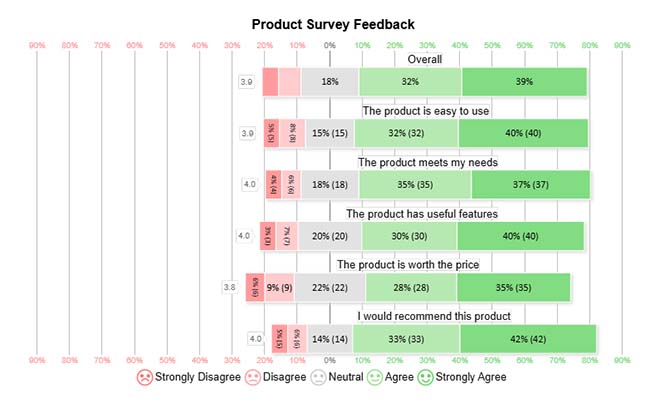
The chart shows product survey feedback with most respondents selecting Agree or Strongly Agree across usability, features, value, and recommendation, indicating overall positive sentiment.

Using ChartExpo, the visualization clearly highlights that ease of use and recommendation score highest, while pricing has relatively more neutral and negative responses.
Product Survey Questions

Key Insights

  • Overall sentiment leans favorable, with over 70% of respondents selecting Agree or Strongly Agree across all statements.
  • Ease of use and feature quality earned the largest share of Strongly Agree ratings among all categories measured.
  • Value for money scored the lowest of all areas, drawing a higher concentration of neutral and negative responses than the other categories.

Benefits of Using Product Survey Questions

Teams that invest in well-designed product survey questions consistently build better products because their decisions draw from real evidence, not internal opinions.

Core advantages include:

  • Understand customer needs: Reveals the priorities, expectations, and preferences that guide product decisions.
  • Improve products: Feedback from survey questions points toward specific changes that will move the product in the right direction.
  • Boost satisfaction: Acting on what customers say builds loyalty and raises overall satisfaction scores.
  • Make data-driven decisions: Quantified survey feedback reinforces product analytics and gives teams a factual basis for every roadmap choice.
  • Reduce churn: Catching dissatisfaction before it escalates gives teams time to fix issues and retain users.
  • Identify opportunities: Customer feedback uncovers demand signals, emerging needs, and untapped product directions.

Common Mistakes to Avoid When Writing Product Survey Questions

Even well-intentioned surveys fail when the product survey questions are vague, excessive, or structured in ways that distort the data they collect.

Watch out for these frequent errors:

  • Asking too many questions: Lengthy surveys exhaust respondents and sharply cut completion rates, leaving you with partial data.
  • Using confusing language: Ambiguous phrasing leaves respondents guessing what you mean, which produces unreliable answers.
  • Writing biased questions: Questions framed to nudge respondents toward a conclusion corrupt the data and reduce its value.
  • Not using rating scales: Leaving out structured rating formats makes it nearly impossible to benchmark or compare results consistently.
  • Ignoring open feedback: Blocking qualitative responses means you miss the nuanced, often surprising ideas that closed questions never surface.
  • Not testing the survey: Skipping a pilot run lets broken logic, unclear wording, or missing options reach your entire audience and undermine the whole effort.

FAQs

How to do a product survey?

Begin by defining a specific goal, then build a set of focused questions, distribute the survey to the right audience, and review the responses for actionable patterns.

How can I create effective product survey questions?

Write in plain, neutral language, mix rating scales with open-ended options, and cut any question that does not connect to a decision your team actually needs to make.

How to create a survey for a new product?

Cover first impressions, expected features, purchase intent, and overall value using product survey questions designed for the pre- or post-launch stage.

How often should product surveys be conducted?

Run surveys on a recurring cadence tied to updates, major releases, and significant changes so your team tracks customer satisfaction as the product evolves.

Wrap Up

Designing product survey questions that actually move the needle requires more than collecting responses. It requires knowing what you are trying to learn, asking with precision, and committing to analyzing what comes back.

Teams that treat feedback as a continuous process rather than a one-time exercise build more resilient products and stronger customer relationships.

Start with a clear goal, choose questions that match it, and revisit the process after every major update. The gap between what you assume customers want and what they actually need narrows every time you listen well.

How much did you enjoy this article?

ExcelAd1
Start Free Trial!
123165

Related articles

next previous
Surveys11 min read

5-Point Performance Rating Scale With Examples:Quick Guide

Learn how the 5-Point Performance Rating Scale improves employee evaluations with clear, consistent, and fair performance reviews across teams.
Surveys9 min read

Fun Survey Questions: Turn Responses into Insights

Fun Survey Questions can raise response rates, reveal patterns, and guide survey planning across teams, classrooms, and customer research. Read on!


Surveys8 min read

How to Interpret 4-Point Likert Scale Results?

Learn how to create, collect, and analyze data using a 4-point Likert scale. A complete guide with definition, examples, advantages, and practical applications.

Surveys11 min read

5 Point Likert Scale: Analysis, Interpretation and Examples

Learn how to analyze and interpret a 5-point Likert scale with examples, charts, and step-by-step methods to turn survey responses into actionable insights.

Surveys8 min read

Income Survey Questions: A Detailed Guide

Income survey questions capture financial data while protecting privacy. Master bracket design, response analysis, and visualization tactics. Learn more!

ChartExpo logo

Turn Data into Visual
Stories

CHARTEXPO

  • Home
  • Gallery
  • Videos
  • Services
  • Pricing
  • Contact us
  • FAQs
  • Privacy policy
  • Terms of Service
  • Sitemap

TOOLS

  • ChartExpo for Google Sheets
  • ChartExpo for Microsoft Excel
  • Power BI Custom Visuals by ChartExpo
  • Word Cloud

CATEGORIES

  • Bar Charts
  • Circle Graphs
  • Column Charts
  • Combo Charts
  • Comparison Charts
  • Line Graphs
  • PPC Charts
  • Sentiment Analysis Charts
  • Survey Charts

TOP CHARTS

  • Sankey Diagram
  • Likert Scale Chart
  • Comparison Bar Chart
  • Pareto Chart
  • Funnel Chart
  • Gauge Chart
  • Radar Chart
  • Radial Bar Chart
  • Sunburst Chart
  • see more
  • Scatter Plot Chart
  • CSAT Survey Bar Chart
  • CSAT Survey Chart
  • Dot Plot Chart
  • Double Bar Graph
  • Matrix Chart
  • Multi Axis Line Chart
  • Overlapping Bar Chart
  • Control Chart
  • Slope Chart
  • Clustered Bar Chart
  • Clustered Column Chart
  • Box and Whisker Plot
  • Tornado Chart
  • Waterfall Chart
  • Word Cloud
  • see less

RESOURCES

  • Blog
  • Resources
  • YouTube
SIGN UP FOR UPDATES

We wouldn't dream of spamming you or selling your info.

© 2026 ChartExpo, all rights reserved.