• Home
  • Tools dropdown img
    • Spreadsheet Charts

      • ChartExpo for Google Sheets
      • ChartExpo for Microsoft Excel
    • Power BI Charts

      • Power BI Custom Visuals by ChartExpo
    • Word Cloud

  • Charts dropdown img
    • Chart Category

      • Bar Charts
      • Circle Graphs
      • Column Charts
      • Combo Charts
      • Comparison Charts
      • Line Graphs
      • PPC Charts
      • Sentiment Analysis Charts
      • Survey Charts
    • Chart Type

      • Box and Whisker Plot
      • Clustered Bar Chart
      • Clustered Column Chart
      • Comparison Bar Chart
      • Control Chart
      • CSAT Survey Bar Chart
      • CSAT Survey Chart
      • Dot Plot Chart
      • Double Bar Graph
      • Funnel Chart
      • Gauge Chart
      • Likert Scale Chart
      • Matrix Chart
      • Multi Axis Line Chart
      • Overlapping Bar Chart
      • Pareto Chart
      • Radar Chart
      • Radial Bar Chart
      • Sankey Diagram
      • Scatter Plot Chart
      • Slope Chart
      • Sunburst Chart
      • Tornado Chart
      • Waterfall Chart
      • Word Cloud
    • Google Sheets
      Microsoft Excel
  • Services
  • Pricing
  • Contact us
  • Blog
  • Support dropdown img
      • Gallery
      • Videos
      • Contact us
      • FAQs
      • Resources
    • Please feel free to contact us

      atsupport@chartexpo.com

Categories
All Data Visualizations Data Analytics Surveys
Add-ons/
  • Google Sheets
  • Microsoft Excel
  • Power BI
All Data Visualizations Data Analytics Surveys
Add-ons
  • Google Sheets
  • Microsoft Excel
  • Power BI

We use cookies

This website uses cookies to provide better user experience and user's session management.
By continuing visiting this website you consent the use of these cookies.

Ok

ChartExpo Survey


Home > Blog > Surveys

Fun Survey Questions: Turn Responses into Insights

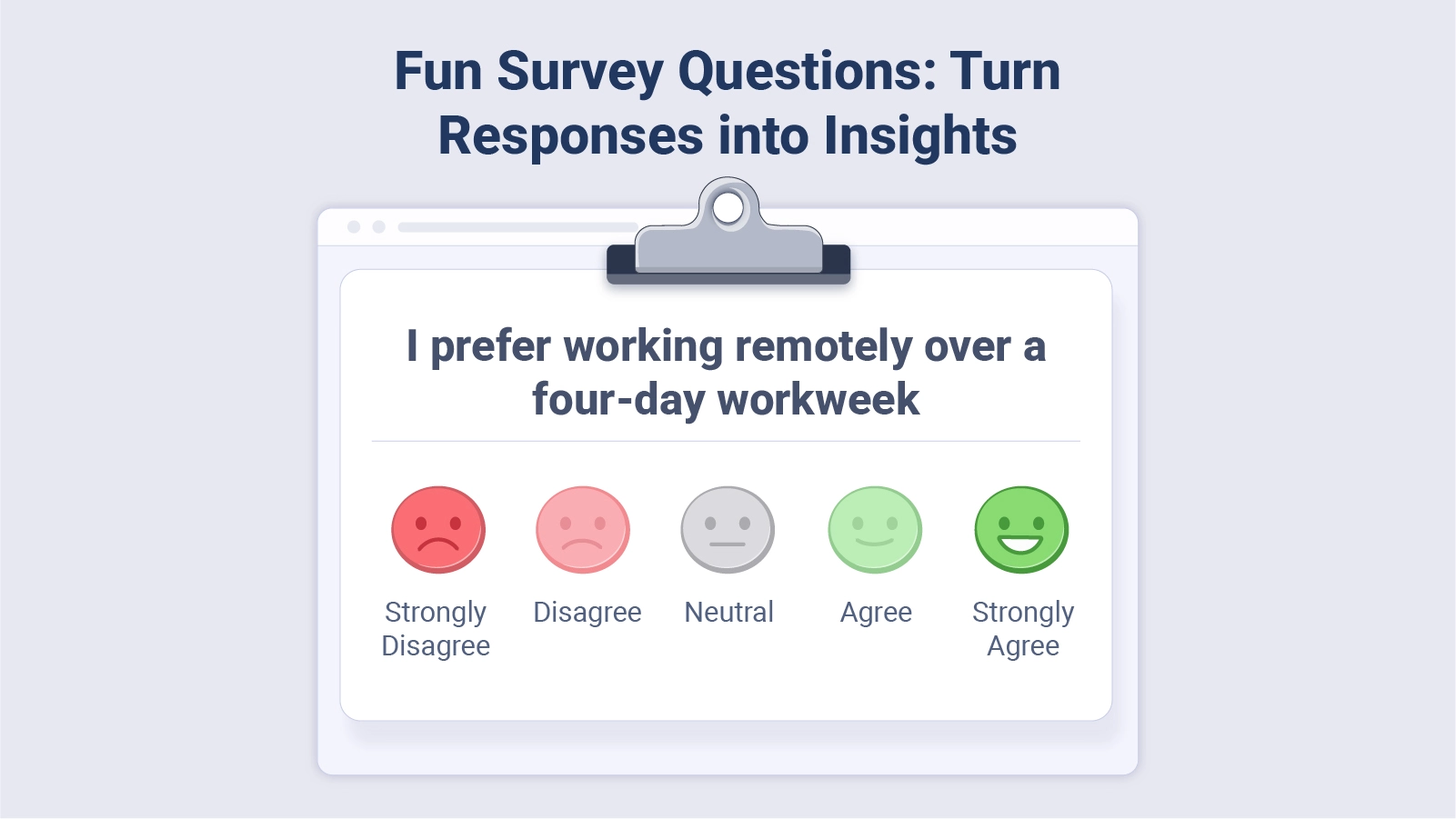
People answer more when the prompt feels human. Fun survey questions replace stiff wording with prompts that invite quick thought, small smiles, and honest replies.
Fun Survey Questions

That simple shift can keep attention high from the first item to the last, even when the topic feels routine, repetitive, or very dry.

A lighter tone can improve participation without weakening the purpose. It helps teams collect cleaner input, compare views, and reduce drop-off in forms, polls, and classroom tasks.

This guide shows how funny survey questions can support planning, writing, and review without turning the form into noise, clutter, or needless confusion today.

Table of Contents:

  1. What are Fun Survey Questions?
  2. Why Use Fun Survey Questions?
  3. Types of Fun Survey Questions for Different Audiences
  4. Top 50 Fun Survey Questions
  5. Fun Survey Questions Examples
  6. How to Analyze a Fun Survey Questionnaire in Google Sheets?
  7. Benefits of Using Fun Survey Questions
  8. Tips for Creating a Fun Survey Question Strategy
  9. FAQs
  10. Wrap Up

What are Fun Survey Questions?

Definition: Fun Survey Questions use light prompts to collect useful input without making the form feel stiff. They bring play, surprise, or choice into a task that often feels routine. That change can help people answer with less hesitation and more trust.

The goal is not distraction. The goal is better participation, clearer preferences, and answers that feel more natural because people respond with less pressure and more ease. When written well, the tone stays clear, and the purpose stays intact for every item.

Why Use Fun Survey Questions?

Clear wording and play can lift response quality. Fun survey questions keep the form active, useful, and easier to complete from the start.

  • Raise response rate: Curiosity pulls people in and helps more participants begin the form.
  • Hold attention longer: Light prompts keep focus steady and make each item easier to answer.
  • Lower form fatigue: Variety reduces boredom, keeps pace moving, and limits mid-form drop-off.
  • Support honest replies: A relaxed tone can reduce guarded answers and invite more candor.
  • Create a good experience: People remember the process more positively and return with less friction.
  • Improve survey results: Strong interest helps more people finish every item.
  • Make collection easier: The task feels lighter, clearer, and less forced for both sides involved.

Used with care, this approach can make feedback feel direct, useful, easier to finish, and easier to trust.

Types of Fun Survey Questions for Different Audiences

Different groups react to different prompts. Fun survey questions work best when the format matches the setting, the audience, and the response style you need most each time.

  • Icebreakers: Simple warm-ups ease tension and help people settle into the form fast.
  • Pop culture prompts: Shared references can spark interest and create quick recognition.
  • Scenario choices: Imagined situations reveal priorities through low-pressure comparison and playful context.
  • Either-or prompts: Quick choices expose preference patterns fast and cleanly.
  • Emoji reactions: Visual cues give fast responses, lower effort, and speed completion.
  • Choice polls: Structured options fit short quantitative surveys and simplify coding during later review.
  • Open prompts: Flexible answers support qualitative surveys and reveal added context.

Used with care, hilarious survey questions can add recall and energy without disrupting the purpose.

Top 50 Fun Survey Questions

Creative surveys thrive on variety and relatability. Below are versatile examples suitable for multiple contexts:

  1. If your mood today were a weather forecast, what would it be?
  2. Which superpower would improve your daily routine the most?
  3. Coffee, tea, or magical energy potion?
  4. What song best represents your work style?
  5. If you could instantly master one skill, what would it be?
  6. Which fictional world would you visit?
  7. Morning energy level: unstoppable or snooze champion?
  8. What emoji matches your current mindset?
  9. Would you rather always be early or always be late?
  10. Favorite productivity snack?
  11. What fictional gadget would simplify your tasks?
  12. Ideal vacation preference?
  13. Which color reflects your personality today?
  14. What motivates you most during challenges?
  15. Preferred brainstorming environment?
  16. Which hobby would you pursue endlessly?
  17. Night owl or early bird?
  18. Dream workspace setup?
  19. Favorite stress-relief activity?
  20. Which movie genre mirrors your decision style?
  21. How spontaneous are your choices?
  22. What inspires your creativity?
  23. Preferred way to learn something new?
  24. What distracts you most easily?
  25. Which trend do you secretly enjoy?
  26. Favorite weekend ritual?
  27. What fictional role sounds exciting?
  28. What always improves your mood?
  29. Which sound helps you focus?
  30. How adventurous are your preferences?
  31. What fictional character feels relatable?
  32. Favorite comfort food?
  33. Which invention changed your routine the most?
  34. What small habit improves your day?
  35. Ideal team activity?
  36. Which skill should everyone learn?
  37. How do you recharge energy?
  38. Favorite digital tool?
  39. What sparks your curiosity?
  40. How organized are your workflows?
  41. What motivates consistency?
  42. Which environment boosts productivity?
  43. How do you celebrate progress?
  44. What fictional creature matches your creativity?
  45. Favorite way to relax?
  46. Which task feels most satisfying?
  47. What improves collaboration?
  48. How adaptable are your routines?
  49. Which activity brings joy?
  50. What always makes you smile?

Fun Survey Questions Examples

Examples show how a lighter tone can guide responses.

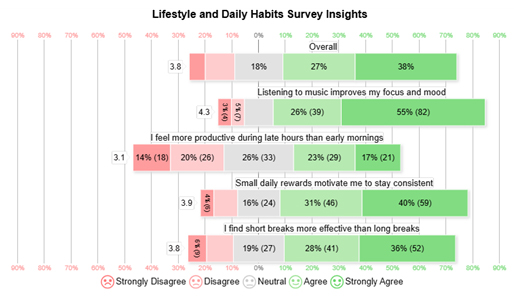
1. Lifestyle and Daily Habits Survey Insights

This example points to broad agreement around focus and rest. Many responses favor music during work and short breaks during the day, which suggests comfort with simple habits.
Fun Survey Questions

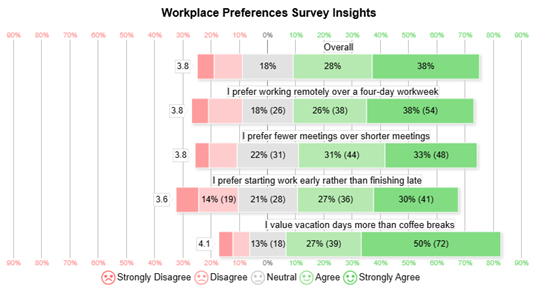
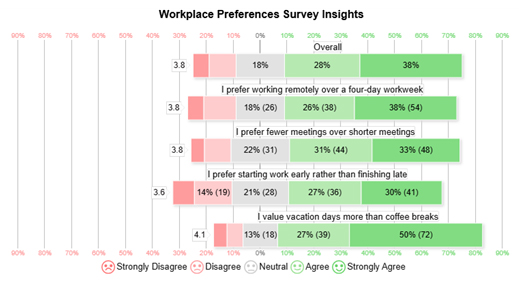
2. Workplace Preferences Survey Insights

This example shows clear support for remote work, fewer meetings, and vacation time. Most selections gather in the Agree and Strongly Agree range, which signals steady alignment.
Fun Survey Questions

3. Travel Preferences Survey Insights

This example suggests travel feels useful and energizing for many people. Responses lean toward stronger agreement, which indicates travel is linked with rest, interest, and positive mood.

How to Analyze a Fun Survey Questionnaire in Google Sheets?

Good review turns raw answers into patterns you can trust, explain, and use.

  1. Start by sending each Google survey response into the worksheet first.
  2. Clean entries first so labels, values, and blanks stay consistent.
  3. Group related answers to compare themes with less effort.
  4. Sort and filter records to spot trends and outliers quickly.
  5. Check odd patterns that may signal survey bias or entry mistakes.
  6. Split responses with demographic survey questions to compare subgroup differences.
  7. Use a Likert Scale Chart to show opinion spread clearly across groups.

Then ChartExpo can turn raw values into views you can read quickly inside the survey in Google Sheets today.

Why Use ChartExpo?

  • Turns sheet data into charts that people read fast.
  • Helps key patterns stand out during review.
  • Works inside Google Sheets with very little setup.
  • Includes a 7-day trial and a $10 per month plan.

 How to Install ChartExpo in Google Sheets?

  • Go to Google Sheets and open the file you want. Then click the Extensions tab in the upper menu.
  • Click Add-ons, then select “Get add-ons.”
  • Go to the Google Workspace Marketplace and search there for ChartExpo.
  • Open “Charts, Graphs & Visualizations by ChartExpo,” then click the “Install” button.
  • Allow the required access and confirm your Google account when asked.

Example:

Consider the following data for a Likert Chart.

Questions

Scale

Responses

I prefer working remotely over a four-day workweek 1 9
I prefer working remotely over a four-day workweek 2 17
I prefer working remotely over a four-day workweek 3 26
I prefer working remotely over a four-day workweek 4 38
I prefer working remotely over a four-day workweek 5 54
I prefer fewer meetings over shorter meetings 1 7
I prefer fewer meetings over shorter meetings 2 14
I prefer fewer meetings over shorter meetings 3 31
I prefer fewer meetings over shorter meetings 4 44
I prefer fewer meetings over shorter meetings 5 48
I prefer starting work early rather than finishing late 1 11
I prefer starting work early rather than finishing late 2 19
I prefer starting work early rather than finishing late 3 28
I prefer starting work early rather than finishing late 4 36
I prefer starting work early rather than finishing late 5 41
I prefer focusing on one task instead of multitasking 1 6
I prefer focusing on one task instead of multitasking 2 13
I prefer focusing on one task instead of multitasking 3 22
I prefer focusing on one task instead of multitasking 4 47
I prefer focusing on one task instead of multitasking 5 63
I value vacation days more than coffee breaks 1 5
I value vacation days more than coffee breaks 2 9
I value vacation days more than coffee breaks 3 18
I value vacation days more than coffee breaks 4 39
I value vacation days more than coffee breaks 5 72
  • To get started with ChartExpo, install ChartExpo.
  • Go to Extensions > Charts, Graphs & Visualizations by ChartExpo > Open.
Fun Survey Questions
  • Once ChartExpo is installed in Google Sheets, click the “Add New Chart” button.
Fun Survey Questions
  • Once it loads, scroll through the chart list to locate and choose the “Likert Chart.”
Fun Survey Questions
  • Then select your worksheet and confirm the data range; your data is mapped automatically. Click the Create button.
Fun Survey Questions
  • If you want to customize your chart, select the “Edit Chart” option and design it to your specifications.
Fun Survey Questions
  • To change the chart title, select the pencil icon on the header. Then enter the text you want and select “Apply.”
Fun Survey Questions
  • You can change the legend label from “Legend Properties” as well.
Fun Survey Questions
  • You can also change the font size and color for better readability.
Fun Survey Questions
  • When you are done with all the changes, click the “Save” button to save them.
Fun Survey Questions
  • The final Likert Chart is shown below.
Fun Survey Questions

Key Insights

  • Most responses cluster on the agreement side, pointing to broad positive sentiment.
  • Remote work stands out as the clearest overall preference.
  • Vacation days earn more support than coffee breaks.

Benefits of Using Fun Survey Questions

Fun survey questions can improve outcomes beyond participation alone.

  • Lift participation rates: Better interest supports completion in any longitudinal survey and helps reduce attrition.
  • Raise answer quality: Relaxed participants often share fuller and more thoughtful responses.
  • Build audience connection: Playful wording can make the exchange feel more human.
  • Support brand trust: A pleasant process leaves a better final impression.
  • Ease pattern review: Cleaner answers make trends easier to spot.
  • Increase time on task: People stay engaged longer and interact more throughout the form.

Tips for Creating a Fun Survey Question Strategy

A workable plan needs structure and restraint.

  • Keep items short: Brief wording reduces confusion and helps people answer without delay or hesitation.
  • Use familiar topics: Known themes make each prompt easier to grasp, judge, and answer confidently.
  • Skip sensitive areas: Avoiding discomfort helps preserve trust, comfort, and honest participation throughout.
  • Mix formats: Variety keeps the pace active and prevents monotony over time.
  • Stay positive: Friendly language supports effort, ease, trust, and cleaner answers.
  • Test before launch: A trial run can reveal weak wording, errors, gaps, or missed instructions.

FAQs

How do you write these questions?

Start with a clear goal and a clear audience. Good, funny survey questions stay simple, avoid confusion, and use humor only when it helps the person answer with ease, speed, trust, focus, and clarity.

Where can they be used?

They fit employee feedback, class activities, customer polls, team check-ins, and community outreach. They work best when attention is limited, and the form needs steady completion across many groups, settings, and time frames.

What can a five-question survey include?

A short set can cover mood, preference, choice, habit, and one open response. That mix gives enough range to spot patterns without making the form feel long, repetitive, hard to finish, mentally heavy, or easy to abandon.

Wrap Up

Fun survey questions work best when they feel playful but still serve a clear goal. The strongest versions use simple wording, fit the audience, and make it easier for people to finish the form with useful, honest input. That balance protects both tone and purpose in every setting.

When the wording matches the setting, participation rises, and review becomes easier. A smart mix of short prompts, clear choices, and hilarious survey questions can keep attention high while still producing answers you can sort, compare, and use with confidence. That makes the final data easier to trust and easier to act on.

How much did you enjoy this article?

GSAd1
Start Free Trial!
160322

Related articles

next previous
Surveys8 min read

How to Interpret 4-Point Likert Scale Results?

Learn how to create, collect, and analyze data using a 4-point Likert scale. A complete guide with definition, examples, advantages, and practical applications.

Surveys11 min read

5 Point Likert Scale: Analysis, Interpretation and Examples

Learn how to analyze and interpret a 5-point Likert scale with examples, charts, and step-by-step methods to turn survey responses into actionable insights.

Surveys8 min read

Income Survey Questions: A Detailed Guide

Income survey questions capture financial data while protecting privacy. Master bracket design, response analysis, and visualization tactics. Learn more!

Surveys5 min read

7-Point Likert Scale: Step by Step Guide

Discover how a 7-point Likert scale works in surveys and learn step-by-step methods to capture detailed opinions and analyze responses effectively.

Surveys11 min read

Google Forms Free Online Surveys for Personal Use

Learn how to create and analyze Google Forms free online surveys for personal use. This guide also has valuable tips for creating effective surveys.

ChartExpo logo

Turn Data into Visual
Stories

CHARTEXPO

  • Home
  • Gallery
  • Videos
  • Services
  • Pricing
  • Contact us
  • FAQs
  • Privacy policy
  • Terms of Service
  • Sitemap

TOOLS

  • ChartExpo for Google Sheets
  • ChartExpo for Microsoft Excel
  • Power BI Custom Visuals by ChartExpo
  • Word Cloud

CATEGORIES

  • Bar Charts
  • Circle Graphs
  • Column Charts
  • Combo Charts
  • Comparison Charts
  • Line Graphs
  • PPC Charts
  • Sentiment Analysis Charts
  • Survey Charts

TOP CHARTS

  • Sankey Diagram
  • Likert Scale Chart
  • Comparison Bar Chart
  • Pareto Chart
  • Funnel Chart
  • Gauge Chart
  • Radar Chart
  • Radial Bar Chart
  • Sunburst Chart
  • see more
  • Scatter Plot Chart
  • CSAT Survey Bar Chart
  • CSAT Survey Chart
  • Dot Plot Chart
  • Double Bar Graph
  • Matrix Chart
  • Multi Axis Line Chart
  • Overlapping Bar Chart
  • Control Chart
  • Slope Chart
  • Clustered Bar Chart
  • Clustered Column Chart
  • Box and Whisker Plot
  • Tornado Chart
  • Waterfall Chart
  • Word Cloud
  • see less

RESOURCES

  • Blog
  • Resources
  • YouTube
SIGN UP FOR UPDATES

We wouldn't dream of spamming you or selling your info.

© 2026 ChartExpo, all rights reserved.